

Adani's AI Gambit: We'll Build Our Own Nuclear Plants to Power Gigawatt-Scale Data Centers
India's Adani Group plans an 'aggressive' push into AI, aiming for 1GW+ data centers powered by its own nuclear plants. This signals a new era where tech supremacy is tied to energy independence.
The Bottom Line
- Who: India's Adani Group, via a statement from Jeet Adani, Director of Adani Digital Labs.
- What: An "aggressive" plan to build AI data centers exceeding 1 gigawatt (GW) in capacity, potentially powered by their own self-built and operated nuclear power plants.
- Why: To vertically integrate and secure a massive, stable power source for the energy-hungry demands of artificial intelligence.
India's Adani Group is making an audacious play to dominate the AI infrastructure landscape, and its secret weapon isn't silicon—it's nuclear fission. The conglomerate plans to "aggressively" build out a fleet of massive AI data centers and, in a radical move, may build its own nuclear power plants to run them.

The plan was detailed by Jeet Adani, the youngest son of Asia's second-richest man and a director at Adani Digital Labs, in a December 22 interview. He stated the group is looking to eventually build AI data centers with capacities larger than 1 gigawatt across India.
Adani's statement signals a crucial shift in the tech industry: the biggest bottleneck for AI's future isn't just a shortage of advanced chips, but a looming crisis in energy supply. Instead of relying on volatile public grids, Adani is exploring a vertically integrated solution: owning the power source itself.
"The Adani Group will be 'aggressive' in building out artificial intelligence data centers as well as the energy infrastructure that will run them, potentially setting up nuclear power plants," Jeet Adani said. This strategy aligns perfectly with the Indian government's recent moves to open its nuclear power sector to private investment, a policy designed to accelerate its clean energy transition.
Authors
Related Articles
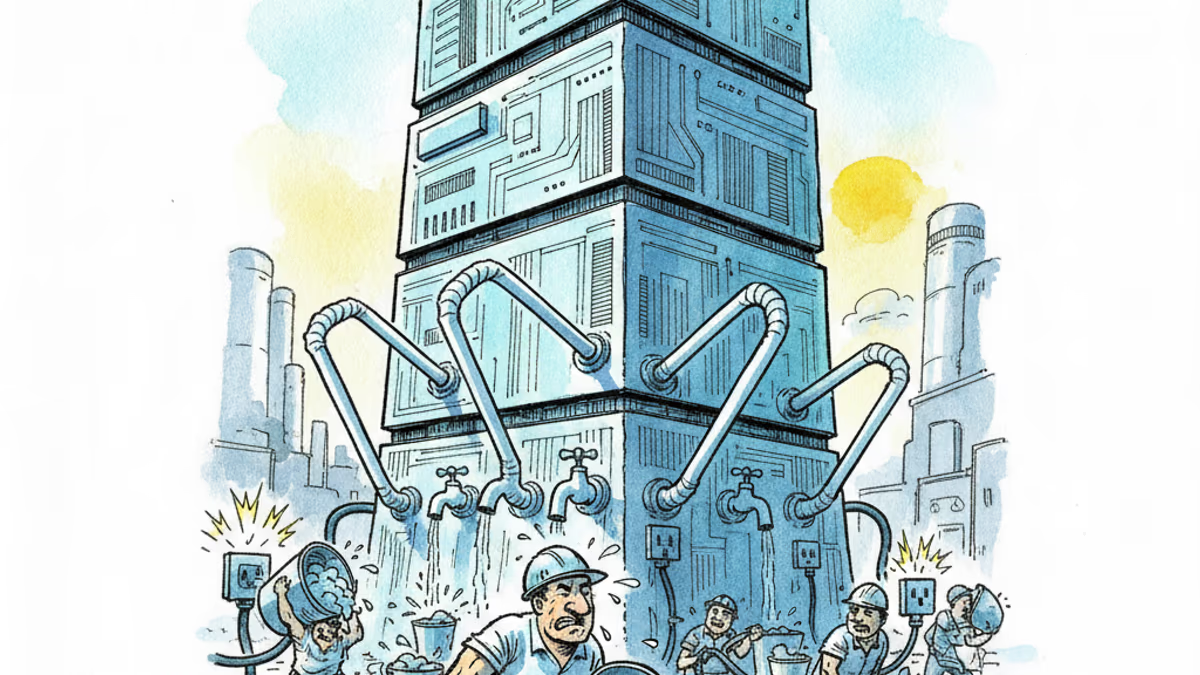
Samsung and SK unveiled a chip and AI investment package worth thousands of trillions of won on June 29. The headline number swings wildly by outlet, but the real contest isn't capital — it's water and power.

SolarSquare is raising $55-60M at a $450-500M valuation, more than doubling its worth in 18 months. Here's what's driving investor conviction in India's residential solar market.

Viral videos show 2026 graduates jeering executives who praise AI at commencement ceremonies. It's not just rudeness — it's a signal about who pays for technological optimism.

Filipino virtual assistants using AI to ghost-manage LinkedIn profiles for executives is now a structured industry. 30 comments a day, fake engagement rings, and a platform struggling to tell real from fabricated.
Samsung and SK unveiled a chip and AI investment package worth thousands of trillions of won on June 29. The headline number swings wildly by outlet, but the real contest isn't capital — it's water and power.
SolarSquare is raising $55-60M at a $450-500M valuation, more than doubling its worth in 18 months. Here's what's driving investor conviction in India's residential solar market.
Viral videos show 2026 graduates jeering executives who praise AI at commencement ceremonies. It's not just rudeness — it's a signal about who pays for technological optimism.
Filipino virtual assistants using AI to ghost-manage LinkedIn profiles for executives is now a structured industry. 30 comments a day, fake engagement rings, and a platform struggling to tell real from fabricated.
Thoughts
Share your thoughts on this article
Sign in to join the conversation