

Trump's Second Term: Why 2025 Foreign Policy Is a 'Significant Departure', Say Analysts
Analysts note a 'significant departure' in President Trump's foreign policy during the first year of his second term. PRISM explores what this 2025 strategic shift means for key global relationships with NATO and China.
The first year of President Donald Trump's second term has been marked by a foreign policy that represents a "significant departure" from his first, surprising many global observers. According to a December 22, 2025, report from NPR, analysts note that the administration's approach to international relations in 2025 has diverged in unexpected ways from the playbook seen between 2017 and 2021.
From 'America First' to a New Pragmatism?
The core of the surprise appears to stem from a recalibration of the 'America First' doctrine. While Trump's first term was defined by skepticism towards long-standing alliances like NATO and withdrawal from international agreements, the second term has shown a different, more nuanced approach. Analysts cited by news outlets suggest this could be due to a new team of advisors, a changed geopolitical landscape, or a strategic calculation that a less disruptive stance could yield better results for U.S. interests.
First-Term Flashback: Key policies from Trump's first term included withdrawing the U.S. from the Trans-Pacific Partnership (TPP) trade deal, the Paris Agreement on climate change, and the Iran nuclear deal.
Key Arenas of Change
While specific policy details are still unfolding, two areas are frequently cited as examples of this departure:
- NATO and European Alliances: Contrary to the persistent threats of withdrawal from his first term, the administration's engagement with NATO in 2025 has reportedly been more constructive, focusing on burden-sharing but within the existing framework. This has eased anxieties among European allies.
- China Relations: The focus seems to have shifted from an all-out trade war to a more selective, strategic competition. Analysts point to a potential move towards building coalitions to counter China's influence in specific technological and military domains, a departure from the broad-based tariff approach of the past.
Unpredictability Remains the Constant
Despite these shifts, observers caution that the president's transactional and often personal approach to diplomacy remains a core feature. The 'departure' may be more a change in tactics than a fundamental change in worldview. For allies and adversaries alike, the key challenge remains navigating a U.S. foreign policy that, while different from the past, is still largely unpredictable.
This evolution suggests Trump's foreign policy is less ideological and more situational. The 'America First' principle isn't being abandoned but redefined—not as isolationism, but as a form of pragmatic nationalism that will use alliances and multilateral tools when they serve a specific, transactional purpose. The surprise isn't a reversal, but an expansion of the toolkit.
This content is AI-generated based on source articles. While we strive for accuracy, errors may occur. We recommend verifying with the original source.
Related Articles

U.S. President Trump warns Venezuelan President Maduro that 'it would be smart to leave' power as the U.S. seizes oil tankers, sparking condemnation from Russia and China and raising geopolitical tensions.

As the US dollar's dominance wanes and the world splits into US- and China-led blocs, a new analysis suggests that energy and water resources, crucial for the AI economy, will become the new arbiters of global power.
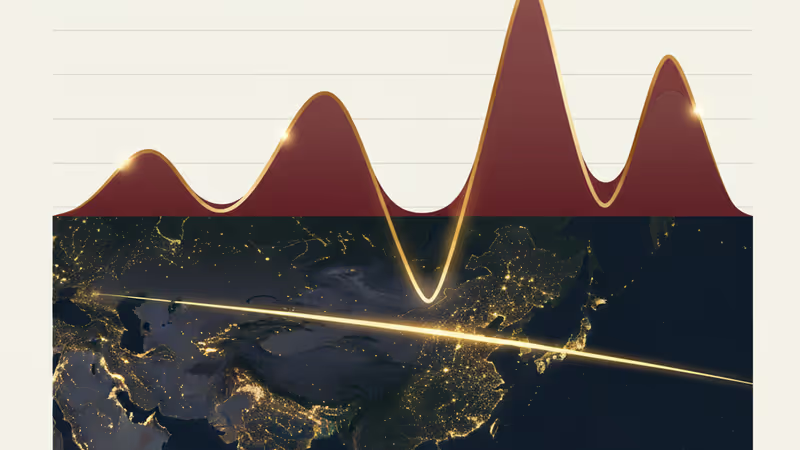
A new KPMG report finds three in four multinational corporations in China maintained or increased investment in 2025, despite mounting political pressure from Washington to decouple.
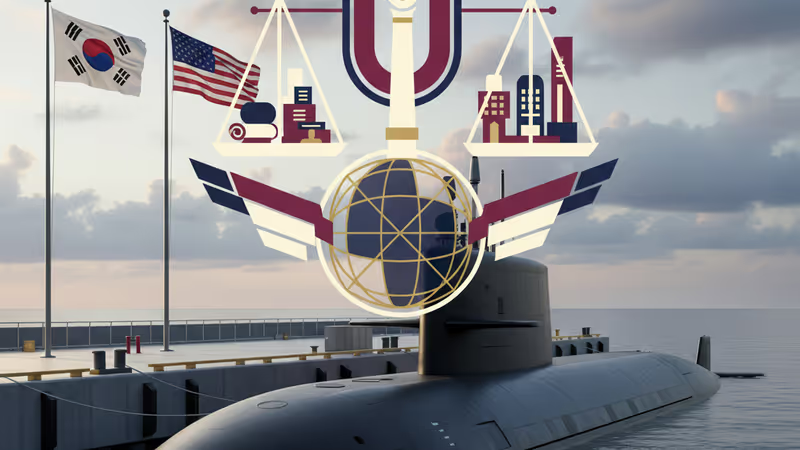
The U.S. nuclear submarine USS Greeneville arrived in Busan, South Korea, on Dec. 23, 2025, for a logistical stop. This visit reinforces the U.S.-South Korea defense alliance and serves as a strategic signal of deterrence in the region.