
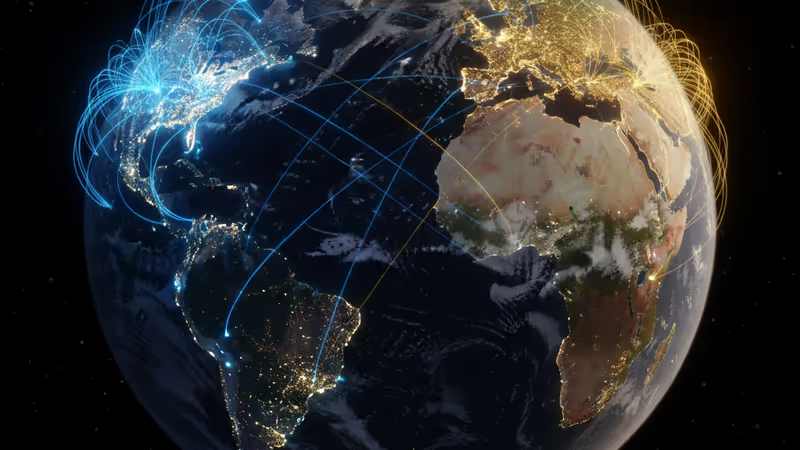
Beyond the Dollar: Why Energy and Water Are the New Currencies of Power
As the US dollar's dominance wanes and the world splits into US- and China-led blocs, a new analysis suggests that energy and water resources, crucial for the AI economy, will become the new arbiters of global power.
As <stat>2025</stat> draws to a close, the era of the a_US dollar's unchallenged global dominance is visibly fading. According to a recent analysis in the South China Morning Post, the 21st century's macroeconomic landscape won't be defined by a single currency, but by access to energy and water. In an economy increasingly driven by artificial intelligence, these resources are becoming the ultimate arbiters of national power.
From Globalization to Geopolitical Blocs
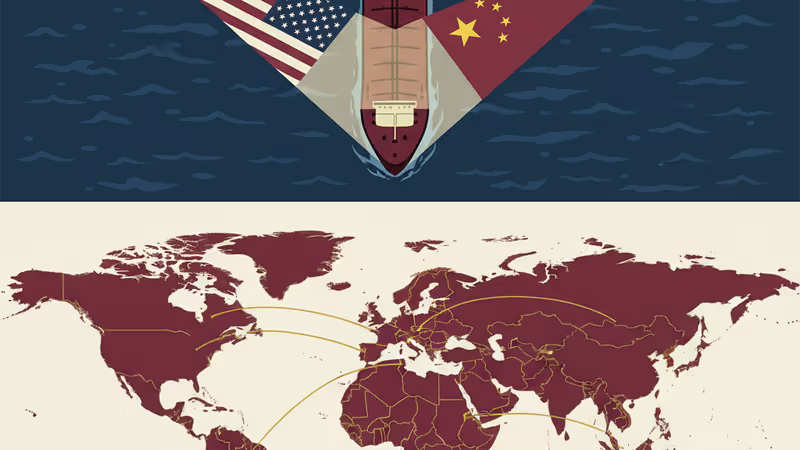
The logic behind this shift is rooted in the world's reorganization into two competing spheres of influence. A recent International Monetary Fund study, “Playing with Blocs: Quantifying Decoupling,” suggests global trade is fracturing around two centers of gravity: the a_United States and a_China. This trend indicates that the global economy isn't returning to the open globalization of the past, but is instead hardening into self-sufficient macro-regions.
This aligns perfectly with the latest a_US national security strategy, which emphasizes building a resilient, a_US-led bloc while implicitly ceding greater influence in Asia to a_China. As the dollar is increasingly bypassed in international settlements, the critical question becomes: what financial instrument or resource will prove most effective in this new world?
The Energy Imperative of the AI Economy
The analysis argues that energy is the most natural answer. A high-tech economy based on knowledge and information simply can't function without access to affordable resources. AI development, in particular, is incredibly energy-intensive, requiring vast amounts of electricity to train models and run data centers, plus significant water resources for cooling.
Only a handful of countries possess both a strong resource base and a long-term commitment to science and education. a_China stands out, having developed its own large language models while accelerating AI deployment, closing the gap with the a_US. Other nations, like a_Russia, have also recognized this trend and are positioning themselves accordingly.
The global AI race is fundamentally a race to build and power data centers. These facilities are the new factories of the 21st century, but their voracious appetite for electricity and water creates a critical bottleneck. Nations that can secure cheap, stable energy and water resources will gain a decisive, long-term strategic advantage over those focused solely on technology.
This content is AI-generated based on source articles. While we strive for accuracy, errors may occur. We recommend verifying with the original source.
Related Articles
U.S. President Trump warns Venezuelan President Maduro that 'it would be smart to leave' power as the U.S. seizes oil tankers, sparking condemnation from Russia and China and raising geopolitical tensions.
A new KPMG report finds three in four multinational corporations in China maintained or increased investment in 2025, despite mounting political pressure from Washington to decouple.
Analysts note a 'significant departure' in President Trump's foreign policy during the first year of his second term. PRISM explores what this 2025 strategic shift means for key global relationships with NATO and China.
China condemned the US for seizing a Venezuelan oil tanker, calling it a 'serious violation of international law.' The US claims the vessel was part of a 'shadow fleet' trafficking stolen oil.