
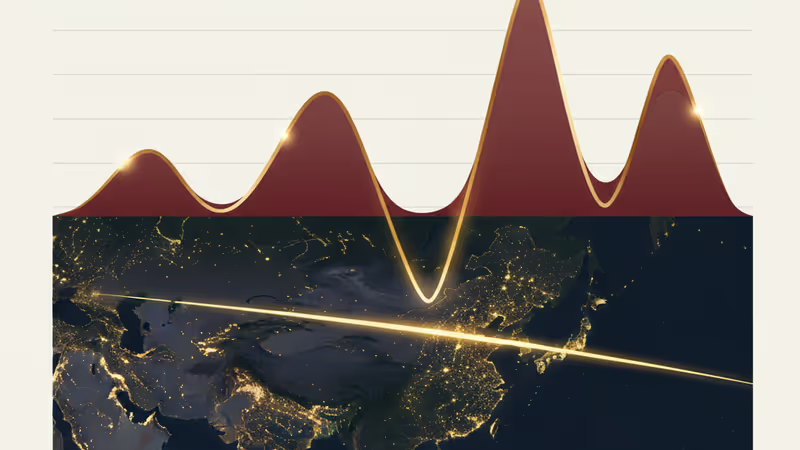
75% of Multinationals Maintain or Boost China Investment, Defying Decoupling Pressure: KPMG Report
A new KPMG report finds three in four multinational corporations in China maintained or increased investment in 2025, despite mounting political pressure from Washington to decouple.
Three in four multinational corporations (MNCs) operating in mainland China have either maintained or increased their investments in 2025, a stark contrast to the intensifying decoupling efforts led by Washington and its allies. According to a new survey from KPMG, the data suggests that despite geopolitical headwinds, global firms remain committed to the world's second-largest economy.
The Data Behind the Strategy
The report, published on Monday, polled 137 senior executives from global companies between June and September. It revealed that 75% of respondents maintained or increased their investments for 2025. Conversely, only 1% reported that they were preparing to exit the China market. While about 20% of companies did reduce their investment, this appears to be a strategic adjustment rather than a full-scale retreat.
Geopolitical Rhetoric vs. Economic Reality
These findings present a challenge to the political narrative pushed by Washington, which has been urging allies to reduce their economic reliance on Beijing through supply chain diversification and technology controls. It's clear that for many corporations, the sheer scale of the Chinese consumer market and its integrated supply chains present an economic reality that's hard to ignore.
The decisions reflect a calculated risk assessment by corporate leaders. Rather than full decoupling, many firms seem to be pursuing a 'China Plus One' strategy—maintaining their core operations in China while diversifying parts of their production to other countries to mitigate risk. This indicates a more nuanced, pragmatic approach than the binary choice often presented in political discourse.
The KPMG data highlights a significant divergence between geopolitical directives and on-the-ground business strategy. While governments talk of decoupling, corporations are making calculated bets on the resilience and scale of the Chinese market. This suggests that economic interdependence is proving more durable than anticipated, creating a complex challenge for policymakers.
This content is AI-generated based on source articles. While we strive for accuracy, errors may occur. We recommend verifying with the original source.
Related Articles

U.S. President Trump warns Venezuelan President Maduro that 'it would be smart to leave' power as the U.S. seizes oil tankers, sparking condemnation from Russia and China and raising geopolitical tensions.
As the US dollar's dominance wanes and the world splits into US- and China-led blocs, a new analysis suggests that energy and water resources, crucial for the AI economy, will become the new arbiters of global power.
Analysts note a 'significant departure' in President Trump's foreign policy during the first year of his second term. PRISM explores what this 2025 strategic shift means for key global relationships with NATO and China.
China condemned the US for seizing a Venezuelan oil tanker, calling it a 'serious violation of international law.' The US claims the vessel was part of a 'shadow fleet' trafficking stolen oil.