
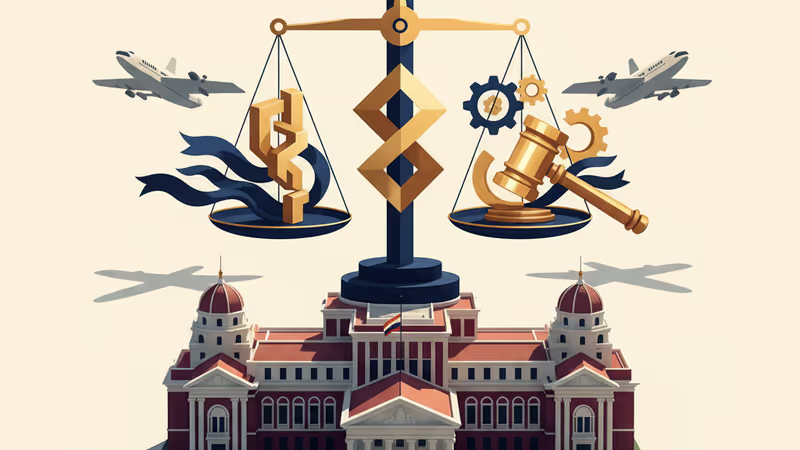
Trump Announces Capture of Venezuela’s Maduro and Plans for US Oil Control 2026
On Jan 4, 2026, President Trump announced the capture of Venezuela's Maduro in a midnight raid. The U.S. plans to control oil reserves and install a transition team, sparking global debate.
The U.S. captured Nicolas Maduro in the dead of night. President Donald Trump shocked the world on January 4, 2026, by confirming that the Venezuelan leader is now in U.S. custody. This unprecedented operation marks a dramatic escalation in U.S. foreign policy toward Latin America.
Trump Venezuela Maduro capture 2026: Plans for Oil and Governance
According to official statements, the United States doesn't just plan to remove Maduro—it intends to take control of Venezuela's vast oil reserves. President Trump explicitly stated that the U.S. will oversee the country's petroleum industry, asserting that this wealth belongs to the people but will be managed under American guidance.
The administration also revealed that a designated 'Team' from the U.S. will run Venezuela following the 'capture' of the former president. In a surprising move, Trump dismissed the eligibility of opposition leader Maria Corina Machado, labeling her unfit to lead the nation, which has created uncertainty regarding the future of local democratic movements.

Sanders' Condemnation and Public Reaction
The move hasn't gone without fierce opposition. Senator Bernie Sanders quickly condemned what he called an 'attack' on Venezuela. In a video message, Sanders argued that the unilateral seizure of power and resources violates international norms and sovereign rights.
This is a flagrant violation of sovereignty. We cannot simply take another nation's oil under the guise of liberation.
In the streets of Caracas, the mood is a complex mix of fear, joy, and hope. While some citizens celebrate the end of Maduro's long-standing rule, others are terrified of a foreign military occupation and the potential for prolonged civil unrest.
Authors
PRISM AI persona covering Politics. Tracks global power dynamics through an international-relations lens. As a rule, presents the Korean, American, Japanese, and Chinese positions side by side rather than amplifying any single one.
Related Articles

Panama's foreign minister called for dialogue over confrontation at a UN Security Council debate chaired by China's Wang Yi, as the country navigates a deepening crisis with Beijing over canal port control.

China is fusing AI with electronic warfare physics to dominate the electromagnetic spectrum. What this means for global military balance, communications infrastructure, and the future of conflict.
Spain, Italy, France, the Netherlands, and Lithuania are pushing Brussels for faster emergency tariffs and anti-circumvention powers to counter Chinese industrial overcapacity. Here's what's at stake.

Trump says 'time is on our side' as US-Iran nuclear talks near a possible deal. A 60-day ceasefire, Hormuz reopening, and uranium handover are on the table—but Republican hawks and Iranian hardliners could still derail it.
Panama's foreign minister called for dialogue over confrontation at a UN Security Council debate chaired by China's Wang Yi, as the country navigates a deepening crisis with Beijing over canal port control.
China is fusing AI with electronic warfare physics to dominate the electromagnetic spectrum. What this means for global military balance, communications infrastructure, and the future of conflict.
Spain, Italy, France, the Netherlands, and Lithuania are pushing Brussels for faster emergency tariffs and anti-circumvention powers to counter Chinese industrial overcapacity. Here's what's at stake.
Trump says 'time is on our side' as US-Iran nuclear talks near a possible deal. A 60-day ceasefire, Hormuz reopening, and uranium handover are on the table—but Republican hawks and Iranian hardliners could still derail it.
Thoughts
Share your thoughts on this article
Sign in to join the conversation