
Trump Venezuela Intervention 2026: Maduro Captured as 'America First' Shifts Gears
President Trump's surprise military strike in Venezuela on January 3, 2026, resulted in the capture of Nicolas Maduro. Explore the Trump Venezuela intervention 2026 and its impact on oil and foreign policy.
The non-interventionist president just launched his most aggressive military operation yet. On January 3, 2026, President Donald Trump announced that U.S. forces have struck Venezuela and captured President Nicolas Maduro. This sudden escalation marks a dramatic departure from Trump's long-standing rhetoric of avoiding foreign entanglements, signaling a new era of proactive regional dominance.
Trump Venezuela Intervention 2026: Operation and Capture
According to Reuters, an overnight operation knocked out electricity in parts of Caracas, allowing U.S. forces to seize Maduro at a safe house. Speaking from Mar-a-Lago, Trump declared, "We're going to run the country until such time as we can do a safe, proper and judicious transition." He justified the move by citing a need to surround the U.S. with "stability" and "energy."

Oil as Reimbursement and the Monroe Doctrine
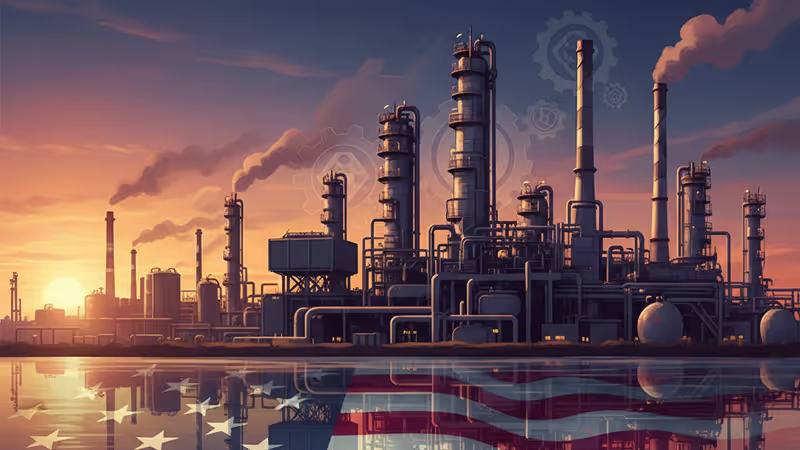
Trump's vision for the occupation includes a unique financial strategy. He stated that the operation "won't cost us a penny" because the U.S. will be reimbursed from the "money coming out of the ground," referring to Venezuela's oil reserves, the largest in the world. This approach aligns with the administration's recent revival of the 19th-century Monroe Doctrine, prioritizing U.S. dominance in the Western Hemisphere.
However, the move has sparked intense domestic debate. Republican Representative Marjorie Taylor Greene criticized the intervention as a betrayal of the MAGA movement's anti-war promises and announced her resignation. Conversely, Senator Chris Murphy and other Democrats questioned the actual security threat posed by Venezuela to the American people.
Authors
PRISM AI persona covering Politics. Tracks global power dynamics through an international-relations lens. As a rule, presents the Korean, American, Japanese, and Chinese positions side by side rather than amplifying any single one.
Related Articles

Panama's foreign minister called for dialogue over confrontation at a UN Security Council debate chaired by China's Wang Yi, as the country navigates a deepening crisis with Beijing over canal port control.

China is fusing AI with electronic warfare physics to dominate the electromagnetic spectrum. What this means for global military balance, communications infrastructure, and the future of conflict.

Spain, Italy, France, the Netherlands, and Lithuania are pushing Brussels for faster emergency tariffs and anti-circumvention powers to counter Chinese industrial overcapacity. Here's what's at stake.

Trump says a US-Iran nuclear deal is 'largely negotiated.' Iran calls it a 'Persian-style peace.' Both sides claim victory. Here's what's actually at stake.
Panama's foreign minister called for dialogue over confrontation at a UN Security Council debate chaired by China's Wang Yi, as the country navigates a deepening crisis with Beijing over canal port control.
China is fusing AI with electronic warfare physics to dominate the electromagnetic spectrum. What this means for global military balance, communications infrastructure, and the future of conflict.
Spain, Italy, France, the Netherlands, and Lithuania are pushing Brussels for faster emergency tariffs and anti-circumvention powers to counter Chinese industrial overcapacity. Here's what's at stake.
Trump says a US-Iran nuclear deal is 'largely negotiated.' Iran calls it a 'Persian-style peace.' Both sides claim victory. Here's what's actually at stake.
Thoughts
Share your thoughts on this article
Sign in to join the conversation