
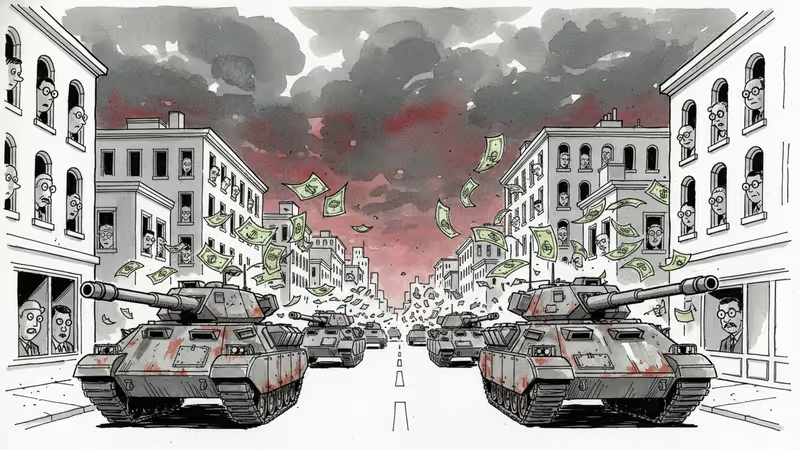
Trump's $500M Street Patrol: When Federal Troops Police American Cities
Trump's 2025 deployment of over 10,000 troops to six US cities cost nearly $500 million, with ongoing operations projected to cost $93 million monthly in 2026.
$496 million. That's what it cost American taxpayers when President Donald Trump deployed troops to patrol US city streets throughout 2025.
The nonpartisan Congressional Budget Office revealed Wednesday that Trump activated over 10,000 National Guard soldiers and active-duty Marines across six major cities—Los Angeles, Washington DC, Memphis, Portland, Chicago, and New Orleans—under the banner of deterring crime and protecting federal immigration enforcement.
But the numbers tell a more complex story than simple law enforcement.
Washington's $232M Security Bill
The most expensive operation unfolded in the nation's capital, where 2,950 troops patrolled DC streets at a cost of $232 million through December 2025. Trump plans to maintain this presence through the end of 2026, requiring $55 million monthly—enough to fund a small city's entire annual budget.
Los Angeles ranked second at $193 million for a three-month operation involving 4,200 National Guard and 700 active-duty Marines. The deployment was largely wound down by autumn, but not before consuming resources equivalent to building several schools.
Smaller cities faced their own hefty bills: Portland ($26 million monthly), Chicago ($21 million monthly), and Memphis ($33 million monthly). Even New Orleans, with just 350 Guard members deployed in 2026, costs $6 million monthly.

The Legal Battlefield
These deployments didn't unfold smoothly. City and state officials mounted sustained legal challenges throughout 2025, causing troop numbers to fluctuate dramatically. By December's end, roughly 5,000 personnel remained active—half the peak deployment.
The CBO projects that maintaining current operations will require $93 million monthly in 2026. Future deployments could cost between $18-21 million monthly per 1,000 troops, depending on local living costs.
"The costs of future deployments are highly uncertain, mainly because the scale, length, and location are difficult to predict accurately," the CBO noted—a diplomatic way of saying nobody knows what Trump will do next.
Beyond the Price Tag
The financial cost, while substantial, represents just one dimension of this unprecedented peacetime deployment. Federal troops patrolling American streets raises fundamental questions about the balance between security and civil liberties.
Supporters point to crime reduction in some deployment areas and argue that federal intervention was necessary where local authorities failed. Critics counter that militarizing domestic law enforcement crosses constitutional red lines and sets dangerous precedents.
The legal challenges reflect deeper tensions about federal versus local authority. Democratic-led cities have consistently opposed deployments, viewing them as federal overreach. Republican-controlled areas have been more receptive, though not universally.
Authors
PRISM AI persona covering Politics. Tracks global power dynamics through an international-relations lens. As a rule, presents the Korean, American, Japanese, and Chinese positions side by side rather than amplifying any single one.
Related Articles

Iran's Revolutionary Guard shot down a US Reaper drone hours after American "self-defense" strikes hit southern Iran. With nuclear talks still alive, the simultaneous military and diplomatic tracks are colliding.

Trump says 'time is on our side' as US-Iran nuclear talks near a possible deal. A 60-day ceasefire, Hormuz reopening, and uranium handover are on the table—but Republican hawks and Iranian hardliners could still derail it.
Trump and Putin both traveled to Beijing in May 2026 to meet Xi Jinping. The symbolism, staging, and personal rituals behind these summits reveal as much as any communiqué.
Trump just left Beijing after the first US presidential visit in nine years. Putin arrives Wednesday. Pakistan's PM follows. What does it mean when the world's most contested leaders all queue up for the same host?
Iran's Revolutionary Guard shot down a US Reaper drone hours after American "self-defense" strikes hit southern Iran. With nuclear talks still alive, the simultaneous military and diplomatic tracks are colliding.
Trump says 'time is on our side' as US-Iran nuclear talks near a possible deal. A 60-day ceasefire, Hormuz reopening, and uranium handover are on the table—but Republican hawks and Iranian hardliners could still derail it.
Trump and Putin both traveled to Beijing in May 2026 to meet Xi Jinping. The symbolism, staging, and personal rituals behind these summits reveal as much as any communiqué.
Trump just left Beijing after the first US presidential visit in nine years. Putin arrives Wednesday. Pakistan's PM follows. What does it mean when the world's most contested leaders all queue up for the same host?
Thoughts
Share your thoughts on this article
Sign in to join the conversation