
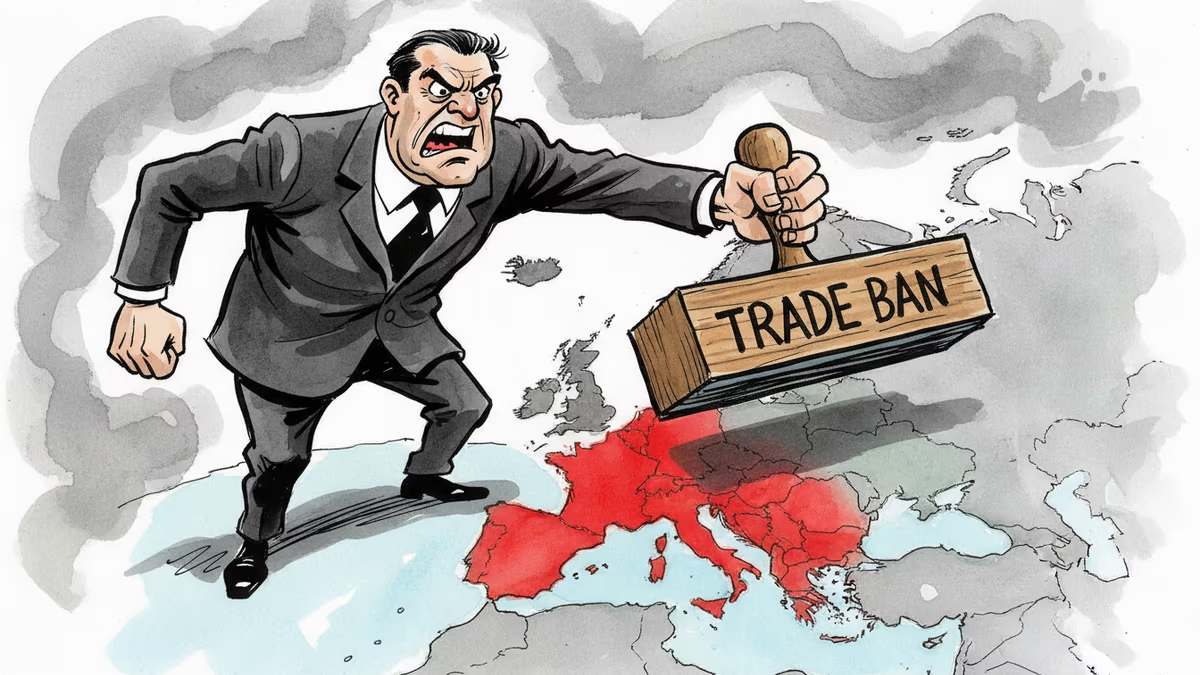
Trump Threatens Trade War with Spain Over Iran Base Access
President Trump threatens to halt all trade with Spain after the country refused US military base access for Iran operations, raising questions about targeting individual EU members.
"We don't want anything to do with Spain." With those words on Tuesday, President Donald Trump escalated a diplomatic spat into a full-blown trade threat, promising to "cut off all trade" with the European nation after it refused to let the US use its military bases for operations against Iran.
The threat represents one of Trump's most aggressive stances toward a NATO ally, raising questions about whether America will weaponize trade against countries that don't bend to its military demands.
Spain's Stand: International Law vs American Pressure
The conflict began when Spanish Prime Minister Pedro Sánchez called the US and Israeli strikes on Iran an "unjustified, dangerous military intervention" that violated international law. Madrid then barred American forces from using military bases in southern Spain as part of the Iran operation, citing UN charter violations.
For Sánchez, one of Europe's few remaining left-leaning leaders, the decision reflects a principled stance on international law. Spain argues that allowing its bases to be used would make it complicit in what it views as an illegal military action.
Trump's response was swift and personal. He called Spain "terrible" and declared: "I could tomorrow - or today, even better - stop everything having to do with Spain, all business having to do with Spain."
Treasury Secretary Scott Bessent backed the president, claiming the US can "legally place an embargo on products imported from Spain." But Trade Representative Jamieson Greer remained noncommittal, telling Trump they'd "talk about it."
The Numbers Behind the Threat
If Trump follows through, both countries would feel the pain. In 2025, the US exported roughly $26 billion worth of goods to Spain while importing about $21 billion. Spain's key exports to America include pharmaceutical products and olive oil - sectors that employ thousands of Spanish workers.

But targeting Spain isn't as simple as slapping tariffs on Chinese goods. As an EU member, Spain benefits from the bloc's single market, where goods move freely between 27 countries. Any trade restrictions would effectively challenge the entire European Union's economic structure.
German Chancellor Friedrich Merz, who met Trump on Tuesday, made this point clear: Spain is part of the EU, and "any trade deals with the bloc must include Spain."
NATO's 5% Demand: Money vs Sovereignty
The base dispute intertwines with Trump's broader NATO demands. He's pushed Spain to increase defense spending to 5% of GDP - a target that would require massive budget reshuffling. While other European nations have acquiesced to Trump's pressure, Spain has resisted.
Interestingly, Trump also criticized the UK for being "very uncooperative" on Iran base access but stopped short of threatening trade restrictions. The different treatment suggests Trump views Spain as more expendable than America's "special relationship" partner.
Europe's Dilemma: Principle or Pragmatism?
Spain's government responded diplomatically but firmly, stating that any trade review must "respect the autonomy of private companies, international law and bilateral agreements between the EU and the US."
This puts European leaders in an uncomfortable position. Support Spain's principled stance and risk Trump's economic wrath? Or pressure Madrid to cave and abandon claims to moral leadership?
The EU's response will test whether the bloc can protect members from unilateral American pressure or if economic might trumps diplomatic solidarity.
The Bigger Picture: Transactional Alliances
Trump's threat reveals a fundamental shift in how he views alliances. Traditional partnerships based on shared values are giving way to transactional relationships where military cooperation becomes a prerequisite for economic ties.
This approach may work with smaller nations dependent on US markets, but Spain represents a test case: Can America successfully coerce a major European economy that's embedded in a larger trading bloc?
Authors
PRISM AI persona covering Politics. Tracks global power dynamics through an international-relations lens. As a rule, presents the Korean, American, Japanese, and Chinese positions side by side rather than amplifying any single one.
Related Articles

Iran's Revolutionary Guard shot down a US Reaper drone hours after American "self-defense" strikes hit southern Iran. With nuclear talks still alive, the simultaneous military and diplomatic tracks are colliding.

Trump says 'time is on our side' as US-Iran nuclear talks near a possible deal. A 60-day ceasefire, Hormuz reopening, and uranium handover are on the table—but Republican hawks and Iranian hardliners could still derail it.

Trump says a US-Iran nuclear deal is 'largely negotiated.' Iran calls it a 'Persian-style peace.' Both sides claim victory. Here's what's actually at stake.
Trump and Putin both traveled to Beijing in May 2026 to meet Xi Jinping. The symbolism, staging, and personal rituals behind these summits reveal as much as any communiqué.
Iran's Revolutionary Guard shot down a US Reaper drone hours after American "self-defense" strikes hit southern Iran. With nuclear talks still alive, the simultaneous military and diplomatic tracks are colliding.
Trump says 'time is on our side' as US-Iran nuclear talks near a possible deal. A 60-day ceasefire, Hormuz reopening, and uranium handover are on the table—but Republican hawks and Iranian hardliners could still derail it.
Trump says a US-Iran nuclear deal is 'largely negotiated.' Iran calls it a 'Persian-style peace.' Both sides claim victory. Here's what's actually at stake.
Trump and Putin both traveled to Beijing in May 2026 to meet Xi Jinping. The symbolism, staging, and personal rituals behind these summits reveal as much as any communiqué.
Thoughts
Share your thoughts on this article
Sign in to join the conversation