

Unilateral Move: The Trump Deep-Sea Mining Permit Fast-Track Strategy
The Trump administration announces a consolidated Trump deep-sea mining permit process, bypassing international codes to secure critical minerals from the ocean floor.
The race for the abyss just got personal. The Trump administration has signaled it's ready to bypass global norms to secure the minerals of the future. By January 2026, the U.S. is positioning itself as a lone wolf in the deep-sea resource grab.
Inside the New Trump Deep-Sea Mining Permit Process
This week, the administration announced a consolidated permitting process designed to jumpstart the extraction of subsea treasures. This new framework merges the search and commercial extraction phases into a single streamlined path, significantly reducing the bureaucratic hurdles for American companies.

The primary targets are polymetallic nodules found in international waters. These potato-sized rocks contain critical amounts of cobalt and nickel—essential for the tech and EV industries. By moving forward without an international mining code, the U.S. is effectively ignoring the International Seabed Authority's jurisdiction.
Environmental Risks and Global Backlash
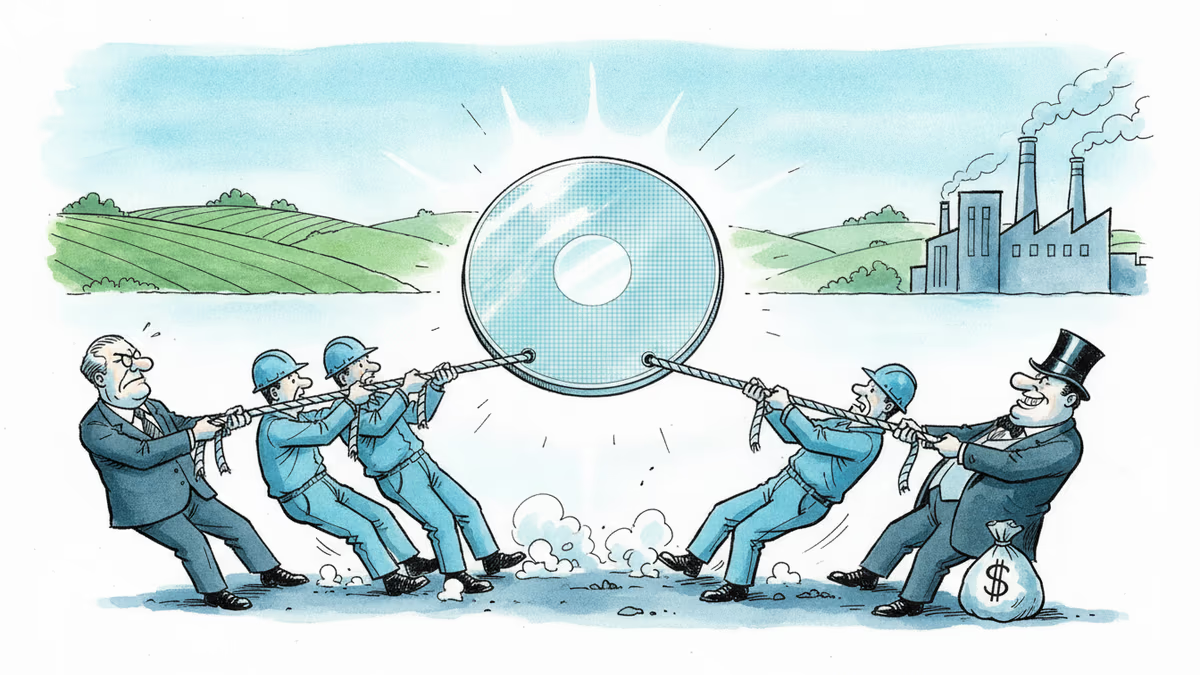
Scientists and ocean advocates are sounding the alarm. They warn that disturbing the seabed could trigger unforeseen consequences that harm coastal communities and destroy unique ecosystems. According to reports from The Verge, the push to bypass international consensus has sparked outrage among global environmental partners.
Authors
Related Articles
Samsung Electronics' union branch revealed that 84% of survey respondents oppose the government's roughly $290 billion (₩400 trillion) semiconductor megaproject in Gwangju. Government, management, the union and shareholders are all reading the same national project in sharply different ways.
Nvidia shipped roughly a billion RISC-V cores in 2024, then announced it would run CUDA on the open standard. We break down how royalty-free instruction sets and open software stacks are trying to route around CUDA's lock-in. Part 2 of the Semiconductor Sovereignty series.

US AI-chip export controls split into three layers in the first half of 2026 — January easing, a May crackdown on circumvention, and a pending bill. Nvidia erased China from its guidance and still posted a record $81.6 billion quarter. A look at the export policy that both shields and cages it.

AMD's MI325X matches or beats Nvidia on memory and bandwidth — yet Nvidia's 86-92% share holds. The real moat is CUDA, 20 years in the making. Part 1 of 4.
Samsung Electronics' union branch revealed that 84% of survey respondents oppose the government's roughly $290 billion (₩400 trillion) semiconductor megaproject in Gwangju. Government, management, the union and shareholders are all reading the same national project in sharply different ways.
Nvidia shipped roughly a billion RISC-V cores in 2024, then announced it would run CUDA on the open standard. We break down how royalty-free instruction sets and open software stacks are trying to route around CUDA's lock-in. Part 2 of the Semiconductor Sovereignty series.
US AI-chip export controls split into three layers in the first half of 2026 — January easing, a May crackdown on circumvention, and a pending bill. Nvidia erased China from its guidance and still posted a record $81.6 billion quarter. A look at the export policy that both shields and cages it.
AMD's MI325X matches or beats Nvidia on memory and bandwidth — yet Nvidia's 86-92% share holds. The real moat is CUDA, 20 years in the making. Part 1 of 4.
Thoughts
Share your thoughts on this article
Sign in to join the conversation