
Mercedes Just Turned Back the Clock to 2014
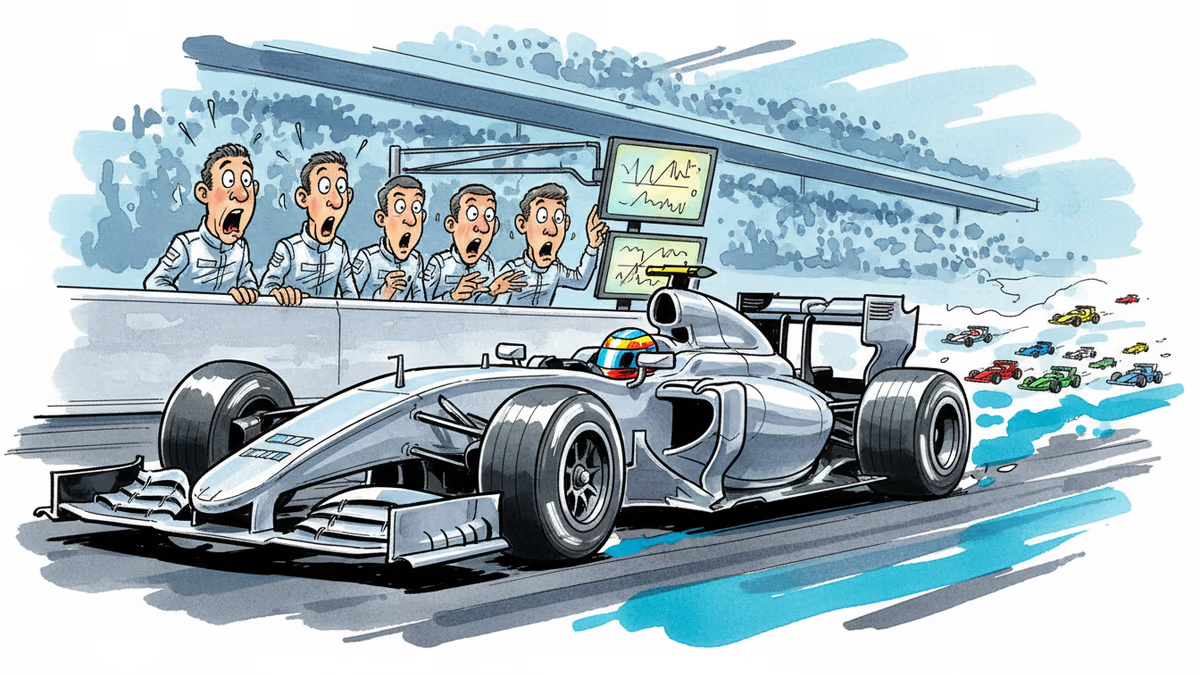
At the 2026 Australian Grand Prix, George Russell lapped 0.6 seconds faster than any other car in practice. The last time Mercedes showed a gap like this, they won eight consecutive championships.
0.6 seconds. In everyday life, it's nothing. In Formula 1, it's a chasm—and the last time Mercedes opened a gap this wide at the start of a new regulatory era, they won eight consecutive Constructors' Championships.
Welcome to 2026.
What Just Happened in Melbourne
The 2026 F1 season opened last weekend in Melbourne, Australia, and it arrived carrying the sport's most sweeping technical overhaul in years. Cars are smaller and lighter. A new hybrid architecture delivers more raw power than anything since the turbocharged 1980s—but only when the battery is fully charged, a caveat that turns energy management into a race-within-a-race. Ground-effect aerodynamics, the dominant philosophy since 2022, has been shelved in favor of a new downforce concept. New engine manufacturers have entered the picture, and every team essentially started from scratch.
The promise of the reset was chaos—a scrambled pecking order, fresh faces at the front, unpredictability. For six days of pre-season testing in Bahrain, nobody could read the field clearly. On Friday in Melbourne, Charles Leclerc's Ferrari and Oscar Piastri's McLaren topped the two practice sessions, and the paddock buzzed with cautious optimism that the fight would be wide open.
Then Saturday came. George Russell stopped sandbagging.
By the end of the final free practice session, Russell's Mercedes was 0.6 seconds clear of the next-quickest car—Lewis Hamilton's Ferrari. In a sport where hundredths of a second separate the grid, six-tenths is not a gap. It's a statement.
Why This Number Echoes

The year 2014 keeps surfacing in paddock conversations, and not by accident. That was the last time F1 introduced a major hybrid power unit regulation. Mercedes arrived that season with a power unit so far ahead of the competition that they won 11 of 16 races in year one. Rivals spent the next two to three seasons just closing the gap—by which point Mercedes had institutionalized their advantage into a dynasty.
The structural parallels to 2026 are hard to ignore: new hybrid architecture, new aerodynamic philosophy, reshuffled engine supply landscape. Rumors circulating for at least a year in the paddock suggested Mercedes might pull off exactly this kind of repeat. Saturday's practice data gave those rumors their first hard evidence.
Crucially, this gap appeared in free practice, not qualifying. Teams routinely run different fuel loads, engine modes, and tyre strategies on Fridays and Saturdays. Mercedes may not have shown everything yet.
Three Ways to Read This
*For Mercedes***, this is the payoff on a long bet. The team spent Max Verstappen's dominant years quietly redirecting resources toward the 2026 regulations. While Red Bull and McLaren fought over the present, Mercedes was engineering the future. Whether that calculation pays out over a full season remains to be seen, but the early signal is unmistakable.
**For Ferrari and McLaren**, Saturday was an uncomfortable déjà vu. Both teams battled fiercely through 2025 and arrived in Melbourne expecting to contend. A 0.6-second deficit in practice doesn't confirm they're fighting for second—but it raises the question loudly enough that it can't be ignored.
For engineers and technologists, the most interesting variable in 2026 isn't raw horsepower—it's battery state management. The new hybrid systems deliver their full output only under specific charge conditions, meaning software, energy recovery algorithms, and deployment strategy become as decisive as mechanical pace. This is, increasingly, a computing competition wearing a racing suit. The teams that master predictive energy modeling may hold an advantage that's harder to copy than a clever floor design.
The Bigger Picture Beyond the Podium
F1's technical regulations have never been purely about sport. The hybrid architecture introduced in 2014 filtered, in modified form, into road cars from multiple manufacturers over the following decade. The 2026 rules push battery efficiency and energy recovery further than any previous formula. What gets proven under race conditions on Sunday afternoons has a habit of appearing in production vehicles by the following decade.
If Mercedes has genuinely cracked the new hybrid formula ahead of the field, the implications extend beyond trophies. It signals where their engineering talent and capital have been concentrated—and that tends to matter in the broader automotive technology race, where the same companies compete for EV market share.
Authors
Related Articles
Ford pulls plug on F-150 Lightning after massive EV losses, pivoting to hybrids and smaller EVs. What this means for the auto industry's electric future.
Lamborghini's Temerario replaces the Huracán with radical aerodynamic improvements and hybrid technology. How will this shift reshape the supercar landscape and customer expectations?

F1's 2026 regulations kill DRS for a new era of active aerodynamics and 'Boost Mode'. PRISM analyzes why this matters for racing, strategy, and auto tech.
Samsung Electronics' union branch revealed that 84% of survey respondents oppose the government's roughly $290 billion (₩400 trillion) semiconductor megaproject in Gwangju. Government, management, the union and shareholders are all reading the same national project in sharply different ways.
Ford pulls plug on F-150 Lightning after massive EV losses, pivoting to hybrids and smaller EVs. What this means for the auto industry's electric future.
Lamborghini's Temerario replaces the Huracán with radical aerodynamic improvements and hybrid technology. How will this shift reshape the supercar landscape and customer expectations?
F1's 2026 regulations kill DRS for a new era of active aerodynamics and 'Boost Mode'. PRISM analyzes why this matters for racing, strategy, and auto tech.
Samsung Electronics' union branch revealed that 84% of survey respondents oppose the government's roughly $290 billion (₩400 trillion) semiconductor megaproject in Gwangju. Government, management, the union and shareholders are all reading the same national project in sharply different ways.
Thoughts
Share your thoughts on this article
Sign in to join the conversation