
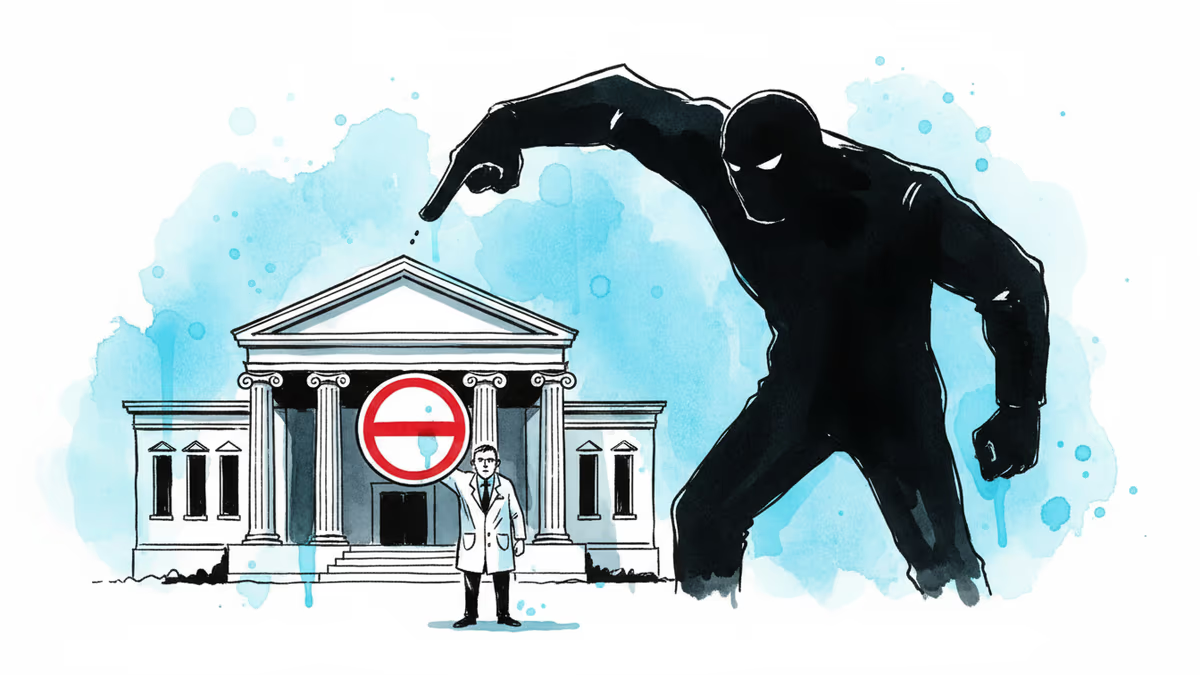
Anthropic Is Suing the US Government Over Its AI Ethics
Anthropic filed suit against the Trump administration after being designated a supply-chain risk — allegedly for refusing to let its AI be used for autonomous weapons and mass surveillance.
What happens when an AI company draws a line — and the government punishes it for doing so?
What Happened
Anthropic has filed a federal lawsuit against the Trump administration in a California district court, challenging its designation as a "supply-chain risk" by the Pentagon. The company argues the designation is unconstitutional retaliation — payback for Anthropic's refusal to allow its AI models to be used for two specific purposes: mass domestic surveillance and fully autonomous weapons.
The suit states plainly that "the federal government retaliated against a leading frontier AI developer for adhering to its protected viewpoint on a subject of great public significance — AI safety and the limitations of its own AI models — in violation of the Constitution."
This isn't a sudden escalation. The lawsuit is the latest move in a weeks-long standoff between Anthropic and the Department of Defense over the boundaries of military AI use. What started as a policy disagreement has now become a First Amendment case.
Why the Timing Matters

The Trump administration has moved quickly to roll back AI oversight since taking office. Biden-era AI safety executive orders were among the first things rescinded. The policy direction has been clear: fewer guardrails, faster deployment, especially in defense and national security contexts.
Into that environment, Anthropic's "red lines" — its internal ethical limits on what its AI can be used for — became a friction point. A supply-chain risk designation isn't just a label. It can block a company from government contracts, complicate partnerships, and send a chilling signal to investors and enterprise clients. In practical terms, it's closer to an economic penalty than an administrative note.
The question the lawsuit forces into the open: can the government use procurement power to punish a private company for its stated ethical positions?
Three Ways to Read This
For AI safety advocates, this is a test case that could define the legal standing of corporate ethics in the AI industry. If Anthropic wins, it establishes that companies have constitutional protection when they set limits on their own technology. If it loses, the message to every AI lab is clear: ethical constraints are a liability when government contracts are on the table.
For defense and national security hawks, the argument runs the other way. Autonomous systems and AI-assisted surveillance aren't hypothetical — they're active areas of military investment globally. From their perspective, a private company unilaterally deciding what the military can and can't use isn't ethics. It's a strategic vulnerability.
For investors and the broader tech industry, this case is a stress test for the "safety-first" brand positioning that several frontier AI companies have built. Anthropic, OpenAI, and others have long argued that safety and commercial success aren't in conflict. This lawsuit suggests the tension may be sharper than their pitch decks implied — particularly when the customer is the US government.
Authors
Related Articles
Anthropic shipped Claude Sonnet 5, its mid-tier agent model, on June 30. Behind the 'Opus-class power, budget price' headline sits a tokenizer catch and a three-horse race that's only half real. Here's what developers should actually run the numbers on.
A small but growing group of developers has gone all-in on AI coding agents like Claude Code and OpenClaw. History suggests the rest of us won't be far behind.
Sam Nelson, 19, died after following ChatGPT's advice to mix Kratom and Xanax. His parents are suing OpenAI for wrongful death, raising urgent questions about AI trust, liability, and design.
OpenAI's new Daybreak initiative uses the Codex AI agent to find and patch security vulnerabilities before attackers do—putting it in direct competition with Anthropic's secretive Claude Mythos.
Anthropic shipped Claude Sonnet 5, its mid-tier agent model, on June 30. Behind the 'Opus-class power, budget price' headline sits a tokenizer catch and a three-horse race that's only half real. Here's what developers should actually run the numbers on.
A small but growing group of developers has gone all-in on AI coding agents like Claude Code and OpenClaw. History suggests the rest of us won't be far behind.
Sam Nelson, 19, died after following ChatGPT's advice to mix Kratom and Xanax. His parents are suing OpenAI for wrongful death, raising urgent questions about AI trust, liability, and design.
OpenAI's new Daybreak initiative uses the Codex AI agent to find and patch security vulnerabilities before attackers do—putting it in direct competition with Anthropic's secretive Claude Mythos.
Thoughts
Share your thoughts on this article
Sign in to join the conversation