
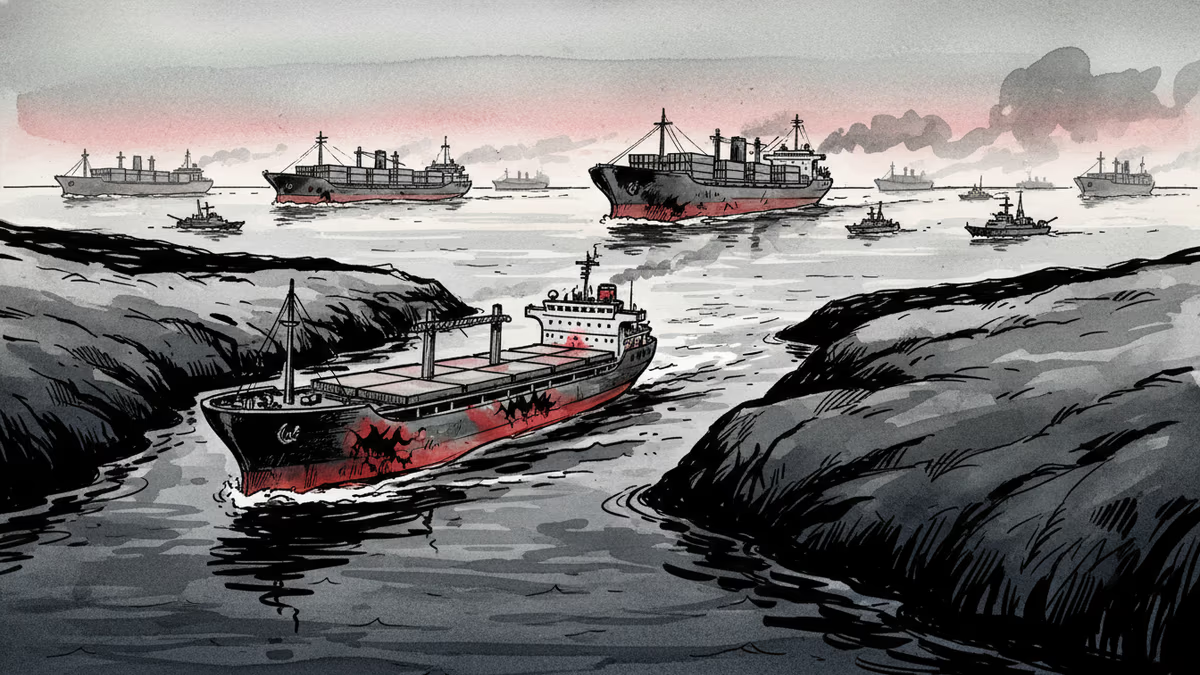
Seoul's Lone Ship: The Cost of Sitting Out
Trump publicly blamed Iran for attacking an HMM cargo vessel, framing it as the consequence of South Korea skipping the U.S.-led Strait of Hormuz escort mission. The incident puts Seoul's energy security and alliance calculus under pressure.
The ship was anchored off the UAE coast when the explosion hit. Seoul called it an incident under investigation. Washington called it a lesson.
One day after HMM Co.'s cargo vessel suffered an onboard explosion on Monday, U.S. President Donald Trump stood at the White House and offered his own verdict. "Their ship was shot at," he said. "They were not in the cavalcade of ships they had. They decided to go it alone, and their ship got hell knocked out of it yesterday — but they didn't shoot the ships that were guarded by us."
Trump had already telegraphed the message on social media the night before, writing that Iran had "taken some shots" at the vessel and that it was time for South Korea to join the U.S.-led mission to reopen the Strait of Hormuz.
What's Actually Happening in the Strait
The backdrop matters. The U.S. recently launched "Project Freedom," a naval escort operation designed to restore freedom of navigation through the Strait of Hormuz — the narrow chokepoint through which roughly 20% of the world's seaborne oil passes. Iran has effectively tightened its grip on the waterway amid the ongoing Middle East conflict, harassing and seizing commercial vessels.
South Korea has not officially joined the mission. HMM, the country's largest container shipping line, was operating its vessel independently when the explosion occurred. Seoul says it's still investigating the cause and that determining it could take days — a cautious framing that pointedly avoids confirming Trump's version of events.
The gap between the two governments' public statements is itself significant. Trump has made his interpretation the dominant narrative. Seoul is still trying to find the facts.
The 43% Number and What It Means
Trump's invocation of 43% — South Korea's oil import reliance on the Strait of Hormuz — wasn't accidental. It's the kind of leverage point his administration deploys deliberately: you benefit from this waterway, so you should help defend it.

The arithmetic isn't wrong. South Korea imports roughly 70% of its crude from the Middle East, and the vast majority transits the strait. An Iranian blockade doesn't just raise oil prices for Seoul — it threatens the energy supply chain of one of Asia's most export-dependent economies. HMM itself is a critical artery for Korean manufacturing exports worldwide.
But the political math is more complicated. South Korea has historically walked a careful line with Iran, maintaining economic ties even under sanctions pressure. Joining a U.S. naval operation that directly confronts Tehran risks inflaming that relationship, complicating Korean construction and energy projects across the region, and drawing Seoul deeper into a Middle East conflict it has no direct stake in.
This isn't a new tension. In 2019, when Washington made a similar request during an earlier Hormuz standoff, Seoul opted for a middle path: expanding the operational scope of its existing Cheonghae Unit — an anti-piracy naval deployment — rather than formally joining the U.S.-led coalition. It was a compromise that satisfied neither side fully.
The Alliance Pressure Pattern
Trump's Hormuz push fits a familiar template. Defense cost-sharing. Trade deficits. Now maritime security. The implicit argument is always the same: American protection isn't free, and countries that rely on it should contribute proportionally.
What makes this instance more pointed is the public nature of the pressure. By naming HMM's ship specifically — and framing its damage as a direct consequence of South Korea's absence from the escort convoy — Trump has made the stakes personal and concrete. It's harder to deflect a specific ship than an abstract alliance obligation.
For Seoul, the timing is particularly awkward. South Korea is simultaneously navigating tense defense cost-sharing negotiations with Washington, managing tariff disputes, and dealing with a domestic political landscape still recovering from last year's constitutional turmoil. Adding Hormuz to that pile is not a welcome development.
Japan, notably, is reportedly already considering some level of contribution to the escort mission. If Tokyo moves and Seoul doesn't, the contrast will be diplomatically uncomfortable.
What Remains Unresolved
The central factual question — what actually caused the explosion on the HMM vessel — remains officially open. The South Korean government has been careful not to confirm Iranian responsibility. An anchored ship in UAE waters suffering an explosion could have multiple explanations, and Seoul clearly wants the investigation to conclude before making any political commitments.
That caution is understandable. But in the current environment, the absence of a clear South Korean response may itself be read as a position — by Washington, by Tehran, and by the shipping industry watching to see how the Hormuz situation develops.
This content is AI-generated based on source articles. While we strive for accuracy, errors may occur. We recommend verifying with the original source.
Related Articles

Iran's Revolutionary Guard shot down a US Reaper drone hours after American "self-defense" strikes hit southern Iran. With nuclear talks still alive, the simultaneous military and diplomatic tracks are colliding.

Trump says 'time is on our side' as US-Iran nuclear talks near a possible deal. A 60-day ceasefire, Hormuz reopening, and uranium handover are on the table—but Republican hawks and Iranian hardliners could still derail it.

Trump says a US-Iran nuclear deal is 'largely negotiated.' Iran calls it a 'Persian-style peace.' Both sides claim victory. Here's what's actually at stake.
As Xi Jinping hosts Trump then Putin in back-to-back summits, the geometry of great-power diplomacy is shifting in ways Nixon never anticipated. Here's what the numbers reveal.
Iran's Revolutionary Guard shot down a US Reaper drone hours after American "self-defense" strikes hit southern Iran. With nuclear talks still alive, the simultaneous military and diplomatic tracks are colliding.
Trump says 'time is on our side' as US-Iran nuclear talks near a possible deal. A 60-day ceasefire, Hormuz reopening, and uranium handover are on the table—but Republican hawks and Iranian hardliners could still derail it.
Trump says a US-Iran nuclear deal is 'largely negotiated.' Iran calls it a 'Persian-style peace.' Both sides claim victory. Here's what's actually at stake.
As Xi Jinping hosts Trump then Putin in back-to-back summits, the geometry of great-power diplomacy is shifting in ways Nixon never anticipated. Here's what the numbers reveal.
Thoughts
Share your thoughts on this article
Sign in to join the conversation