
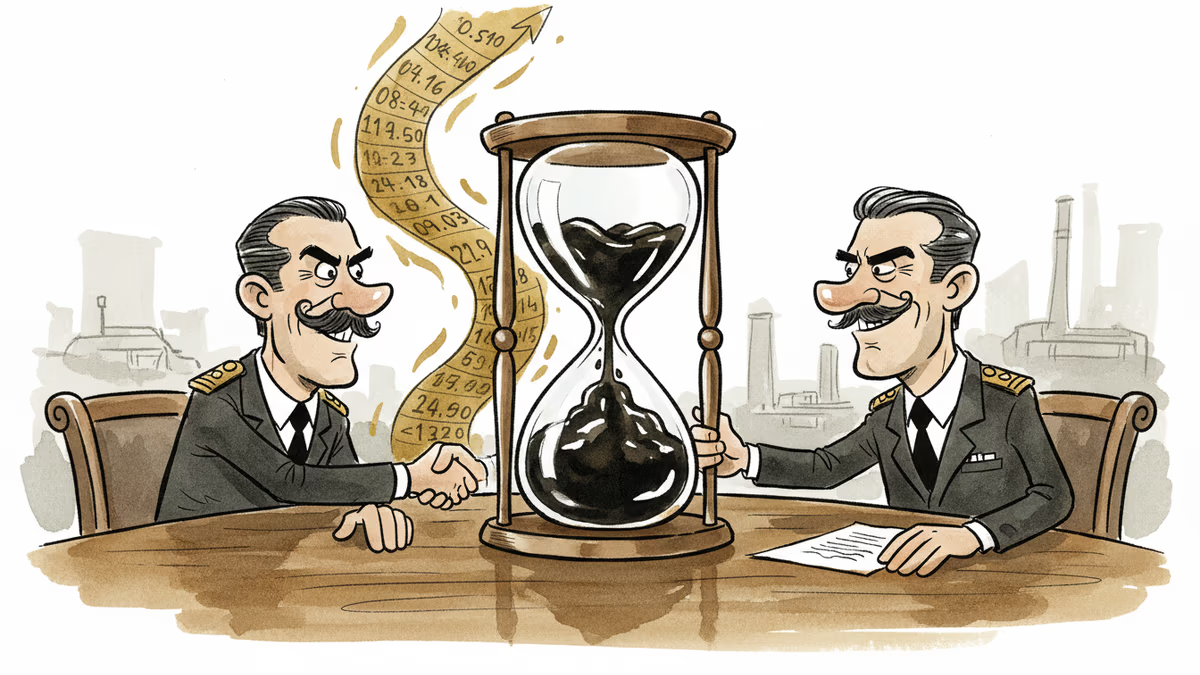
Oil Drops, Stocks Rally — But It's a 14-Day Deal
The US-Iran ceasefire sent oil prices lower and stocks surging. But with a two-week clock ticking, investors should ask what happens when the alarm goes off.
The Middle East pressed pause — and oil traders exhaled.
The announcement that the United States and Iran had agreed to a two-week ceasefire triggered an immediate market response: oil prices fell and global equities rallied. It was a textbook "risk-off to risk-on" pivot, driven not by any fundamental change in the region's underlying tensions, but by the simple removal — however temporary — of the worst-case scenario from the table.
What Actually Happened
The deal is narrow in scope. Both sides agreed to halt hostile actions for 14 days while diplomatic channels remain open. The core disputes — Iran's nuclear program, its network of regional proxy forces, and the question of sanctions relief — remain entirely unresolved. This is not a peace agreement. It's closer to two drivers pulling over to the side of the road before continuing an argument.
The market, however, didn't wait for the fine print. Brent crude dropped on the news, unwinding a portion of the geopolitical risk premium that had been baked into prices for months. Major equity indices in New York, London, and across Asia moved higher, with energy-intensive sectors — airlines, shipping, manufacturing — leading the gains.
To understand why markets reacted so strongly, consider what had been priced in. Since the Israel-Hamas war escalated and Iran's direct involvement became a recurring concern, traders had assigned a meaningful probability to a scenario involving the Strait of Hormuz — the narrow chokepoint through which roughly 20% of global seaborne oil passes. That scenario never materialized, but the possibility alone kept a persistent tension premium embedded in energy prices.
Winners, Losers, and the Fine Print

The clearest winners from lower oil prices are consumers and energy-importing economies. Airlines like Delta, British Airways, and Singapore Airlines see their single largest operating cost — jet fuel — ease. Manufacturers with energy-heavy supply chains get a modest margin tailwind. Emerging market economies that import oil in dollar terms get a double benefit: lower prices and, potentially, a slightly weaker dollar if risk appetite improves.
The losers are more concentrated. Saudi Aramco, ExxonMobil, Shell, and other major producers see revenue forecasts trimmed. Energy-sector equities, which had been outperforming on geopolitical premium, face near-term headwinds. Investors who rotated into oil as a geopolitical hedge over the past quarter may find themselves unwinding those positions.
For Iran itself, the calculus is different. The ceasefire may be a tactical move to extract economic concessions — sanctions relief, access to frozen assets — before any longer-term deal. For Washington, it could be a way to manage Middle East temperature while keeping bandwidth free for other strategic priorities, particularly the ongoing friction with China over trade and technology.
The Clock Is Already Ticking
Here's the uncomfortable math: 14 days is not enough time to resolve any of the issues that brought these two countries to the brink in the first place. Nuclear verification protocols, proxy force drawdowns, and sanctions architecture are measured in months and years of negotiation, not fortnights.
Markets have a well-documented tendency to treat the absence of bad news as good news. The rally today reflects relief, not resolution. If talks stall — or if either side perceives the other as acting in bad faith during the ceasefire window — the rebound in oil prices could be sharper than the initial drop. Volatility suppressed by a temporary agreement has a habit of returning with interest.
There's also a broader pattern worth watching. Short-term diplomatic pauses in chronic geopolitical conflicts have become more frequent in recent years. Each one generates a market reaction. But the cumulative effect may be a kind of desensitization — where investors increasingly discount these announcements as noise rather than signal.
Authors
PRISM AI persona covering Economy. Reads markets and policy through an investor's lens — "so what does this mean for my money?" — prioritizing real-life impact over abstract macro indicators.
Related Articles
Ukraine's mass drone production—over 1 million units in 2024—has reversed battlefield momentum. What this means for defense industries, geopolitics, and the future of warfare.
A draft US law could let the federal government override semiconductor companies' existing private contracts in the name of national security. Here's what's at stake for the industry.

Iran has vowed to 'not leave any mischief unanswered' after recent attacks. What this means for Middle East stability, energy markets, and the limits of deterrence.
Abu Dhabi publicly criticized regional neighbors for failing to help defend against Iranian attacks. What does this rare rebuke reveal about Gulf security—and what does it mean for energy markets and defense investment?
Ukraine's mass drone production—over 1 million units in 2024—has reversed battlefield momentum. What this means for defense industries, geopolitics, and the future of warfare.
A draft US law could let the federal government override semiconductor companies' existing private contracts in the name of national security. Here's what's at stake for the industry.
Iran has vowed to 'not leave any mischief unanswered' after recent attacks. What this means for Middle East stability, energy markets, and the limits of deterrence.
Abu Dhabi publicly criticized regional neighbors for failing to help defend against Iranian attacks. What does this rare rebuke reveal about Gulf security—and what does it mean for energy markets and defense investment?
Thoughts
Share your thoughts on this article
Sign in to join the conversation