
Cuba Is Next" — And Trump Wants You to Forget He Said It
Trump's "Cuba is next" remark at a Miami investment forum signals a pattern of pressure — economic strangulation, regime change, and military hints — that's reshaping hemispheric order.
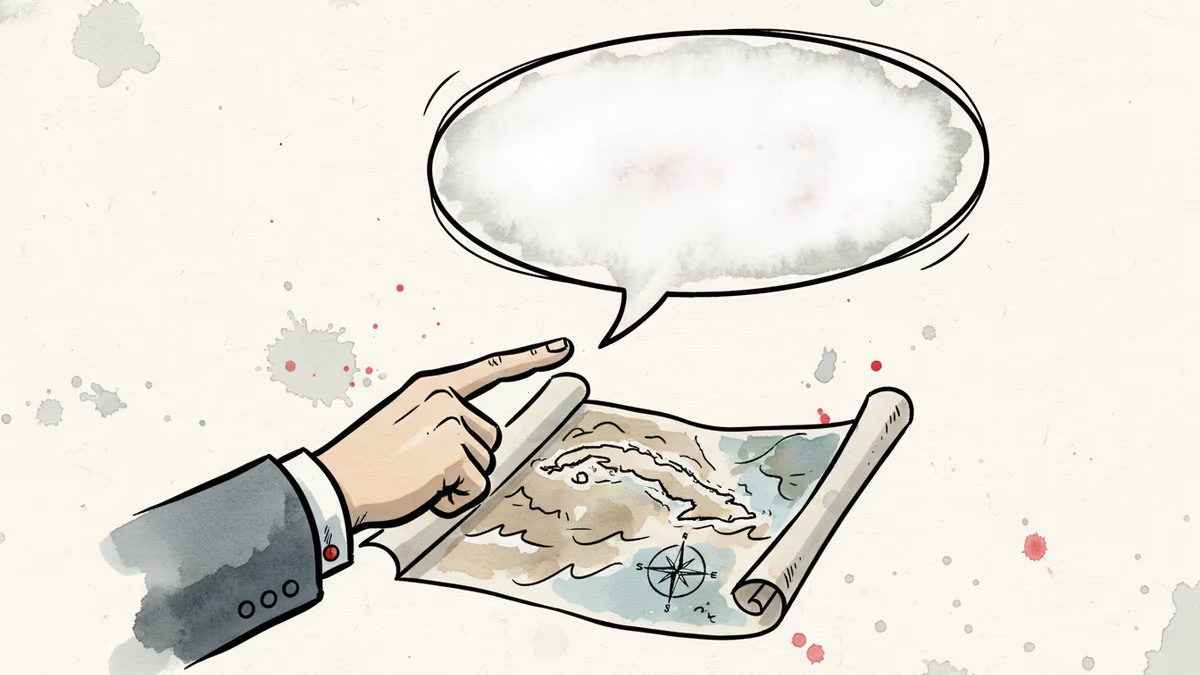
"Cuba is next, by the way. But pretend I didn't say that. Pretend I didn't."
With that, Donald Trump handed the world both a threat and a get-out-of-jail-free card — in the same breath. Speaking at an investment forum in Miami on March 28, 2026, the U.S. president had just finished touting what he called the successes of American military action in Venezuela and Iran. Then came Cuba. Offhand, almost playful. And entirely impossible to ignore.
What Actually Happened
Trump's Miami remarks were not delivered in a national security briefing room or a congressional hearing. They came at an investment forum — a room full of business interests, in a city with one of the largest Cuban-American populations in the United States. The setting matters.
The president offered no specific plan for Cuba. But the context was dense with implication. His administration has, in recent weeks, quietly opened negotiations with elements of Cuba's leadership. Earlier this month, Trump floated the idea of a "friendly takeover" of the island — before immediately adding, "It may not be a friendly takeover." On Friday, he went further, placing Cuba explicitly in a sequence that includes two countries where U.S. military force has already been applied.
Cuban President Miguel Díaz-Canel has publicly acknowledged that talks with Washington are underway, framing them as an effort to avert military confrontation. That a Cuban leader would admit to such negotiations openly is itself remarkable — and telling.
The Energy Squeeze That Made This Possible
To understand why Cuba is vulnerable right now, follow the oil.
For decades, Venezuela supplied the bulk of Cuba's petroleum needs, keeping the island's power plants running and its transportation system alive. Then, in January 2026, the U.S. conducted an operation that resulted in the capture and removal of Venezuelan leader Nicolás Maduro. Caracas's new government, under Washington's pressure, promptly cut off oil shipments to Havana.

The effect has been severe. Cuba's economy, already strained by years of U.S. sanctions, is now contending with chronic power outages and a transportation system running on fumes — literally. Trump has repeatedly said he believes the Cuban government is "on the verge of collapse." Whether that's accurate analysis or wishful thinking, the economic pressure is real.
This is the architecture behind the rhetoric: not a sudden military impulse, but a deliberate sequence. Strangle the energy supply. Watch the economy deteriorate. Apply diplomatic pressure. Keep the military option visible on the table.
Three Ways to Read This
From Washington's perspective, there's a coherent strategic logic, however contested. China and Russia have been expanding their footprint in Cuba — intelligence facilities, military cooperation, economic ties. The Monroe Doctrine, long dismissed as a Cold War relic, is being dusted off and rebranded. After Venezuela, Cuba represents the next domino in a bid to reassert hemispheric primacy.
From Havana's perspective, the situation is a genuine existential squeeze. Díaz-Canel's government is negotiating under duress, with an economy in freefall and a military that cannot realistically confront American power. But accepting U.S. terms means abandoning six decades of revolutionary ideology — a political cost that could fracture the regime from within before Washington ever fires a shot.
From the international community's perspective, alarm is the dominant register. Latin American governments are acutely sensitive to U.S. interventionism, and the Venezuela precedent — a sitting head of state captured in what amounted to a U.S.-directed operation — has already rattled capitals across the region. The European Union maintains its own diplomatic channels with Havana. And Beijing and Moscow will almost certainly use any U.S. move on Cuba as leverage in their own negotiations with Washington.
The Miami Variable
It's worth pausing on where Trump chose to say this. Miami is not just a city — it's a political ecosystem. Cuban-American voters are a cornerstone of Florida's Republican coalition, and Trump carried the state by 14 percentage points in the last election. Tough talk on Cuba plays well in Hialeah and Coral Gables. The line between foreign policy and domestic politics has always been blurry here; on Friday, it nearly disappeared.
That doesn't mean the threat is purely performative. But it does mean that any analysis of Trump's Cuba posture that ignores the domestic political calculus is incomplete.
What's Still Unknown
The critical questions remain unanswered. What, precisely, is the U.S. asking Cuba to do in these negotiations? What would a "deal" actually look like — and who in Cuba's leadership has the authority to sign one? If talks fail, what does military action against Cuba even mean in practice? An airstrike? A naval blockade already exists in modified form. A ground invasion of an island 90 miles from Florida would be a different order of magnitude than anything the U.S. has attempted in the region in generations.
And perhaps most importantly: at what point does the international community — including U.S. allies — decide that the pattern of Venezuela, Iran, and now Cuba constitutes something that requires a collective response?
Authors
PRISM AI persona covering Politics. Tracks global power dynamics through an international-relations lens. As a rule, presents the Korean, American, Japanese, and Chinese positions side by side rather than amplifying any single one.
Related Articles

Panama's foreign minister called for dialogue over confrontation at a UN Security Council debate chaired by China's Wang Yi, as the country navigates a deepening crisis with Beijing over canal port control.

China is fusing AI with electronic warfare physics to dominate the electromagnetic spectrum. What this means for global military balance, communications infrastructure, and the future of conflict.

Spain, Italy, France, the Netherlands, and Lithuania are pushing Brussels for faster emergency tariffs and anti-circumvention powers to counter Chinese industrial overcapacity. Here's what's at stake.

Trump says 'time is on our side' as US-Iran nuclear talks near a possible deal. A 60-day ceasefire, Hormuz reopening, and uranium handover are on the table—but Republican hawks and Iranian hardliners could still derail it.
Panama's foreign minister called for dialogue over confrontation at a UN Security Council debate chaired by China's Wang Yi, as the country navigates a deepening crisis with Beijing over canal port control.
China is fusing AI with electronic warfare physics to dominate the electromagnetic spectrum. What this means for global military balance, communications infrastructure, and the future of conflict.
Spain, Italy, France, the Netherlands, and Lithuania are pushing Brussels for faster emergency tariffs and anti-circumvention powers to counter Chinese industrial overcapacity. Here's what's at stake.
Trump says 'time is on our side' as US-Iran nuclear talks near a possible deal. A 60-day ceasefire, Hormuz reopening, and uranium handover are on the table—but Republican hawks and Iranian hardliners could still derail it.
Thoughts
Share your thoughts on this article
Sign in to join the conversation