
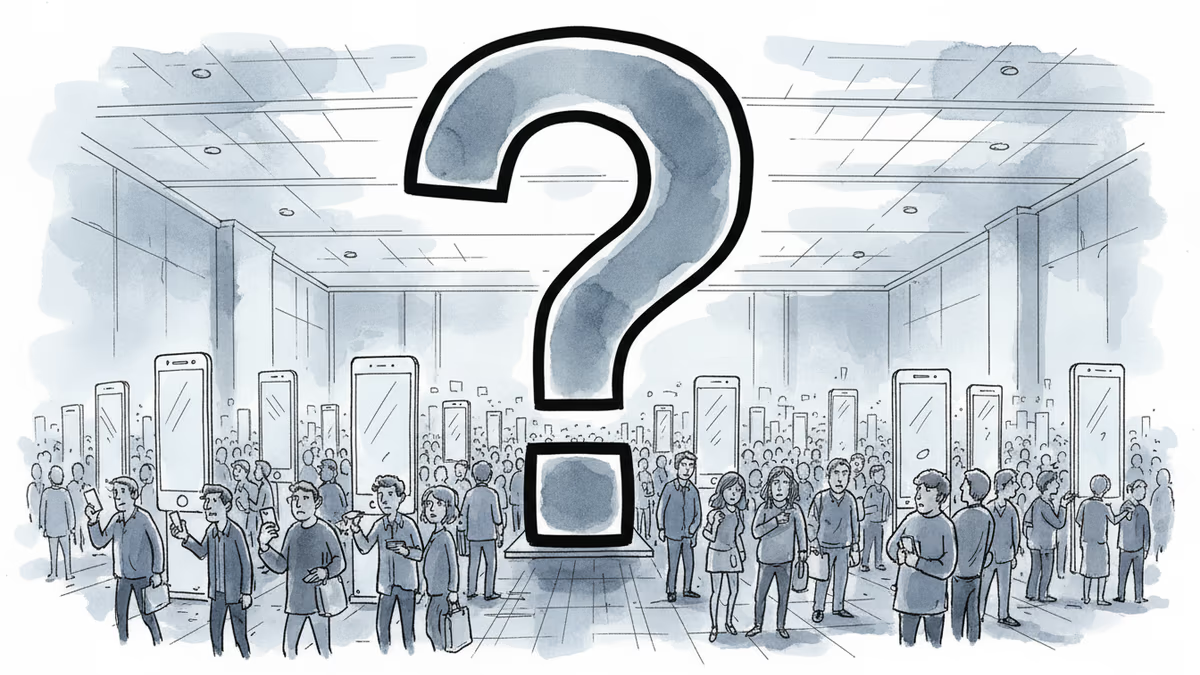
The Missing Trump Phone: What MWC's Silence Tells Us
Even at the world's largest mobile trade show, the Trump phone was nowhere to be found. What does this absence reveal about politics meeting tech?
100,000 attendees. Hundreds of booths. Zero Trump phones.
Last week's Mobile World Congress in Barcelona showcased the mobile industry's biggest names. Xiaomi unveiled new flagships, Honor demonstrated AI features, and Samsung dominated with massive displays. But one promised player was conspicuously absent: Trump Mobile.
This wasn't the first no-show. The Trump-branded network also missed CES earlier this year, leaving industry watchers wondering if the venture exists beyond press releases and social media buzz.
The Reality Check of Mobile Manufacturing
Launching a smartphone isn't like printing campaign merchandise. It requires securing manufacturing partners, negotiating carrier relationships, obtaining regulatory approvals, and building distribution networks. The timeline alone typically spans 2-3 years from concept to market.
The global smartphone market is dominated by just five companies controlling over 85% of sales: Samsung, Apple, Xiaomi, Oppo, and Vivo. Breaking into this oligopoly requires not just brand recognition, but billions in R&D investment and established supply chains.
Carriers Hold the Keys

In the US market, carrier approval is crucial. Verizon, AT&T, and T-Mobile control distribution channels and determine which devices reach consumers. These partnerships take years to develop and require proven track records in device support, security, and reliability.
Political branding adds another layer of complexity. Carriers typically avoid associating with partisan politics to maintain broad customer appeal. This creates a catch-22: without carrier support, mass market success is nearly impossible.
The Consumer Equation
Would Americans actually buy a Trump-branded phone? Brand loyalty in politics doesn't automatically translate to tech purchases. Consumers prioritize features, price, and ecosystem compatibility over political messaging.
Recent surveys show that 78% of smartphone buyers rank technical specifications and price as top factors, while brand ideology ranks much lower. Even strong political supporters often separate their voting preferences from purchasing decisions.
Industry Skepticism
Mobile industry executives we spoke with expressed doubt about politically-branded devices. "The smartphone market is brutally competitive," noted one carrier executive who requested anonymity. "Success requires deep technical expertise, not just marketing buzz."
The absence at MWC—where even small startups showcase prototypes—suggests the Trump phone may be more concept than reality. Major trade shows serve as credibility markers in the industry.
The answer may determine whether political tech ventures can ever move beyond the announcement stage.
Authors
Related Articles
MWC 2026 is reclaiming relevance as Chinese manufacturers and niche players drive smartphone innovation while major brands play it safe.
MWC 2026 promises breakthrough innovations from Xiaomi's European push to Honor's robot pivot. Here's what matters beyond the headlines.
Trump Mobile executives finally show their T1 phone after months of silence, revealing why specs keep changing and when it might actually launch.
Samsung Electronics' union branch revealed that 84% of survey respondents oppose the government's roughly $290 billion (₩400 trillion) semiconductor megaproject in Gwangju. Government, management, the union and shareholders are all reading the same national project in sharply different ways.
MWC 2026 is reclaiming relevance as Chinese manufacturers and niche players drive smartphone innovation while major brands play it safe.
MWC 2026 promises breakthrough innovations from Xiaomi's European push to Honor's robot pivot. Here's what matters beyond the headlines.
Trump Mobile executives finally show their T1 phone after months of silence, revealing why specs keep changing and when it might actually launch.
Samsung Electronics' union branch revealed that 84% of survey respondents oppose the government's roughly $290 billion (₩400 trillion) semiconductor megaproject in Gwangju. Government, management, the union and shareholders are all reading the same national project in sharply different ways.
Thoughts
Share your thoughts on this article
Sign in to join the conversation