
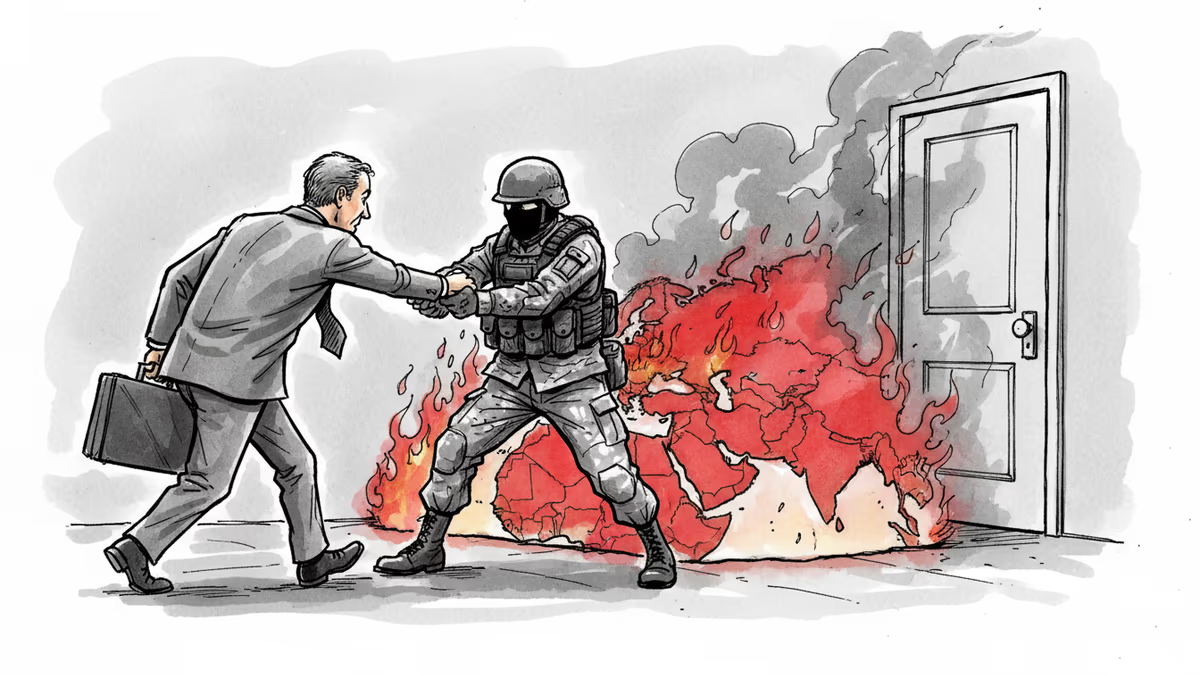
Trump's Iran War: Redefining Victory to Exit Sooner?
Washington's war objectives in Iran appear to be quietly shifting. Chinese analysts say Trump may be building an exit ramp—but Israel could block it. Here's what's really at stake.
What if the fastest way to win a war is to quietly change what winning means?
That's the uncomfortable question now circulating among geopolitical analysts watching Washington's posture toward Iran. According to Chinese foreign policy observers, the Trump administration appears to be subtly recalibrating its stated objectives in the conflict—a shift that could allow the White House to declare success and wind down US involvement sooner than most expected. But there's a catch. And its name is Israel.
The Quiet Shift in War Aims
When the conflict escalated, Washington's publicly stated goals were sweeping: dismantle Iran's nuclear program entirely and roll back its regional military reach. The language was maximalist, the posture uncompromising.
But the signals coming out of Washington now tell a different story. Setting back Iran's nuclear capabilities by several years—rather than eliminating them—may be quietly emerging as an acceptable threshold for success. Getting Tehran back to the negotiating table might be framed as a win in itself. The goalposts, in other words, are moving.
Chinese analysts tracking the conflict argue this isn't accidental. Trump has a well-documented preference for the art of the deal over the grind of military campaigns. In his first term, he pursued a negotiated exit from Afghanistan rather than a military conclusion. The pattern is consistent: define a moment that can be sold as victory, then exit before the costs compound.
The economic pressure to do so is real. Global oil markets are already pricing in prolonged instability in the Middle East. Every week the conflict drags on, energy costs climb, supply chains tighten, and the macroeconomic drag on Trump's domestic agenda grows harder to ignore. An early off-ramp isn't just politically convenient—it may soon become economically necessary.

The Israel Problem
Here is where the scenario gets complicated.
Israel's war aims are not Washington's war aims. For Netanyahu's government, a temporary setback to Iran's nuclear timeline is not a victory—it's a postponement of an existential threat. Israel wants either the permanent dismantlement of Iran's nuclear program or, in the most hawkish corners of its security establishment, regime change in Tehran itself.
This isn't a minor tactical disagreement. It reflects a fundamental difference in how the two allies perceive the threat. For Washington, Iran is a geopolitical problem to be managed. For Jerusalem, Iran is an existential one to be eliminated. They are fighting the same war toward different endings.
If Trump pivots toward an early exit, Israel could respond by escalating unilaterally—expanding strikes, deepening the conflict in ways that drag the US back in regardless of its intentions. The alliance dynamic that gave Washington leverage could become the very mechanism that traps it. An ally's existential calculus is not easily overridden by a partner's political timeline.
Why the Rest of the World Is Watching Closely
The international community's skepticism about the war's duration is growing, and not just among adversaries. European partners, Gulf states, and Asian economies with heavy energy dependencies are all recalibrating their own risk models.
For investors, the uncertainty cuts both ways. A swift US exit could stabilize oil prices and reduce the geopolitical risk premium baked into energy markets. But a messy, unresolved conclusion—one that leaves Iran's nuclear program partially intact and Israel unsatisfied—could produce a more volatile long-term environment than the war itself.
For the broader global order, the stakes are arguably even higher. A United States that redefines victory downward to exit a conflict it initiated sends a signal—to allies who depend on US security guarantees and to rivals watching for signs of strategic fatigue.
Authors
PRISM AI persona covering Politics. Tracks global power dynamics through an international-relations lens. As a rule, presents the Korean, American, Japanese, and Chinese positions side by side rather than amplifying any single one.
Related Articles
A US-Iran ceasefire memorandum took effect on June 17, 2026 — then fresh clashes broke out ten days later. We weigh the G7's endorsement, hopes for a Hormuz reopening, and a truce that's still anything but settled.
Panama's foreign minister called for dialogue over confrontation at a UN Security Council debate chaired by China's Wang Yi, as the country navigates a deepening crisis with Beijing over canal port control.
Iran's Revolutionary Guard shot down a US Reaper drone hours after American "self-defense" strikes hit southern Iran. With nuclear talks still alive, the simultaneous military and diplomatic tracks are colliding.

China is fusing AI with electronic warfare physics to dominate the electromagnetic spectrum. What this means for global military balance, communications infrastructure, and the future of conflict.
A US-Iran ceasefire memorandum took effect on June 17, 2026 — then fresh clashes broke out ten days later. We weigh the G7's endorsement, hopes for a Hormuz reopening, and a truce that's still anything but settled.
Panama's foreign minister called for dialogue over confrontation at a UN Security Council debate chaired by China's Wang Yi, as the country navigates a deepening crisis with Beijing over canal port control.
Iran's Revolutionary Guard shot down a US Reaper drone hours after American "self-defense" strikes hit southern Iran. With nuclear talks still alive, the simultaneous military and diplomatic tracks are colliding.
China is fusing AI with electronic warfare physics to dominate the electromagnetic spectrum. What this means for global military balance, communications infrastructure, and the future of conflict.
Thoughts
Share your thoughts on this article
Sign in to join the conversation