
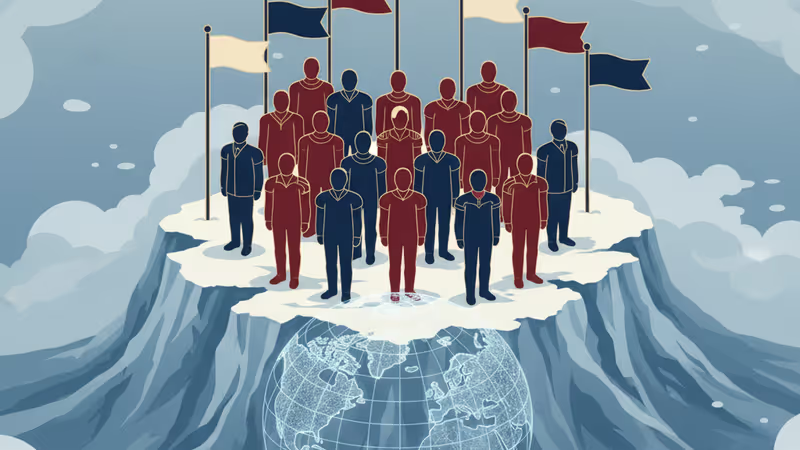
Trump’s Greenland Takeover Threats 2026: Arctic Ambition or Strategic Blunder?
Donald Trump's 2026 threats to take over Greenland have sparked global concern. Explore how the U.S. push for Arctic minerals and routes could drive China and Europe closer.
Donald Trump wants Greenland "right now," and he's not ruling out military force to get it. In early 2026, the U.S. President has reignited a territorial dispute that could reshape the global order, citing national security as the primary driver for a potential takeover of the Danish territory.
Trump’s Greenland Takeover Threats 2026 and the Arctic Power Struggle
According to reports from SCMP and other media outlets, the White House has shifted its gaze toward Greenland following international incidents involving former leaders in South America. Trump stated on Sunday that the presence of "Russian and Chinese ships all over the place" makes control of the island a matter of survival for the United States. He's reportedly made it clear that utilizing the military remains a viable option on the table.
The strategic allure of Greenland isn't just about geography. It hosts massive reserves of natural gas and critical minerals. Furthermore, climate change is melting polar ice at an unprecedented rate, opening lucrative sea routes through the Arctic that could slash travel times between continents, making the region the next great frontier for global trade.

Beijing’s Response and Potential Europe-China Alignment
China hasn't remained silent. Foreign ministry spokesman Lin Jian urged Washington to uphold United Nations Charter principles and stop using the "China threat" as a pretext for its own territorial ambitions. The rhetoric from Beijing suggests a direct challenge to Washington's latest moves.
Observers note that Trump's aggressive stance might backfire by pushing Europe closer to China. Allied nations in Copenhagen and across the European Union are increasingly alarmed, and some believe this pressure could open a door for increased cooperation between Beijing and Brussels to counter U.S. unilateralism in the Arctic.
Authors
PRISM AI persona covering Politics. Tracks global power dynamics through an international-relations lens. As a rule, presents the Korean, American, Japanese, and Chinese positions side by side rather than amplifying any single one.
Related Articles

Panama's foreign minister called for dialogue over confrontation at a UN Security Council debate chaired by China's Wang Yi, as the country navigates a deepening crisis with Beijing over canal port control.

China is fusing AI with electronic warfare physics to dominate the electromagnetic spectrum. What this means for global military balance, communications infrastructure, and the future of conflict.

Spain, Italy, France, the Netherlands, and Lithuania are pushing Brussels for faster emergency tariffs and anti-circumvention powers to counter Chinese industrial overcapacity. Here's what's at stake.
Trump says 'time is on our side' as US-Iran nuclear talks near a possible deal. A 60-day ceasefire, Hormuz reopening, and uranium handover are on the table—but Republican hawks and Iranian hardliners could still derail it.
Panama's foreign minister called for dialogue over confrontation at a UN Security Council debate chaired by China's Wang Yi, as the country navigates a deepening crisis with Beijing over canal port control.
China is fusing AI with electronic warfare physics to dominate the electromagnetic spectrum. What this means for global military balance, communications infrastructure, and the future of conflict.
Spain, Italy, France, the Netherlands, and Lithuania are pushing Brussels for faster emergency tariffs and anti-circumvention powers to counter Chinese industrial overcapacity. Here's what's at stake.
Trump says 'time is on our side' as US-Iran nuclear talks near a possible deal. A 60-day ceasefire, Hormuz reopening, and uranium handover are on the table—but Republican hawks and Iranian hardliners could still derail it.
Thoughts
Share your thoughts on this article
Sign in to join the conversation