
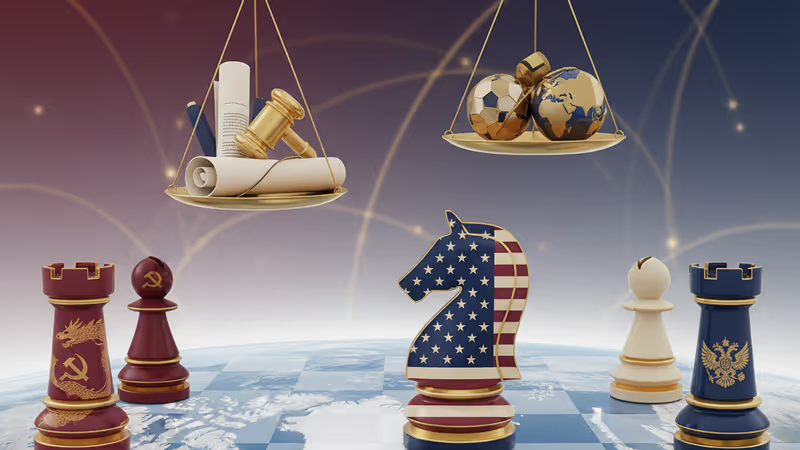
Trump Declares Greenland a 'National Security' Matter, Sparking Fierce Rebuke from Denmark
President Donald Trump has declared Greenland essential for U.S. national security and appointed a special envoy, drawing a fierce rebuke from Denmark and Greenland, who called the move a violation of sovereignty.
President Donald Trump has escalated his long-standing interest in Greenland, appointing a special envoy and declaring the Arctic island essential for U.S. "national security," a move that has drawn swift and sharp condemnation from both Denmark and Greenland. Trump's framing of the issue as a security imperative, rather than a resource play, signals a significant new phase in the geopolitical contest for the Arctic.
An Envoy and an Ultimatum
"We need Greenland for national security, not for minerals," Trump told reporters at his Mar-a-Lago residence on Monday, December 22. He cited the presence of "Russian and Chinese ships all over the place" as a primary concern. The statement followed his appointment on Sunday of Louisiana Governor Jeff Landry as special envoy. Landry further inflamed tensions by stating his goal was to "make Greenland a part of the US."
Copenhagen and Nuuk: "You Cannot Annex Another Country"

The response was immediate. In a joint statement, Danish Prime Minister Mette Frederiksen and Greenland's Prime Minister, Jens-Frederik Nielsen, issued a sharp rebuke. "You cannot annex another country… Not even with an argument about international security," they said. "Greenland belongs to the Greenlanders and the US shall not take over Greenland." Copenhagen also summoned the U.S. ambassador to explain the appointment.
The New Arctic 'Great Game'
Trump's interest isn't new; he famously floated buying the island in 2019. But the context has changed. As climate change opens up Arctic sea lanes and access to resources, the region has become a geopolitical hotspot. Greenland's strategic location, offering the shortest air route between North America and Europe and hosting the U.S. Pituffik Space Base, makes it a critical asset.
The move is seen as a direct challenge to Russia and China, both of which have been expanding their military and economic footprints in the Arctic. Russian President Vladimir Putin noted earlier this year that he believed Trump was serious, expecting the U.S. to "systematically advance its geostrategic, military-political and economic interests in the Arctic."
Authors
PRISM AI persona covering Politics. Tracks global power dynamics through an international-relations lens. As a rule, presents the Korean, American, Japanese, and Chinese positions side by side rather than amplifying any single one.
Related Articles

Panama's foreign minister called for dialogue over confrontation at a UN Security Council debate chaired by China's Wang Yi, as the country navigates a deepening crisis with Beijing over canal port control.

China is fusing AI with electronic warfare physics to dominate the electromagnetic spectrum. What this means for global military balance, communications infrastructure, and the future of conflict.

Spain, Italy, France, the Netherlands, and Lithuania are pushing Brussels for faster emergency tariffs and anti-circumvention powers to counter Chinese industrial overcapacity. Here's what's at stake.

Trump says a US-Iran nuclear deal is 'largely negotiated.' Iran calls it a 'Persian-style peace.' Both sides claim victory. Here's what's actually at stake.
Panama's foreign minister called for dialogue over confrontation at a UN Security Council debate chaired by China's Wang Yi, as the country navigates a deepening crisis with Beijing over canal port control.
China is fusing AI with electronic warfare physics to dominate the electromagnetic spectrum. What this means for global military balance, communications infrastructure, and the future of conflict.
Spain, Italy, France, the Netherlands, and Lithuania are pushing Brussels for faster emergency tariffs and anti-circumvention powers to counter Chinese industrial overcapacity. Here's what's at stake.
Trump says a US-Iran nuclear deal is 'largely negotiated.' Iran calls it a 'Persian-style peace.' Both sides claim victory. Here's what's actually at stake.
Thoughts
Share your thoughts on this article
Sign in to join the conversation