
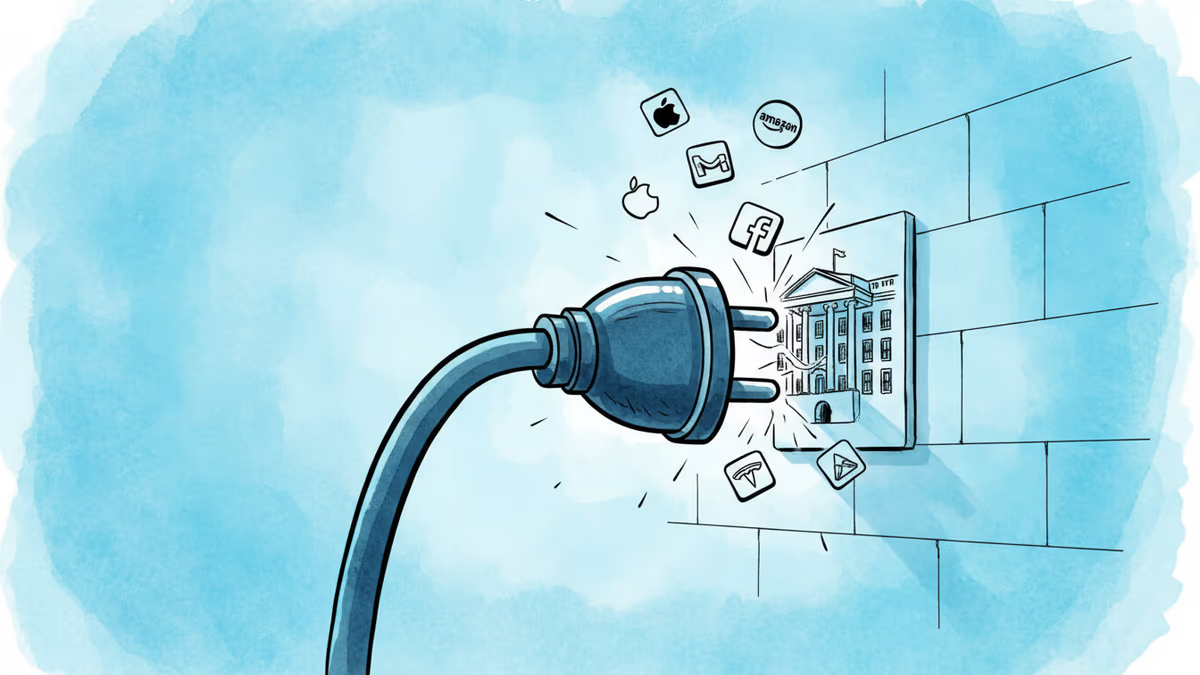
Trump's Electric Bill Promise Hinges on Big Tech Footing the Power
Trump's pledge to cut electricity costs relies on Amazon, Google, Meta and 4 other tech giants signing a rate protection deal March 4th. Can Silicon Valley solve America's power crunch?
America's $400 billion electricity market just got a presidential ultimatum. Donald Trump's State of the Union promise to slash power bills hinges on seven tech titans agreeing to pay their own way—literally.
Next Tuesday, CEOs from Amazon, Google, Meta, Microsoft, xAI, Oracle, and OpenAI will gather at the White House to sign what Trump calls a "rate payer protection pledge." The deal: stop freeloading off the grid and start building your own power plants.
The Math Behind the Squeeze
The numbers tell a stark story. A single ChatGPT query consumes 10 times more electricity than a Google search. As AI explodes, data centers now gobble up 4% of U.S. electricity—projected to hit 9% by 2030. That's roughly equivalent to powering the entire state of California.
Meanwhile, residential electricity rates have climbed 28% since 2020. Trump's betting Americans will blame Big Tech for their rising bills, and he's probably right.
But here's the catch: the pledge remains a black box. No details on how much power companies must generate, what penalties await violators, or who enforces compliance. It's political theater with a TBD script.
Silicon Valley's Power Play Dilemma

Tech giants face a classic prisoner's dilemma. Go solo on power generation and shoulder massive upfront costs, or keep drawing from the grid and risk regulatory backlash.
Microsoft is already hedging its bets, investing in nuclear plant restarts and small modular reactors. Google has inked massive renewable energy contracts. But building power plants takes 5-7 years—AI data centers need electricity now.
The economics get messier. A typical data center requires 30-50 megawatts of continuous power. That's enough to run 25,000 homes. For tech companies burning through billions on AI development, adding power plant construction to their to-do list feels like mission creep.
The Regulatory Wild Card
Trump's pledge sidesteps a bigger question: should private companies control critical infrastructure? If Amazon owns both cloud services and power plants, its market dominance becomes even more entrenched.
State utility regulators are watching nervously. Texas and Virginia—major data center hubs—already struggle with grid stability. Adding corporate-owned power plants to the mix could either solve capacity crunches or create new coordination headaches.
Environmental groups remain split. Some applaud tech companies' renewable commitments; others worry about accelerated energy consumption regardless of the source.
Authors
Related Articles
Google's Gmail Live lets you ask your inbox questions out loud. Announced at I/O 2026, it's AI's pitch to skeptics — and a reminder of how much Google already knows about you.
OpenAI has reorganized for the second time in a month, merging ChatGPT and Codex into a single agentic platform under president Greg Brockman's unified product leadership.
AI sustainability researcher Sasha Luccioni is launching a new venture to push for energy transparency in AI. Here's why Big Tech keeps the numbers hidden—and what's starting to change.
Josh D'Amaro took over Disney with a bold Disney Plus vision. Days later, he's in a First Amendment fight with the Trump administration over The View. What does this mean for media freedom?
Google's Gmail Live lets you ask your inbox questions out loud. Announced at I/O 2026, it's AI's pitch to skeptics — and a reminder of how much Google already knows about you.
OpenAI has reorganized for the second time in a month, merging ChatGPT and Codex into a single agentic platform under president Greg Brockman's unified product leadership.
AI sustainability researcher Sasha Luccioni is launching a new venture to push for energy transparency in AI. Here's why Big Tech keeps the numbers hidden—and what's starting to change.
Josh D'Amaro took over Disney with a bold Disney Plus vision. Days later, he's in a First Amendment fight with the Trump administration over The View. What does this mean for media freedom?
Thoughts
Share your thoughts on this article
Sign in to join the conversation