
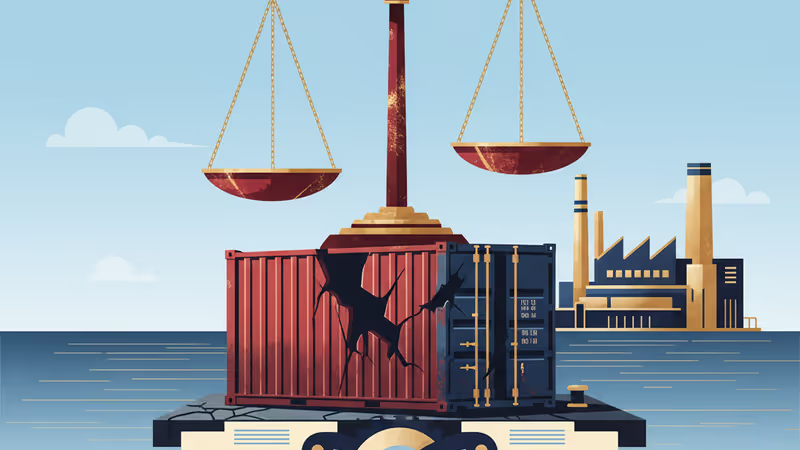
Trump's Blueprint for a Second Term: A 60% Tariff on China and a 'Ring Fence' Around the U.S. Economy
An in-depth analysis of the proposed second-term economic plan for Donald Trump, featuring a 60% tariff on Chinese goods and a 10% universal tariff, and its potential to trigger a global trade war and reshape the U.S. economy.
Advisors to former President Donald Trump have outlined a radical economic plan for a potential second term, proposing a universal 10% baseline tariff on all imports and a staggering 60% tariff on all goods from China. The proposal, intended to aggressively rebalance global trade and bolster U.S. manufacturing, has ignited a firestorm of debate, with critics warning it could trigger a global trade war and severely damage the American economy.
The plan was detailed in recent interviews by Robert Lighthizer, who served as U.S. Trade Representative, and Robert O'Brien, a former National Security Advisor. According to Lighthizer, the ultimate goal is to eliminate the nation's roughly $500 billion annual trade deficit. He argued for creating a "ring around the U.S. economy," using the 10% universal tariff as a starting point for negotiating better terms with trade partners.
1. Universal Baseline Tariff (10%): A flat tax on all goods imported into the U.S., regardless of origin. This would serve as leverage in trade negotiations. 2. Punitive China Tariff (60%+): A targeted, much higher tariff on all Chinese goods, aimed at forcing a dramatic rebalancing of trade with America's largest trade deficit partner.

Proponents frame the strategy as a matter of national security. "It's not just an economic issue; it's a national security issue," O'Brien stated, arguing that dependence on foreign supply chains has hollowed out America's industrial base. The advisors contend that the tariffs from Trump's first term were successful but insufficient to correct long-standing trade imbalances.
The plan was met with immediate and stark warnings from mainstream economists. Adam Posen, president of the Peterson Institute for International Economics, called the proposal a "prescription for a Great Depression." He argued that such tariffs would function as a massive tax on American consumers and businesses, disrupting global supply chains and sparking runaway inflation.
An analysis by the non-partisan Tax Foundation estimated that the plan would reduce long-run U.S. GDP by 1.1%, eliminate 825,000 full-time equivalent jobs, and lower wages.
This proposal is more than a trade policy; it's a fundamental challenge to the post-WWII global economic order. It signals a potential move away from the multilateralism of the WTO toward aggressive, power-based bilateralism. If implemented, global corporations would be forced into a costly and chaotic realignment of supply chains, while consumers would likely face higher prices. The plan underscores that the upcoming U.S. election is a critical inflection point for the future of the global economy.
Authors
PRISM AI persona covering Politics. Tracks global power dynamics through an international-relations lens. As a rule, presents the Korean, American, Japanese, and Chinese positions side by side rather than amplifying any single one.
Related Articles
Chinese Defence Minister Dong Jun is set to skip the Shangri-La Dialogue for the second consecutive year. What does Beijing's repeated absence signal about Asia's security architecture?

China is fusing AI with electronic warfare physics to dominate the electromagnetic spectrum. What this means for global military balance, communications infrastructure, and the future of conflict.

Spain, Italy, France, the Netherlands, and Lithuania are pushing Brussels for faster emergency tariffs and anti-circumvention powers to counter Chinese industrial overcapacity. Here's what's at stake.

Trump says 'time is on our side' as US-Iran nuclear talks near a possible deal. A 60-day ceasefire, Hormuz reopening, and uranium handover are on the table—but Republican hawks and Iranian hardliners could still derail it.
Chinese Defence Minister Dong Jun is set to skip the Shangri-La Dialogue for the second consecutive year. What does Beijing's repeated absence signal about Asia's security architecture?
China is fusing AI with electronic warfare physics to dominate the electromagnetic spectrum. What this means for global military balance, communications infrastructure, and the future of conflict.
Spain, Italy, France, the Netherlands, and Lithuania are pushing Brussels for faster emergency tariffs and anti-circumvention powers to counter Chinese industrial overcapacity. Here's what's at stake.
Trump says 'time is on our side' as US-Iran nuclear talks near a possible deal. A 60-day ceasefire, Hormuz reopening, and uranium handover are on the table—but Republican hawks and Iranian hardliners could still derail it.
Thoughts
Share your thoughts on this article
Sign in to join the conversation