
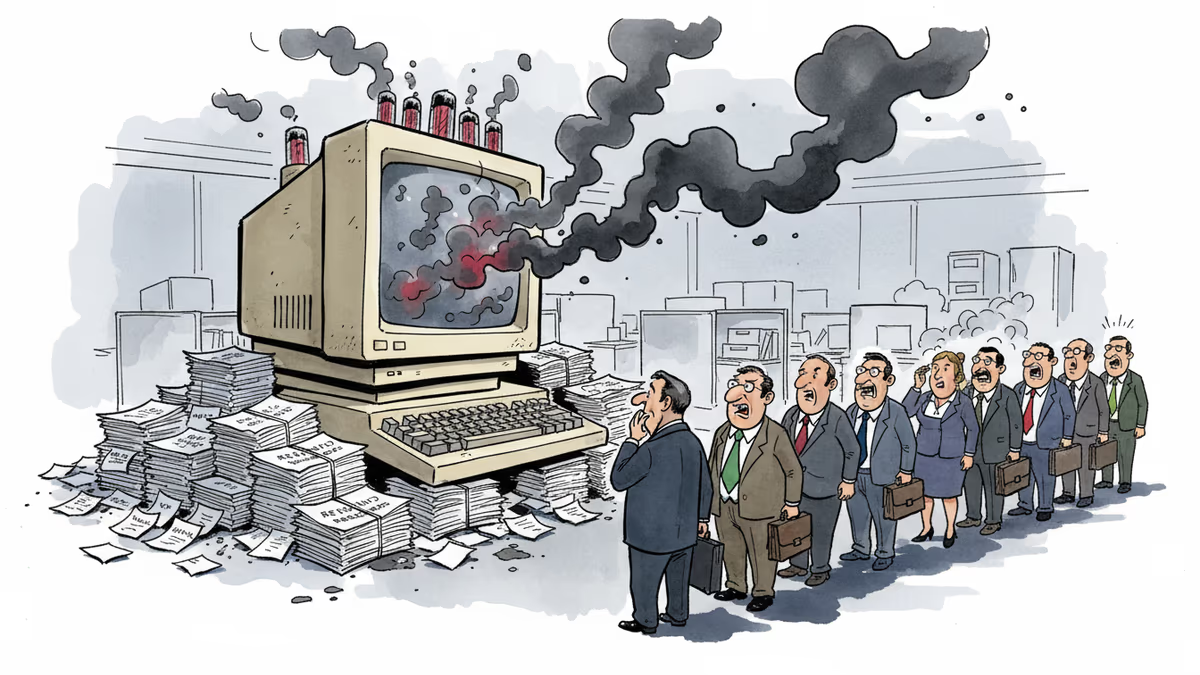
When Courts Order Billions in Refunds But Government Says "System Can't Handle It
US Customs admits its decades-old system can't process billions in Trump tariff refunds despite Supreme Court ruling. What happens when analog government meets digital-age commerce?
The math is simple: billions of dollars in wrongfully collected tariffs need to be refunded. The execution? Not so much.
The US Customs and Border Protection (CBP) just told a federal court it cannot comply with orders to process massive refunds from Trump-era tariffs. The reason isn't political—it's technological. Their digital import system, as executive director Brandon Lord admitted Friday, is "not well suited to a task of this scale."
We're talking about tens of billions in refunds with interest, affecting thousands of importers who paid tariffs later deemed unconstitutional by the Supreme Court.
When Legal Victory Meets Technical Reality
Last month's Supreme Court ruling was clear: Trump's tariffs under the International Emergency Economic Powers Act were unconstitutional. This week, the International Trade Court ruled that affected importers deserve their money back—with interest.
Legally, it's settled. Practically? That's another story.
CBP's current system was designed for individual refund cases, not mass processing of hundreds of thousands of transactions spanning multiple years. Think of it as asking a calculator to run Netflix—technically both involve numbers, but the scale is impossibly different.
The Ripple Effect Across Industries
This isn't just about government inefficiency. Real businesses are waiting for real money.

Tech companies that import components from Asia. Auto manufacturers who paid tariffs on steel and aluminum. Retailers who absorbed costs on Chinese goods. Many have already written off these expenses as sunk costs, restructured their supply chains, or passed costs to consumers.
Now they're told they were right all along—but getting their money back is a different challenge entirely.
Some companies have already folded under the tariff burden. Others downsized or relocated operations. For them, a refund years later feels like justice served cold—if it comes at all.
The Analog Government Problem
Here's the deeper issue: we live in an era where a teenager can build an app that processes millions of transactions, but the world's largest economy can't refund money it admits it shouldn't have collected.
This isn't unique to customs. The IRS faced similar challenges during pandemic relief distribution. State unemployment systems crashed under COVID-19 claims. Social Security still runs on COBOL code from the 1960s.
The pattern is clear: government systems built for a simpler time are breaking under modern complexity.
What Happens Next?
CBP will likely request months or years to upgrade their systems—time that businesses don't have. Some may settle for partial refunds just to get something. Others will sue for additional damages caused by the delay.
Meanwhile, this case sets a precedent. What happens when other mass government errors need correction? Climate regulations that get overturned? Healthcare policies that require retroactive adjustments?
The question isn't just about tariff refunds—it's about whether our institutions can keep pace with the complexity they've created.
Authors
Related Articles
Nintendo has filed a lawsuit against the US government over Trump's tariffs, demanding refunds with interest. This legal battle reveals deeper questions about trade policy and corporate rights.
Supreme Court rules 6-3 that Trump lacked authority for emergency tariffs. Billions in paid tariffs now face legal challenges as businesses seek refunds

Summit Group enters the Bangladesh data center market. Chairman Muhammed Aziz Khan reveals plans for its first project within a year, leveraging existing fiber networks.
Five stories from late September, traced to where the paper trail stops: Korea's export record, Nvidia's Hugging Face 8-K, a US-China AI channel, the UN on AI, and rising births.
Nintendo has filed a lawsuit against the US government over Trump's tariffs, demanding refunds with interest. This legal battle reveals deeper questions about trade policy and corporate rights.
Supreme Court rules 6-3 that Trump lacked authority for emergency tariffs. Billions in paid tariffs now face legal challenges as businesses seek refunds
Summit Group enters the Bangladesh data center market. Chairman Muhammed Aziz Khan reveals plans for its first project within a year, leveraging existing fiber networks.
Five stories from late September, traced to where the paper trail stops: Korea's export record, Nvidia's Hugging Face 8-K, a US-China AI channel, the UN on AI, and rising births.
Thoughts
Share your thoughts on this article
Sign in to join the conversation