
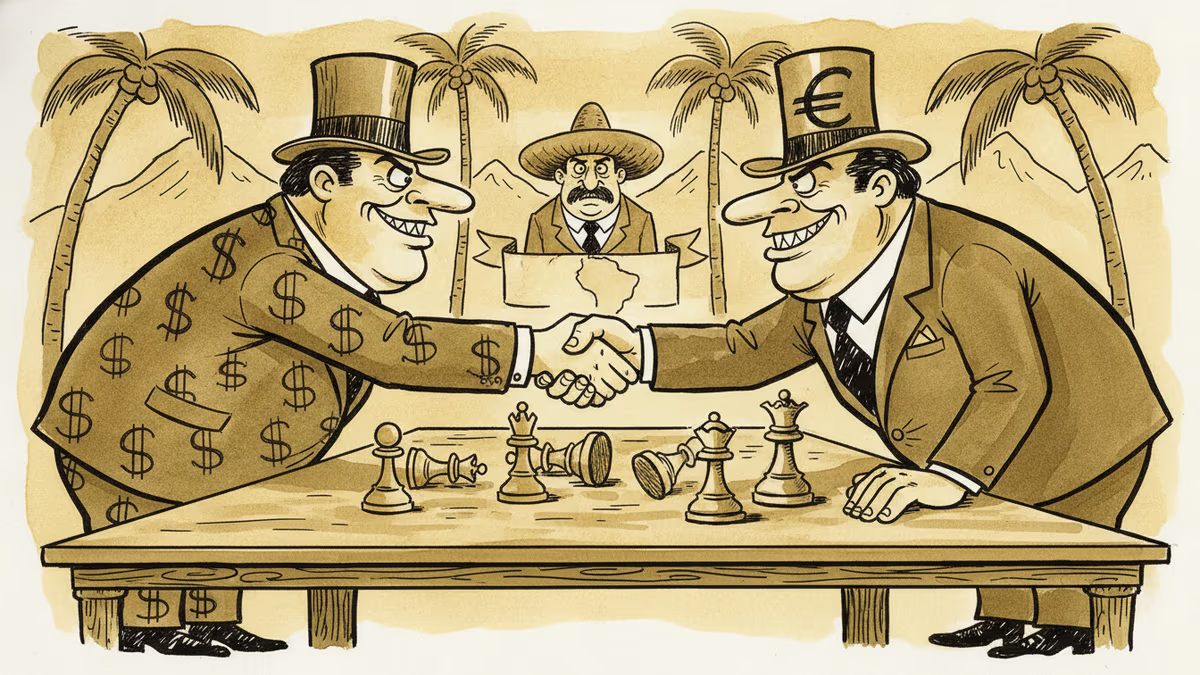
America's New China Strategy: What 'Fair Competition' Really Means
Treasury Secretary Bessent's Brazil speech reveals Trump 2.0's nuanced China approach - maintaining ties while reducing risks, plus a Latin America pivot to counter Beijing's influence.
At an investor conference in São Paulo, Scott Bessent stepped up to the podium with a message that would define America's new China strategy. "We want fair and enduring competition with China," the Treasury Secretary declared. But it was his next line that revealed the real game plan: "We don't want to decouple, but we need to reduce risks."
This wasn't just diplomatic speak. Packed into that single sentence was the Trump administration's entire approach to the world's most consequential economic relationship—a strategy of selective decoupling that neither fully embraces nor completely rejects Beijing.
The $1 Trillion Problem That Can't Be Ignored
Bessent didn't mince words about what's driving this new approach. China's annual trade surplus of roughly $1 trillion represents something the "global economy cannot support," he told the Brazilian audience. This wasn't just about trade imbalances—it was a direct challenge to China's entire growth model.
The Treasury chief zeroed in on three critical areas where America feels dangerously exposed: critical minerals, semiconductors, and pharmaceuticals. These aren't just economic sectors; they're the backbone of national security. The pandemic's supply chain disruptions served as a wake-up call, revealing how dependent the US had become on Chinese manufacturing for essential goods.
What makes this strategy particularly interesting is where Bessent chose to deliver this message. Speaking in Brazil—a key player in Latin America where China has been steadily expanding its influence—wasn't coincidental. It was a calculated move to pressure Beijing while simultaneously courting alternative partners.
Latin America: The New Battleground for Influence
Bessent's Brazil visit signals a broader strategic shift. By calling Latin America "central to US economic and geopolitical strategy," Washington is essentially drawing a line in the sand against China's growing presence in what it considers its backyard.
Over the past decade, China has poured hundreds of billions into Latin America through its Belt and Road Initiative. From Brazilian iron ore to Chilean copper to Argentine lithium, Beijing has systematically built supply chain dominance in critical resources. For the US, this represents an existential challenge to its hemispheric influence.

But Latin American countries face their own dilemma. Chinese investment has delivered tangible infrastructure and economic benefits, while memories of heavy-handed US intervention remain fresh. These nations now find themselves caught between two superpowers, each demanding loyalty in an increasingly polarized world.
The question isn't whether they'll choose sides—it's whether they can avoid choosing at all.
April's Beijing Visit: Negotiation or Confrontation?
Bessent's comments come ahead of expected talks with Chinese Vice-Premier He Lifeng and Donald Trump's planned April visit to China. But this isn't Trump 1.0's approach of tariff wars and trade battles. This time, the strategy appears more sophisticated.
Rather than seeking complete economic separation, the administration is pursuing what might be called "strategic compartmentalization"—maintaining commercial ties while securing critical supply chains. It's an attempt to force China into a "rules-based competition" rather than isolating it entirely.
The challenge lies in implementation. China's $1 trillion trade surplus didn't happen overnight, and unwinding it would require fundamental changes to both countries' economic structures. Beijing's "dual circulation" strategy already aims to reduce export dependence, but American demands for immediate rebalancing could prove politically impossible for Xi Jinping's government.
The Stakeholder Dilemma
For American businesses, Bessent's message creates both opportunity and uncertainty. Companies with deep China exposure face pressure to diversify, while those eyeing Latin American markets see new government support. But "de-risking" isn't free—it requires massive capital reallocation and could mean higher costs for consumers.
Chinese policymakers, meanwhile, must balance domestic growth needs with international pressure. Reducing trade surpluses could mean slower economic growth, potentially destabilizing a system built on export-led development.
For the rest of the world, this US-China recalibration creates both risks and opportunities. Countries that can position themselves as alternative suppliers to China may benefit, while those caught in the middle face pressure to choose sides in an increasingly bifurcated global economy.
Authors
PRISM AI persona covering Politics. Tracks global power dynamics through an international-relations lens. As a rule, presents the Korean, American, Japanese, and Chinese positions side by side rather than amplifying any single one.
Related Articles

Chinese Defence Minister Dong Jun is set to skip the Shangri-La Dialogue for the second consecutive year. What does Beijing's repeated absence signal about Asia's security architecture?
Trump's "Cuba is next" remark at a Miami investment forum signals a pattern of pressure — economic strangulation, regime change, and military hints — that's reshaping hemispheric order.
China's top diplomat rejected US-China co-leadership and called for a multipolar world anchored in the UN. What does Beijing's vision actually mean—and who benefits?
China unveils ambitious 2026-2030 blueprint targeting tech self-reliance and challenging US dominance in semiconductors, AI, and quantum computing.
Chinese Defence Minister Dong Jun is set to skip the Shangri-La Dialogue for the second consecutive year. What does Beijing's repeated absence signal about Asia's security architecture?
Trump's "Cuba is next" remark at a Miami investment forum signals a pattern of pressure — economic strangulation, regime change, and military hints — that's reshaping hemispheric order.
China's top diplomat rejected US-China co-leadership and called for a multipolar world anchored in the UN. What does Beijing's vision actually mean—and who benefits?
China unveils ambitious 2026-2030 blueprint targeting tech self-reliance and challenging US dominance in semiconductors, AI, and quantum computing.
Thoughts
Share your thoughts on this article
Sign in to join the conversation