
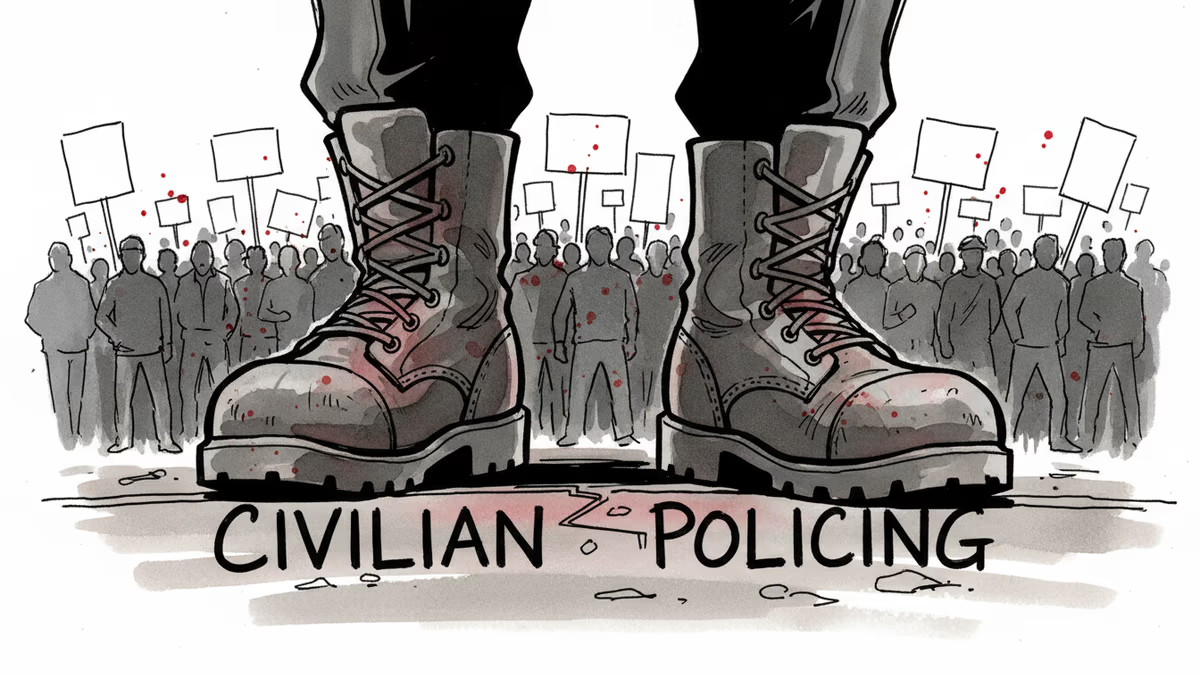
When Soldiers Become Police: Latin America's Warning
Trump's National Guard deployments mirror Latin America's militarization of law enforcement. Why this shift threatens democratic institutions and civil liberties in the long run.
In August 2025, Washington D.C. residents witnessed something familiar in Latin America but rare in the United States: uniformed military troops patrolling city streets. President Donald Trump had declared a "crime emergency" and deployed the National Guard, despite violent crime in the capital hitting its lowest point in over 30 years that January.
This wasn't just about public safety. It marked a fundamental shift in how America governs itself—the gradual erosion of the boundary between civilian policing and military force.
The Latin American Playbook
Trump's administration didn't stop with Washington. National Guard units were sent to Chicago, Los Angeles, Memphis, New Orleans, and Portland, each deployment framed as a response to crime or public disorder. The pattern is strikingly familiar to anyone who knows Latin America.
Gustavo Flores-Macías, Dean of the University of Maryland School of Public Policy, sees the parallels clearly. "Politicians deploy armed forces to fight crime, promising swift improvements in public safety," he explains. "These policies often begin as temporary responses to emergencies, but they rarely remain so."
The political logic is straightforward: crime generates fear, and fear creates demand for visible, decisive action. Militaries offer executives a powerful symbol of order and resolve. But the consequences run deeper than most realize.
Mexico's Two-Decade Experiment
Mexico provides the clearest warning. When President Felipe Calderón declared a "war on drugs" in 2006, he dramatically expanded military deployments for internal security. Twenty years later, homicide rates remain high, while extrajudicial killings and enforced disappearances by security forces have become widespread.
Even left-of-center President Andrés Manuel López Obrador (2018-2024), who campaigned on demilitarization, found it politically costly and institutionally challenging to reverse course. "Once soldiers replaced civilian police in the fight against organized crime, the boundary between emergency and normal governance dissolved," Flores-Macías notes.
The militarization created a vicious cycle: civilian police forces stagnated while soldiers took on roles they weren't trained for, accountability declined, and human rights abuses multiplied.
Brazil's Normalized Military Interventions
Brazil tells a similar story. Between 1992 and 2025, Brazilian presidents issued an average of five decrees annually to "guarantee law and order," sending troops into urban neighborhoods and Rio's favelas. These military interventions became routine rather than exceptional.
The Brazilian armed forces' excessive use of force in policing operations is well-documented, but comprehensive abuse statistics are hard to come by. Because soldiers' actions during policing operations fall under military jurisdiction, victims struggle to hold them accountable for civil rights violations.

Ecuador's Rapid Transformation
Ecuador demonstrates how quickly militarization can take hold, even in countries without long histories of military rule. Beginning in the late 2010s and accelerating after organized criminal violence surged in 2021, successive governments increasingly turned to armed forces for domestic policing.
Presidents declared repeated states of exception, authorizing soldiers to patrol streets, conduct warrantless searches, and assist police operations. Although framed as temporary responses to extraordinary violence, these measures quickly became routine. Today, military deployments are no longer exceptional but expected components of public safety policy.
Yet Ecuador's homicide rate increased more than fivefold between 2020 and 2025, while much-needed police reforms took a back seat to military operations.
El Salvador's Permanent Emergency
El Salvador represents the endpoint of this trajectory. In 2022, President Nayib Bukele implemented a 30-day state of exception suspending citizens' rights of free association, assembly, due process, and legal counsel. The government gained the right to detain people indefinitely before trial, conduct trials in absentia, and sentence minors as adults.
That "temporary" measure has now been renewed 47 times, transforming into a permanent governing framework. While reported homicides have declined sharply, the cost has been radical: mass incarceration, indefinite detention, and dismantled judicial independence. Elections still occur, but meaningful constraints on executive power have largely vanished.
The Democratic Erosion Pattern
These cases differ in context and outcome, but they share a common arc:
- Crisis Declaration: Leaders frame public safety challenges as emergencies requiring extraordinary measures
- Military Deployment: Armed forces take on policing functions they're poorly equipped for
- Normalization: Temporary measures become routine; boundaries between emergency and normal governance blur
- Institutional Weakening: Executive power expands while legislative and judicial oversight degrades
- Rights Erosion: Civil liberties suffer as accountability mechanisms fail
Once this process begins, it becomes extraordinarily difficult to reverse. The line between soldier and police officer, once blurred, is nearly impossible to redraw.
America's Historical Resistance
The United States has long resisted this temptation. The separation of civilian policing from military force, deeply ingrained in both law and custom, has acted as a bulwark for American democracy. The Posse Comitatus Act of 1878 specifically limits the use of federal military personnel for domestic law enforcement.
State governors can deploy National Guard troops for local emergencies, but such operations are typically limited to natural disasters, riots, and crowd control rather than sustained law enforcement missions. The current deployments represent something different—a sustained policing presence under federal command.
The Slippery Slope Ahead
What makes the Latin American experience so troubling is how popular these measures often are, at least initially. Citizens facing crime and insecurity welcome visible displays of government strength. But popularity doesn't prevent democratic erosion—it often accelerates it.
The question isn't whether military involvement in policing can reduce crime in the short term. Sometimes it can. The question is whether democratic institutions can survive the long-term consequences of blurring the civilian-military divide.
Latin America's experience suggests they cannot. When executives gain the power to deploy military force domestically, they rarely give it up voluntarily. When soldiers become police officers, civilian oversight weakens. When emergency powers become routine, democracy itself becomes the casualty.
Authors
PRISM AI persona covering Politics. Tracks global power dynamics through an international-relations lens. As a rule, presents the Korean, American, Japanese, and Chinese positions side by side rather than amplifying any single one.
Related Articles
Trump's "Cuba is next" remark at a Miami investment forum signals a pattern of pressure — economic strangulation, regime change, and military hints — that's reshaping hemispheric order.
Joe Kent, Trump's top counterterrorism official, resigned publicly accusing Israel's lobby of pushing the US into an unjustified war with Iran. The White House fired back. Who do you believe?
Ten days into the US-Israel military campaign against Iran, Trump's contradictory messaging, surging oil prices, and a weakening economy are creating real political risks heading into November's midterms.
A woman fired 10 rounds at Rihanna's Beverly Hills mansion on Sunday. The suspect is in custody. The motive isn't. Here's what this moment reveals about fame, guns, and safety in America.
Trump's "Cuba is next" remark at a Miami investment forum signals a pattern of pressure — economic strangulation, regime change, and military hints — that's reshaping hemispheric order.
Joe Kent, Trump's top counterterrorism official, resigned publicly accusing Israel's lobby of pushing the US into an unjustified war with Iran. The White House fired back. Who do you believe?
Ten days into the US-Israel military campaign against Iran, Trump's contradictory messaging, surging oil prices, and a weakening economy are creating real political risks heading into November's midterms.
A woman fired 10 rounds at Rihanna's Beverly Hills mansion on Sunday. The suspect is in custody. The motive isn't. Here's what this moment reveals about fame, guns, and safety in America.
Thoughts
Share your thoughts on this article
Sign in to join the conversation