
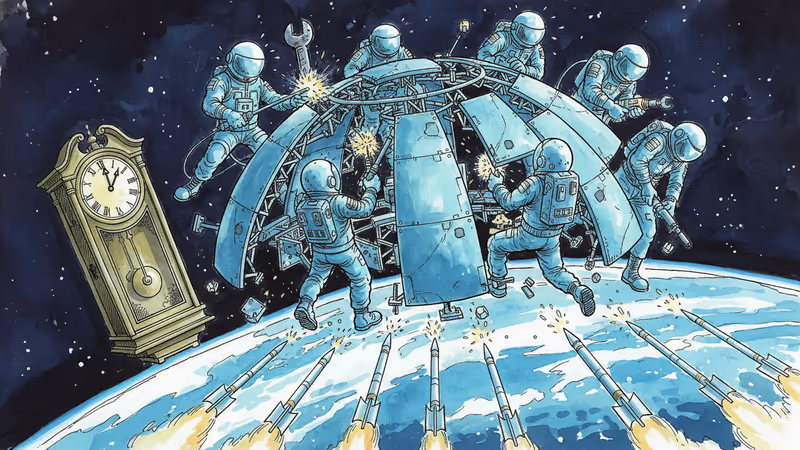
America's Space Shield: A Three-Year Race Against Rising Threats
US military plans ambitious Golden Dome missile defense system by 2028, promising nationwide protection against ICBMs, hypersonics, and emerging aerial threats in space-based network.
By summer 2028, every American city could be protected by an invisible shield in space. That's the bold promise from General Michael Guetlein, who's overseeing the Pentagon's most ambitious defense project since the Strategic Defense Initiative of the 1980s.
The Golden Dome missile defense system represents a fundamental shift in how America protects itself. Unlike ground-based interceptors that wait for incoming threats, this space-based network would detect and destroy missiles, hypersonic weapons, and drones before they reach U.S. airspace.
Racing Against the Clock
Guetlein's timeline is breathtakingly aggressive. Three years to deploy a constellation of space-based sensors and interceptors that can defend against the full spectrum of modern aerial threats—from traditional ICBMs to cutting-edge hypersonic gliders that can maneuver at five times the speed of sound.
The general's presentation to defense industry representatives last Friday outlined a two-phase approach. The initial deployment by 2028 would provide nationwide coverage against ballistic missiles and "other generation aerial threats." The system would then expand through 2035, presumably adding more sophisticated capabilities and denser coverage.
This timeline coincides precisely with Donald Trump's presidential term, suggesting the project carries significant political momentum. The previous Trump administration championed space-based missile defense, and this accelerated schedule indicates renewed commitment to the concept.
Beyond Traditional Threats
What makes Golden Dome particularly intriguing is its scope. Traditional missile defense systems focus primarily on ballistic threats—predictable trajectories that follow the laws of physics. But Guetlein specifically mentioned protection against cruise missiles, hypersonic weapons, and drones.

This broader mission reflects how warfare has evolved. China's hypersonic glide vehicles can change course mid-flight, making them nearly impossible to intercept with conventional systems. Russia's nuclear-powered cruise missiles can loiter for extended periods before striking. Even non-state actors now deploy sophisticated drone swarms.
A space-based defense network offers unique advantages: global coverage, reduced response times, and the ability to engage threats during their most vulnerable boost phase. But it also presents unprecedented technical challenges.
The Engineering Challenge
Building a space-based missile defense system isn't just difficult—it's the kind of engineering challenge that has humbled previous generations of defense planners. The system must coordinate dozens of satellites, process massive amounts of sensor data in real-time, and execute split-second intercepts in the vacuum of space.
Consider the physics: a hypersonic weapon traveling at Mach 5 covers roughly one mile per second. The time between detection and impact could be measured in minutes, not hours. Every component—from sensors to communication links to interceptor missiles—must function flawlessly under these constraints.
The cost implications are staggering. While Guetlein didn't mention specific budget figures, similar programs have historically consumed tens of billions of dollars. The Ground-based Midcourse Defense system, which protects against a limited ICBM threat, has cost over $40 billion since 2002 and provides coverage for only part of the continental United States.
International Implications
America's space-based missile defense ambitions won't exist in a vacuum. China and Russia have both invested heavily in anti-satellite weapons, viewing U.S. space assets as high-value targets. A comprehensive missile defense system would likely accelerate their development of countermeasures.
The system could also complicate arms control efforts. Previous missile defense deployments have prompted adversaries to build more offensive weapons, creating a classic security dilemma. If Golden Dome appears too effective, it might incentivize rivals to develop new classes of weapons specifically designed to overwhelm or circumvent space-based defenses.
Allied nations will watch closely as well. Countries under U.S. security guarantees might question whether American missile defense reduces their own protection. Conversely, nations facing ballistic missile threats from regional adversaries might seek similar space-based capabilities.
Authors
Related Articles
Anthropic CEO challenges Defense Department's supply chain risk designation in court. The clash reveals deeper tensions between AI ethics and national security imperatives.

US Treasury sanctions Russian zero-day broker Operation Zero and UAE affiliates for stealing government cyber tools. Analysis of the underground market threatening national security.

From 3,000 to 14,000 active satellites in five years. With Starlink's 10,000 satellites and 50,000 pieces of space debris, Earth's 'anthroposphere' faces a collision course.

NIST's restrictions on foreign scientists could undermine US research leadership. Examining the tension between national security and scientific innovation.
Anthropic CEO challenges Defense Department's supply chain risk designation in court. The clash reveals deeper tensions between AI ethics and national security imperatives.
US Treasury sanctions Russian zero-day broker Operation Zero and UAE affiliates for stealing government cyber tools. Analysis of the underground market threatening national security.
From 3,000 to 14,000 active satellites in five years. With Starlink's 10,000 satellites and 50,000 pieces of space debris, Earth's 'anthroposphere' faces a collision course.
NIST's restrictions on foreign scientists could undermine US research leadership. Examining the tension between national security and scientific innovation.
Thoughts
Share your thoughts on this article
Sign in to join the conversation