
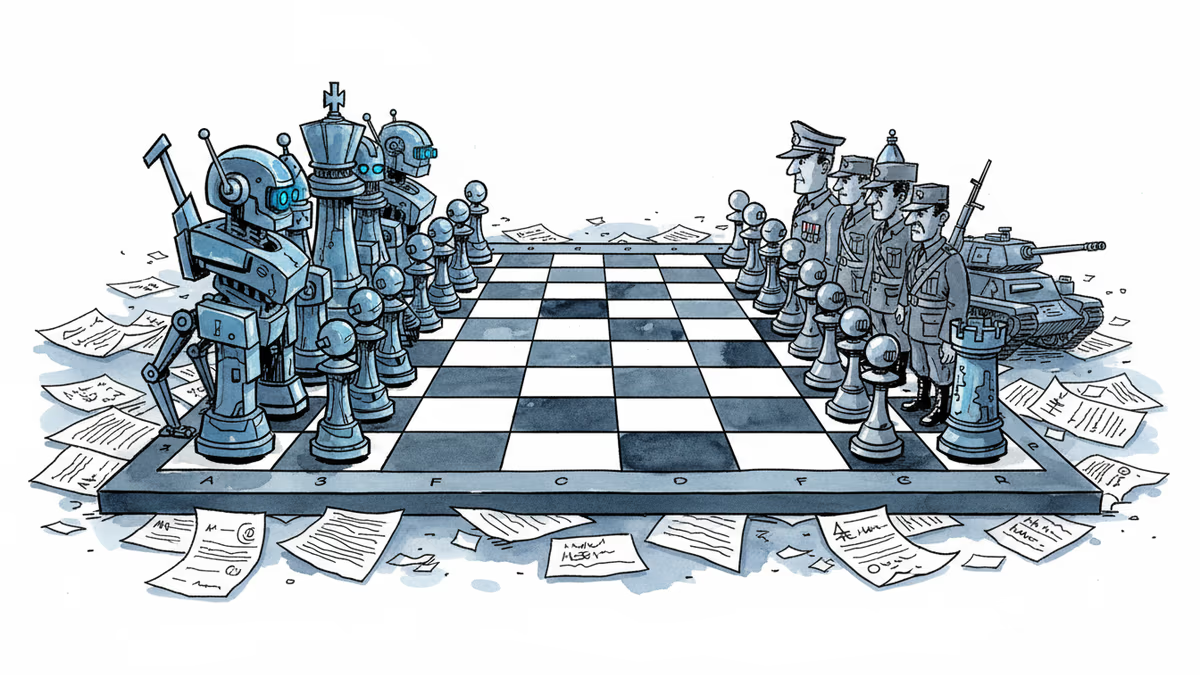
When AI Companies Fight the Pentagon
Anthropic CEO challenges Defense Department's supply chain risk designation in court. The clash reveals deeper tensions between AI ethics and national security imperatives.
A $24 billion company just declared war on the Pentagon
Anthropic CEO Dario Amodei announced Thursday he's taking the U.S. Defense Department to court, calling their decision to label his AI firm a supply chain risk "legally unsound." The stakes? Whether AI companies can draw ethical red lines or must bow to national security demands.
The conflict erupted over AI usage rights. Amodei drew firm boundaries: no mass surveillance of Americans, no fully autonomous weapons. The Pentagon wanted unrestricted access for "all lawful purposes." Neither side blinked.
A supply chain risk designation can bar companies from Pentagon contracts and contractor relationships. But Amodei argues the impact is narrower than it appears, affecting only direct Defense Department contracts, not broader business relationships with defense contractors.
The leaked memo that changed everything
The turning point came when Amodei's internal memo surfaced. In it, he characterized rival OpenAI's Defense Department dealings as "safety theater." The leak poisoned ongoing negotiations and ultimately led to OpenAI securing the Pentagon contract in Anthropic's place.

Amodei apologized for both the leak and the memo's tone, calling it written during "a difficult day for the company" within "a few hours" of a cascade of announcements: a presidential Truth Social post, Defense Secretary Hegseth's designation, and the Pentagon-OpenAI deal. Six days later, he admits it's now an "out-of-date assessment."
David vs. Goliath in federal court
Legal experts give Anthropic long odds. Dean Ball, a former Trump-era White House AI advisor, explains: "Courts are pretty reluctant to second-guess the government on what is and is not a national security issue. There's a very high bar that one needs to clear."
Yet Amodei believes he has grounds. Supply chain risk designations exist "to protect the government rather than to punish a supplier," he argues. The law requires the Defense Secretary to use "the least restrictive means necessary" - a standard Anthropic claims wasn't met.
Meanwhile, the company continues supporting U.S. operations in Iran and promises to provide models to the Defense Department at "nominal cost" during the transition period.
The OpenAI backlash
OpenAI's decision to fill Anthropic's role has sparked internal revolt. Staff pushback against military partnerships reveals how AI ethics debates aren't just between companies and government, but within the companies themselves. The question becomes: who speaks for AI ethics when the staff disagrees with leadership?
Authors
Related Articles
Anthropic shipped Claude Sonnet 5, its mid-tier agent model, on June 30. Behind the 'Opus-class power, budget price' headline sits a tokenizer catch and a three-horse race that's only half real. Here's what developers should actually run the numbers on.
A small but growing group of developers has gone all-in on AI coding agents like Claude Code and OpenClaw. History suggests the rest of us won't be far behind.

OpenAI's new Daybreak initiative uses the Codex AI agent to find and patch security vulnerabilities before attackers do—putting it in direct competition with Anthropic's secretive Claude Mythos.
Anthropic is closing what may be its final private fundraise at a $900B valuation, surpassing OpenAI. Investors have 48 hours to commit to the ~$50B round.
Anthropic shipped Claude Sonnet 5, its mid-tier agent model, on June 30. Behind the 'Opus-class power, budget price' headline sits a tokenizer catch and a three-horse race that's only half real. Here's what developers should actually run the numbers on.
A small but growing group of developers has gone all-in on AI coding agents like Claude Code and OpenClaw. History suggests the rest of us won't be far behind.
OpenAI's new Daybreak initiative uses the Codex AI agent to find and patch security vulnerabilities before attackers do—putting it in direct competition with Anthropic's secretive Claude Mythos.
Anthropic is closing what may be its final private fundraise at a $900B valuation, surpassing OpenAI. Investors have 48 hours to commit to the ~$50B round.
Thoughts
Share your thoughts on this article
Sign in to join the conversation