

14,000 Satellites Circle Earth—What Happens When They Crash?
From 3,000 to 14,000 active satellites in five years. With Starlink's 10,000 satellites and 50,000 pieces of space debris, Earth's 'anthroposphere' faces a collision course.
50,000 Pieces of Junk Are Racing Around Earth at 17,000 MPH
Since 1957, humans have turned Earth's orbit into the ultimate storage unit. But what started as a trickle has become a flood. In just five years, active satellites jumped from 3,000 to 14,000. Elon Musk's Starlink alone operates nearly 10,000 satellites, with plans to reach 42,000.
Here's the problem: for every working satellite, there's a growing cloud of debris. 50,000 objects larger than a baseball now orbit Earth at speeds that make bullets look slow. Add another million coin-sized fragments, and you've got a cosmic demolition derby waiting to happen.
If these objects start colliding en masse, your GPS, weather apps, and internet could vanish overnight. Welcome to the "anthroposphere"—the shell of human-made stuff now wrapping our planet.
The Internet Gold Rush in Space
The satellite boom isn't random. It's driven by a simple promise: internet everywhere. Starlink has already connected remote villages in Brazil and provided lifeline communications in war-torn Ukraine. Amazon's Project Kuiper and China's constellation plans could add 100,000 more satellites by 2030.
For consumers, this means faster internet in rural areas and backup connectivity during disasters. For investors, it's a $400 billion market by 2030, according to McKinsey. But there's a catch: space isn't infinite.
Low Earth orbit—where most satellites live—is only about 1,200 miles thick. Cram tens of thousands of objects into that shell, and collisions become inevitable. In 2009, a dead Russian satellite smashed into an active U.S. satellite, creating over 2,000 trackable fragments. Each fragment became a potential bullet for other satellites.
No Traffic Cops in Space

On Earth, we license drivers and regulate airspace. In space? It's the Wild West. The 1967 Outer Space Treaty established basic principles, but it doesn't limit how many satellites you can launch or where you can put them.
SpaceX launches over 2,000 satellites per year. China is building its own megaconstellation. Europe wants in. Everyone's racing to claim the best orbital real estate before someone else does.
The European Space Agency has proposed a "space traffic management" system—think air traffic control for satellites. But getting the U.S., China, and Russia to agree on orbital speed limits? Good luck with that.
The Kessler Syndrome Nightmare
Here's what keeps space experts awake at night: the Kessler Syndrome. Named after NASA scientist Donald Kessler, it describes a cascade of collisions that could make certain orbits unusable for generations.
It starts with one collision creating thousands of fragments. Those fragments hit other satellites, creating more fragments. Soon, you have a self-sustaining chain reaction that turns useful orbit into a shooting gallery.
We're not there yet, but we're getting close. The International Space Station has had to dodge debris 32 times since 2020. Commercial satellites perform avoidance maneuvers daily.
Cleaning Up the Mess
Some companies are betting on space cleanup. ClearSpace-1, a European mission, plans to grab dead satellites and pull them into Earth's atmosphere to burn up. Japan's Astroscale is developing "space tugboats" to remove debris.
But cleanup is expensive and technically challenging. It's like trying to catch bullets with a butterfly net while riding a motorcycle. Prevention might be smarter than cure.
Authors
Related Articles
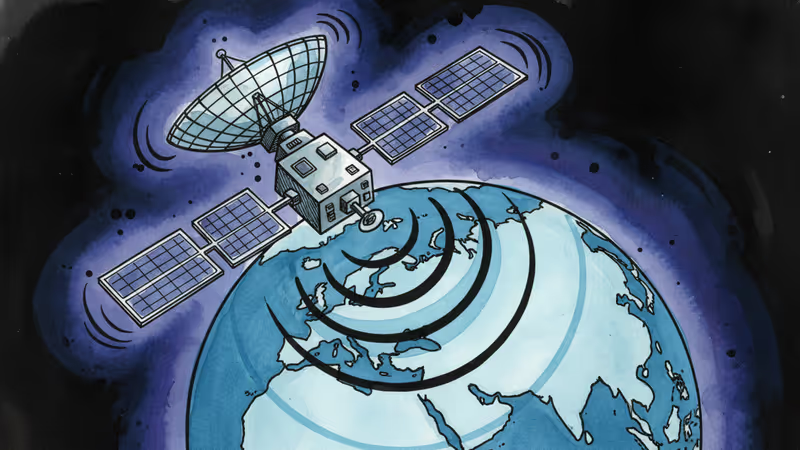
The National Reconnaissance Office revealed details of Jumpseat, a Cold War-era program that eavesdropped on Soviet military communications. What does this disclosure mean today?
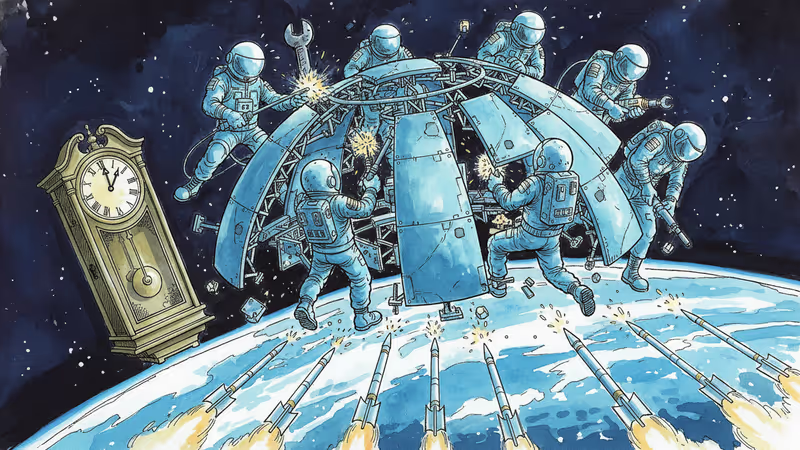
US military plans ambitious Golden Dome missile defense system by 2028, promising nationwide protection against ICBMs, hypersonics, and emerging aerial threats in space-based network.
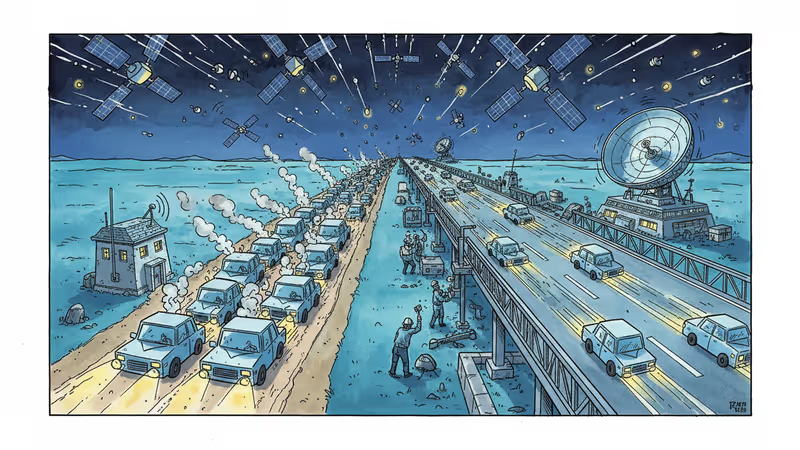
Northwood Space raises $100M and secures a $50M government contract, positioning itself to transform how space data flows to Earth. The ground infrastructure race has begun.
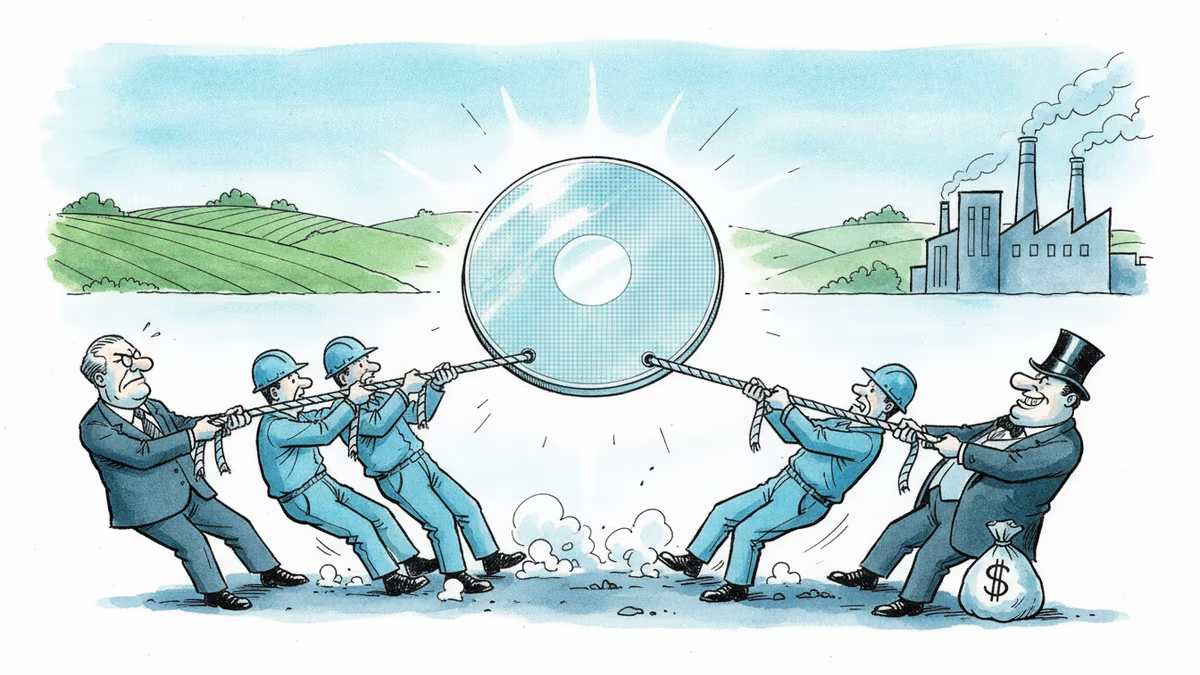
Samsung Electronics' union branch revealed that 84% of survey respondents oppose the government's roughly $290 billion (₩400 trillion) semiconductor megaproject in Gwangju. Government, management, the union and shareholders are all reading the same national project in sharply different ways.
The National Reconnaissance Office revealed details of Jumpseat, a Cold War-era program that eavesdropped on Soviet military communications. What does this disclosure mean today?
US military plans ambitious Golden Dome missile defense system by 2028, promising nationwide protection against ICBMs, hypersonics, and emerging aerial threats in space-based network.
Northwood Space raises $100M and secures a $50M government contract, positioning itself to transform how space data flows to Earth. The ground infrastructure race has begun.
Samsung Electronics' union branch revealed that 84% of survey respondents oppose the government's roughly $290 billion (₩400 trillion) semiconductor megaproject in Gwangju. Government, management, the union and shareholders are all reading the same national project in sharply different ways.
Thoughts
Share your thoughts on this article
Sign in to join the conversation