
The $100M Bet on Space's Data Highway Revolution
Northwood Space raises $100M and secures a $50M government contract, positioning itself to transform how space data flows to Earth. The ground infrastructure race has begun.
$100 million in funding and a $50 million government contract in the same announcement. That's how Northwood Space is making its mark on the space data transmission industry.
Tuesday morning brought a double dose of validation for the startup that wants to revolutionize how we receive and transmit data from space. The company closed a Series B round of $100 million while simultaneously announcing a $49.8 million contract from the US Space Force to enhance the Satellite Control Network that tracks military satellites.
This isn't just about money—it's about timing. The space economy is exploding, but the infrastructure to handle all that data is still stuck in the past.
Ground Control to Major Innovation
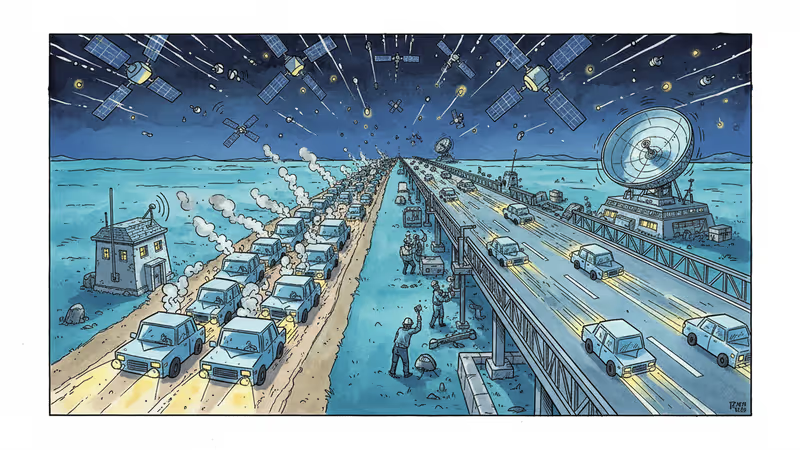
Northwood's secret weapon is called Portal—a phased-array radar system that's fundamentally different from traditional satellite communication. Instead of using one giant dish antenna that can only talk to one satellite at a time, Portal uses thousands of small antennas working together to communicate with multiple satellites simultaneously.
Think of it as upgrading from a single-lane country road to a multi-lane highway for space data.
"Ground is an enabler for pushing forward more capable missions on shorter timelines," explained CEO and co-founder Bridgit Mendler during a media roundtable. "There's a lot of important capability in space that needs to be built faster, and the way to do that is through a vertically integrated ground network."

The current system creates bottlenecks. Satellites can only transmit data when they pass over specific ground stations, creating delays and limiting real-time communication. Northwood wants to eliminate these constraints entirely.
The Infrastructure Play Behind the Space Race
What makes this announcement particularly significant is the timing—less than a year after their previous funding round. That rapid-fire fundraising suggests something bigger is happening in the space data market.
The Space Force contract validates Northwood's technology at the highest levels. Government agencies are notoriously conservative about adopting new technologies, especially for critical military satellites. This contract signals that even the most risk-averse customers see the need for a fundamental upgrade.
We're witnessing a shift from government-led space programs to private companies building the essential infrastructure. SpaceX transformed launch capabilities, and now companies like Northwood are targeting the next bottleneck: getting data from space to where it's needed on Earth.
The Data Deluge Demands New Solutions
The numbers tell the story. The amount of data flowing from space to Earth is growing exponentially. Earth observation satellites, GPS systems, communication networks—they're all generating more data than current ground infrastructure can handle efficiently.
This creates opportunities for companies that can solve the data transmission problem, but it also raises questions about who controls these critical information highways. As more of our daily life depends on satellite data—from weather forecasting to navigation to internet connectivity—the companies that control the flow of this information gain significant influence.
Authors
Related Articles

From 3,000 to 14,000 active satellites in five years. With Starlink's 10,000 satellites and 50,000 pieces of space debris, Earth's 'anthroposphere' faces a collision course.
US Space Force shifts $24B R&D focus from rockets to space sensors and payloads, signaling major industry transformation and new opportunities for startups
Thrive Capital raised its largest-ever $10B fund, nearly doubling its previous size. What does this mega-fund tell us about the current state of venture investing?

While Silicon Valley chases mega-rounds, former Google exec Stacy Brown-Philpot built a 2,000-company pipeline in just one year. Her contrarian bet on overlooked founders is paying off.
From 3,000 to 14,000 active satellites in five years. With Starlink's 10,000 satellites and 50,000 pieces of space debris, Earth's 'anthroposphere' faces a collision course.
US Space Force shifts $24B R&D focus from rockets to space sensors and payloads, signaling major industry transformation and new opportunities for startups
Thrive Capital raised its largest-ever $10B fund, nearly doubling its previous size. What does this mega-fund tell us about the current state of venture investing?
While Silicon Valley chases mega-rounds, former Google exec Stacy Brown-Philpot built a 2,000-company pipeline in just one year. Her contrarian bet on overlooked founders is paying off.
Thoughts
Share your thoughts on this article
Sign in to join the conversation