
Why the US Just Declassified a 50-Year-Old Soviet Spy Satellite Program
The National Reconnaissance Office revealed details of Jumpseat, a Cold War-era program that eavesdropped on Soviet military communications. What does this disclosure mean today?
After 50 years of secrecy, the US government has pulled back the curtain on one of its Cold War-era spy satellite programs. But why declassify decades-old intelligence operations now?
The National Reconnaissance Office (NRO) recently revealed details about Jumpseat, America's first signals-collection satellite program designed to intercept Soviet military communications. While the program's existence had been leaked through media reports over the years, this marks the first time the US government has officially acknowledged its purpose, development process, and even released actual photographs of the satellites.
Listening from 24,000 Miles Above
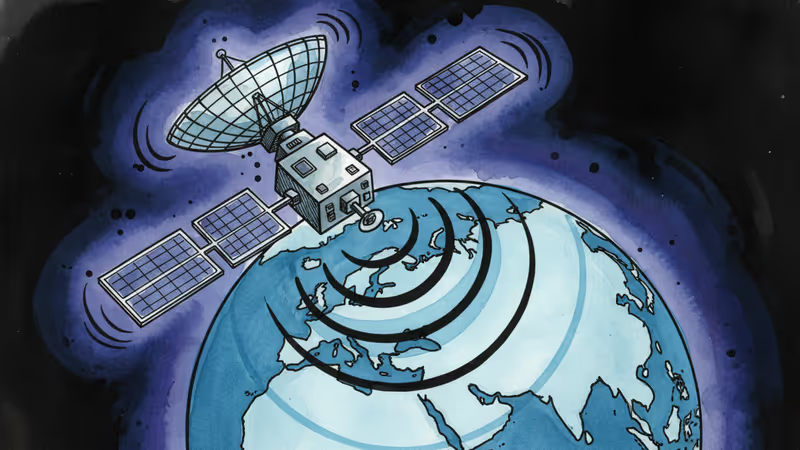
Jumpseat satellites operated in highly elliptical orbits, swinging out to 39,000 kilometers above Earth to capture Soviet radio transmissions. These weren't your typical spy satellites taking pictures—they were essentially giant ears in space, designed to eavesdrop on military communications across the vast Soviet territory.
The program ran during the height of the Cold War, when both superpowers were locked in an intelligence arms race. Every intercepted radio signal could provide crucial insights into Soviet military capabilities, troop movements, or strategic planning. For American intelligence analysts, these satellites were windows into an otherwise impenetrable adversary.
The Timing Question

Why declassify this now? The Cold War ended over 30 years ago, and most of the technology is obsolete by today's standards. The answer likely lies in today's space competition with China and Russia.
Both countries have demonstrated anti-satellite weapons capabilities—China destroyed one of its own satellites with a missile in 2007, while Russia continues developing similar technologies. By revealing past capabilities, the US might be sending a subtle message: "We've been doing this longer than you think."
The disclosure also comes as commercial satellite companies like SpaceX and Planet Labs make high-resolution imagery widely available. When anyone can buy satellite photos online, the line between military and civilian space surveillance continues to blur.
The New Space Race Reality
Today's reconnaissance satellites make Jumpseat look primitive. Modern spy satellites can capture real-time video, intercept digital communications, and even track individual vehicles. The National Geospatial-Intelligence Agency processes millions of images daily, using AI to identify changes in global hotspots.
But this technological leap raises uncomfortable questions. If governments can see everything from space, what happens to privacy? When satellite imagery can reveal individual license plates, the distinction between national security and mass surveillance becomes increasingly thin.
The declassification of Jumpseat also highlights how intelligence agencies balance secrecy with public accountability. Revealing 50-year-old programs might seem harmless, but it also demonstrates capabilities that could influence current adversaries' strategic planning.
Authors
Related Articles

From 3,000 to 14,000 active satellites in five years. With Starlink's 10,000 satellites and 50,000 pieces of space debris, Earth's 'anthroposphere' faces a collision course.

US military plans ambitious Golden Dome missile defense system by 2028, promising nationwide protection against ICBMs, hypersonics, and emerging aerial threats in space-based network.
Northwood Space raises $100M and secures a $50M government contract, positioning itself to transform how space data flows to Earth. The ground infrastructure race has begun.

Five stories from late September, traced to where the paper trail stops: Korea's export record, Nvidia's Hugging Face 8-K, a US-China AI channel, the UN on AI, and rising births.
From 3,000 to 14,000 active satellites in five years. With Starlink's 10,000 satellites and 50,000 pieces of space debris, Earth's 'anthroposphere' faces a collision course.
US military plans ambitious Golden Dome missile defense system by 2028, promising nationwide protection against ICBMs, hypersonics, and emerging aerial threats in space-based network.
Northwood Space raises $100M and secures a $50M government contract, positioning itself to transform how space data flows to Earth. The ground infrastructure race has begun.
Five stories from late September, traced to where the paper trail stops: Korea's export record, Nvidia's Hugging Face 8-K, a US-China AI channel, the UN on AI, and rising births.
Thoughts
Share your thoughts on this article
Sign in to join the conversation