
Why Ethos' Rocky IPO Debut Tells a Bigger Story
Life insurance platform Ethos went public with an 11% first-day drop, but its survival story reveals what separates winners from losers in the insurtech shakeout. Here's why it matters for 2026's IPO market.
Ten minutes. That's how long it takes to buy life insurance on Ethos Technologies' platform—no medical exam required. The San Francisco insurtech made its Nasdaq debut Thursday with the ticker symbol "LIFE," perhaps the most on-the-nose choice in recent memory.
The stock closed its first day at $16.85, down 11% from its $19 IPO price. But the real story isn't in the day-one performance—it's in how Ethos managed to reach the public markets at all while most of its peers didn't make it past the starting line.
The Great Insurtech Shakeout
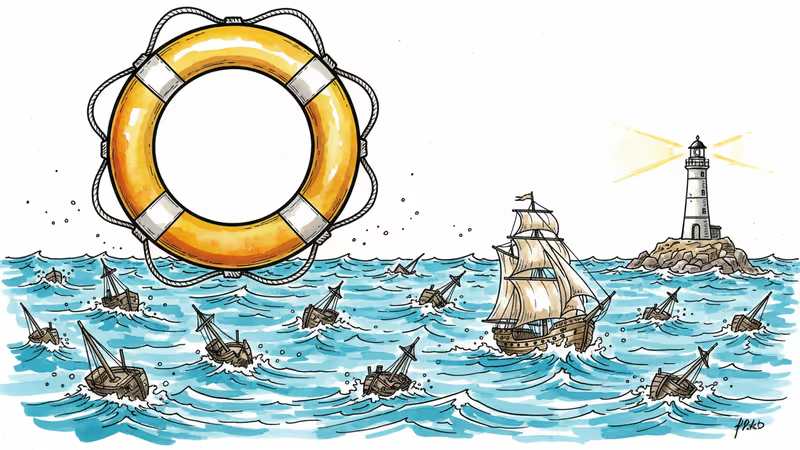
"When we launched the business, there were like eight or nine other life insurtech startups that looked very similar to Ethos," co-founder Peter Colis told TechCrunch. "Over time, the vast majority of those startups have pivoted, been acquired at subscale, remain at subscale or gone out of business."
The casualties tell a sobering story. Policygenius, which raised over $250 million from investors including KKR and Norwest Venture Partners, was acquired by PE-backed Zinnia in 2023. Health IQ, which secured more than $200 million from prominent VCs like Andreessen Horowitz, filed for bankruptcy the same year.
What separated Ethos from the graveyard? When cheap capital dried up in 2022, the company made a crucial pivot toward profitability rather than growth-at-all-costs. "Not knowing what the ongoing funding climate would be, we got really serious about ensuring profitability," Colis explained.
That financial discipline paid off. Ethos turned profitable by mid-2023 and has maintained year-over-year revenue growth of more than 50% since then. In the nine months ending September 30, 2025, the company generated almost $278 million in revenue and just under $46.6 million in net income.

The Platform Play
Ethos operates what it calls a "three-sided platform." Consumers buy policies online in 10 minutes without medical exams. Over 10,000 independent agents use its software to sell those policies. Carriers like Legal & General America and John Hancock rely on it for underwriting and administrative services.
Crucially, Ethos isn't an insurer itself—it's a licensed agency earning commissions on sales. This model insulates it from the capital-intensive business of actually underwriting risk while positioning it as essential infrastructure for the industry.
Valuation Reality Check
Despite the survival story, public markets delivered a harsh reality check. Ethos ended its first day with a market cap of about $1.1 billion—significantly below the $2.7 billion valuation it garnered in its last private round led by SoftBank Vision Fund 2 in July 2021.
The company and selling shareholders raised approximately $200 million in the offering, selling 10.5 million shares. Notable investors including Sequoia, Accel, Google Ventures, and SoftBank remain major shareholders, with Sequoia and Accel choosing not to sell shares in the IPO.
Why Go Public Now?
Colis cited "additional trust and credibility" with potential partners and clients as a key motivation. Given that many major insurance carriers are over a century old, being publicly traded signals staying power in an industry where longevity matters.
But there's likely more to it. With venture funding still challenging and the IPO window showing signs of reopening, Ethos may have calculated that now was the right time to access public capital markets—even at a lower valuation than its private peak.
Authors
Related Articles
American Airlines just signed Starlink for 500+ aircraft. It's not just about faster inflight internet — it's a calculated move in the run-up to what could be the largest IPO in history.

SpaceX's upgraded Starship V3 completed its first test flight, deploying 20 Starlink simulators but losing the Super Heavy booster. With an IPO weeks away, the stakes just got higher.
SpaceX's IPO filing puts AI at the center, claiming a $26.5 trillion market opportunity. But can Grok compete with OpenAI and Anthropic for enterprise customers?
SpaceX filed a nearly 400-page S-1 with the SEC, targeting an IPO as early as June 12. Here's what the filing reveals—and what it doesn't.
American Airlines just signed Starlink for 500+ aircraft. It's not just about faster inflight internet — it's a calculated move in the run-up to what could be the largest IPO in history.
SpaceX's upgraded Starship V3 completed its first test flight, deploying 20 Starlink simulators but losing the Super Heavy booster. With an IPO weeks away, the stakes just got higher.
SpaceX's IPO filing puts AI at the center, claiming a $26.5 trillion market opportunity. But can Grok compete with OpenAI and Anthropic for enterprise customers?
SpaceX filed a nearly 400-page S-1 with the SEC, targeting an IPO as early as June 12. Here's what the filing reveals—and what it doesn't.
Thoughts
1 thoughts
Share your thoughts on this article
Sign in to join the conversation