
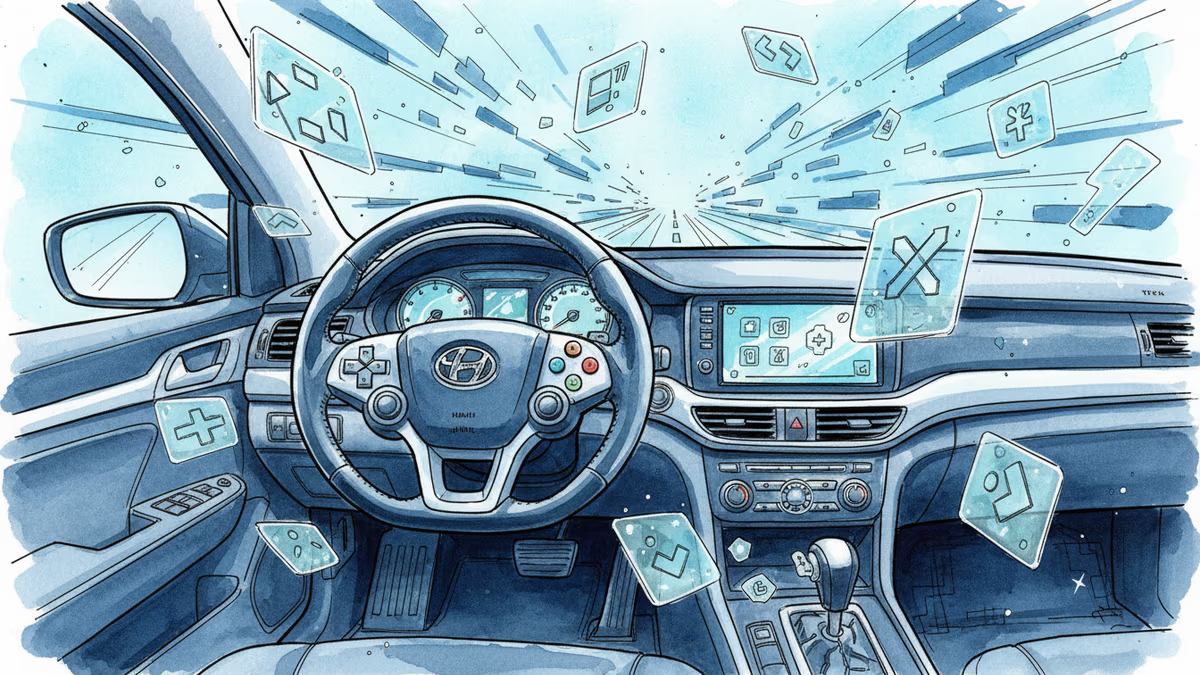
When Your Car Dashboard Becomes a Video Game: Toyota's Bold Bet
Toyota unveils Fluorite, a custom game engine for automotive digital cockpits. Analyzing how gaming technology could reshape the driving experience and industry dynamics.
150 Million Cars Could Soon Feel Like Video Games
Toyota just dropped a bombshell at FOSDEM 2026: they're building car dashboards with game engine technology. Their custom Fluorite engine isn't just a tech demo—it's a direct challenge to how we've thought about automotive interfaces for the past 20 years.
Lead engineer Jamie Kerber outlined the vision: "step-by-step 3D tutorials, environmental mapping, and natural controls." Think of it as turning your car's interface into something as intuitive as your favorite mobile game, but with real-world consequences.
Epic vs. Toyota: The Battle for Automotive Minds
The timing is fascinating. Just as Epic Games aggressively pushes Unreal Engine into automotive design and visualization, Toyota goes the opposite direction—building their own.
Epic's approach:
- Leverage proven, battle-tested technology
- Massive developer ecosystem already exists
- Immediate access to advanced rendering capabilities
Toyota's gambit:
- Automotive-specific optimization from the ground up
- Complete control over the technology stack
- No licensing fees or external dependencies
This isn't just about technology—it's about control. Do automakers want to depend on gaming companies for their digital future, or build their own destiny?

Developers: Opportunity or Overwhelming Complexity?
For software developers, this shift creates a paradox. Game engines promise familiar tools and workflows, but automotive development demands safety-critical standards that gaming never required.
Consider the implications: A bug in Call of Duty means a frustrated player. A bug in your car's navigation system could mean a life-threatening situation. The development paradigms are fundamentally different.
Yet the talent pool is tempting. Game developers already understand 3D rendering, real-time systems, and user experience design. Automotive companies are struggling to find these skills in traditional embedded systems engineers.
The Consumer Reality Check
Here's what Toyota isn't saying: most drivers don't want their cars to feel like video games. They want reliability, simplicity, and safety. The average car buyer is 45 years old and may find game-like interfaces more confusing than helpful.
But younger consumers? They've grown up with smartphones, gaming consoles, and expect every interface to be as responsive as their favorite apps. Toyota might be betting on demographic inevitability rather than current market demand.
The real test will be in the details: Can Fluorite deliver game-like fluidity while maintaining the instant response drivers expect from critical controls like climate, navigation, and safety systems?
The Bigger Picture: Software Eating the Car
This move reflects a broader industry transformation. Modern vehicles are becoming software platforms that happen to have wheels. Tesla proved this model works; now traditional automakers are scrambling to catch up.
But there's a crucial difference: Tesla built their software culture from day one. Toyota is retrofitting 70 years of hardware-focused engineering culture with gaming technology. That's not a technical challenge—it's an organizational one.
The winner won't be determined by the most advanced graphics or smoothest animations—it'll be whoever makes driving feel effortlessly human.
Authors
Related Articles
Auto giants gather to standardize digital car keys, promising convenience while raising questions about security, privacy, and the future of vehicle ownership.

Samsung Electronics' union branch revealed that 84% of survey respondents oppose the government's roughly $290 billion (₩400 trillion) semiconductor megaproject in Gwangju. Government, management, the union and shareholders are all reading the same national project in sharply different ways.

Nvidia shipped roughly a billion RISC-V cores in 2024, then announced it would run CUDA on the open standard. We break down how royalty-free instruction sets and open software stacks are trying to route around CUDA's lock-in. Part 2 of the Semiconductor Sovereignty series.

US AI-chip export controls split into three layers in the first half of 2026 — January easing, a May crackdown on circumvention, and a pending bill. Nvidia erased China from its guidance and still posted a record $81.6 billion quarter. A look at the export policy that both shields and cages it.
Auto giants gather to standardize digital car keys, promising convenience while raising questions about security, privacy, and the future of vehicle ownership.
Samsung Electronics' union branch revealed that 84% of survey respondents oppose the government's roughly $290 billion (₩400 trillion) semiconductor megaproject in Gwangju. Government, management, the union and shareholders are all reading the same national project in sharply different ways.
Nvidia shipped roughly a billion RISC-V cores in 2024, then announced it would run CUDA on the open standard. We break down how royalty-free instruction sets and open software stacks are trying to route around CUDA's lock-in. Part 2 of the Semiconductor Sovereignty series.
US AI-chip export controls split into three layers in the first half of 2026 — January easing, a May crackdown on circumvention, and a pending bill. Nvidia erased China from its guidance and still posted a record $81.6 billion quarter. A look at the export policy that both shields and cages it.
Thoughts
Share your thoughts on this article
Sign in to join the conversation