
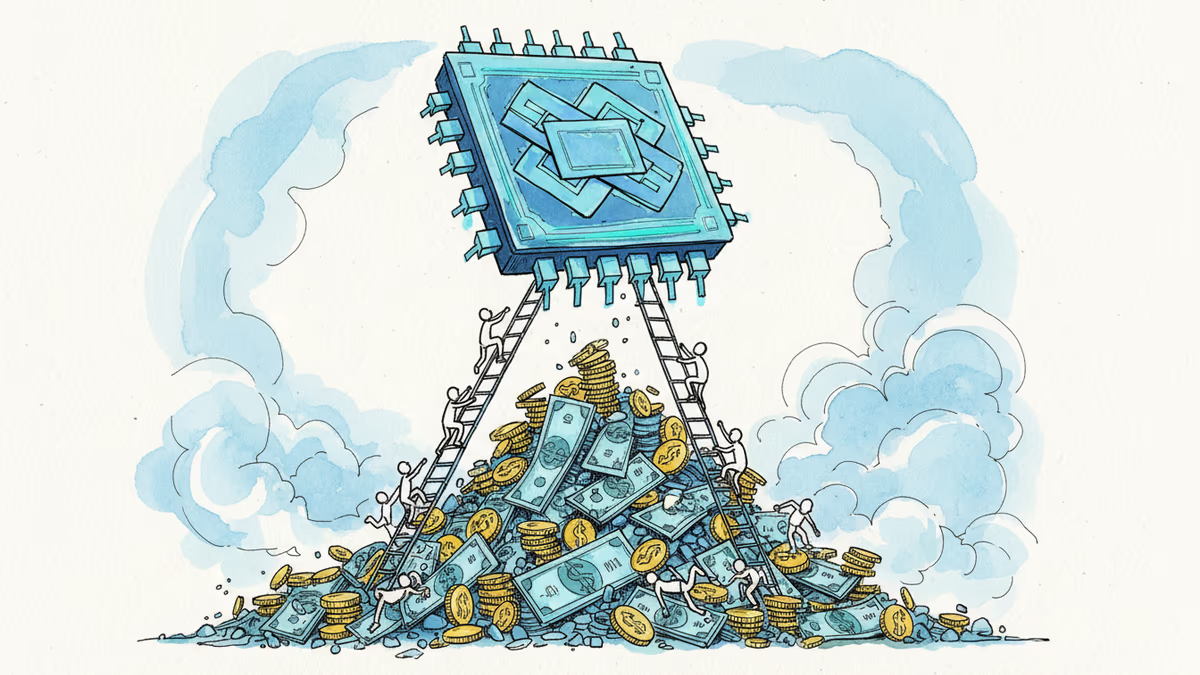
Quantum Winter? $260M Fund Says Otherwise
Quantonation raises €220M second fund despite quantum computing being years from industrial scale. Why investors are doubling down on unproven tech.
The Paradox: No Commercial Quantum, Double the Investment
Quantum computing won't replace supercomputers in 2026. Industrial scale? Even further away. Yet investor appetite hasn't just survived the hype cycle—it's thrived. Quantonation Ventures just closed its second fund at €220 million ($260 million), more than double its inaugural fund size.
The predicted "quantum winter" never came. Instead of funding collapse from excessive hype and minimal results, we're seeing the opposite. Governments and Big Tech are racing toward a quantum future that has no clear timeline, especially the promise that quantum will eventually crack modern encryption.
Since Quantonation's 2018 launch, the quantum sector has evolved from nascent to substantial, with both technological breakthroughs and early demand from academic and industrial labs. This maturation has fundamentally "shifted the types of investment opportunities available," according to Quantonation partner Will Zeng.
The 'Picks and Shovels' Play
The most intriguing shift? The emergence of what Zeng calls "picks and shovels" opportunities—companies building the infrastructure that supports the quantum industry rather than quantum computers themselves.
Take Dutch startup Qblox. This bootstrapped company was selling quantum control hardware and software to Quantonation portfolio companies before the VC firm co-led its Series A. It's the classic gold rush strategy: while everyone's digging for gold, sell them the tools.
This growing ecosystem explains why dedicated quantum funds like QDNL and 55 North are emerging. "VCs recognize that this is not an easy area to invest in at the early stage," Zeng notes. "The technology is very specific and complex, the markets are often new, and the teams as well."
When Jensen Huang Speaks, Markets Listen

Public quantum companies have surged in recent months, creating what Bloomberg calls a "quantum frenzy." The catalyst? Nvidia CEO Jensen Huang's June 2025 declaration that "quantum computing is reaching an inflection point."
Despite quantum chips failing to outperform classical computers outside purpose-built benchmarks, consensus is building that real-world applications are just years away—from life sciences to new materials. The key driver is advancement in error correction, the ability to fix mistakes that quantum systems are prone to.
Google's Willow chip marked a 2024 landmark for error correction, but no architecture has won yet. Smaller players remain in the race, with a surprising number entering DARPA's Quantum Benchmarking Initiative.
Beyond the Chip: A Broader Canvas
Quantonation's second fund has already invested in 12 startups, targeting around 25 total. But the thesis extends beyond quantum chips to encompass the entire stack needed for quantum advantage—software, industrial applications, and adjacent physics-based technologies like photonics and lasers.
This expanded approach attracts both returning investors (Vertex Holdings, Bpifrance) and new limited partners including the European Investment Fund, Grupo ACS, and Toshiba. The geographic scope is equally international, with dual headquarters in Paris and New York enabling bets across Europe, Asia, and North America.
"In a lot of the areas we invest in, there's not yet a clear regional winner," Zeng explains. "A lot of the research has come from universities in many places."
The Regulatory Wild Card
What's notably absent from most quantum investment discussions? Regulatory implications. As quantum computing inches toward cryptography-breaking capabilities, governments face a dilemma: promote innovation while protecting national security.
The U.S. has already implemented export controls on quantum technology to China. Europe is developing its own quantum sovereignty strategy. These regulatory moves could dramatically reshape the investment landscape, potentially creating regional quantum blocs rather than a global market.
The quantum revolution may not be here yet, but the money certainly is. Whether that's wisdom or folly, we'll know soon enough.
Authors
Related Articles
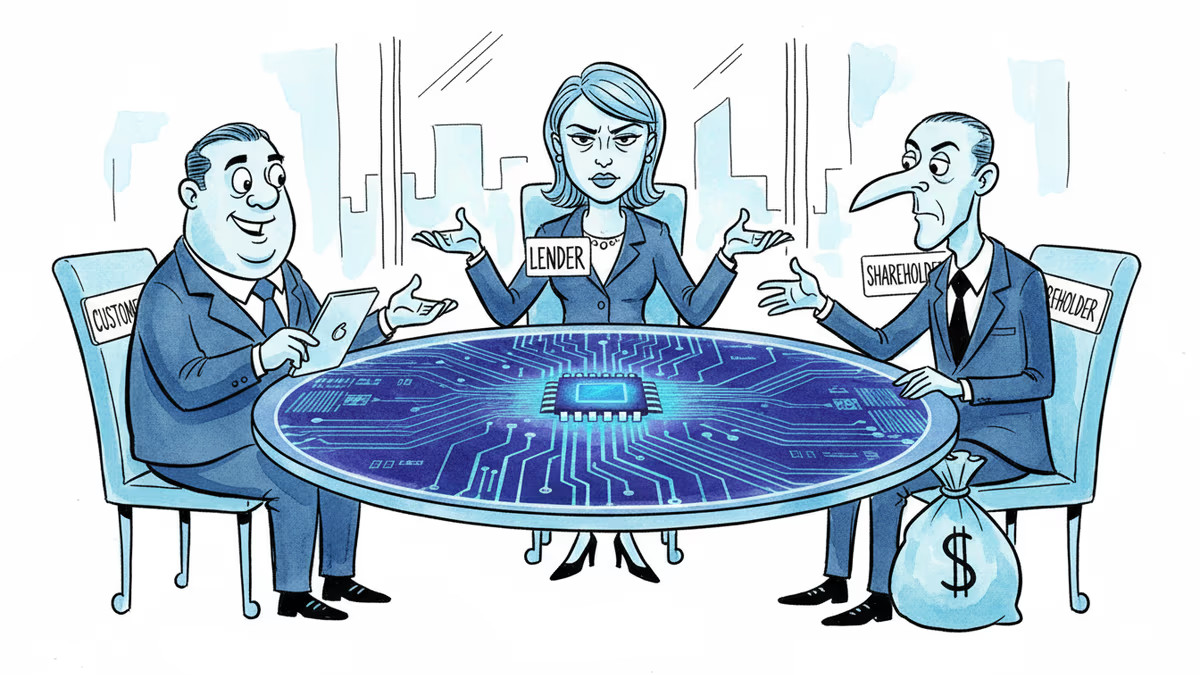
Cerebras Systems is targeting a $26.6B valuation in what could be 2026's largest tech IPO. But the real story is how deeply OpenAI is embedded in its capital structure—as customer, lender, and potential shareholder.

Despite fierce competition, the CEOs of Polymarket and Kalshi have co-invested in 5(c) Capital, a $35M VC fund targeting prediction market infrastructure. What this signals for the industry.

A $7M quantum computing competition is testing whether today's noisy, limited quantum machines can actually help human health—before the powerful ones we've been promised ever arrive.

French quantum computing company Pasqal joins the exodus to US markets with a $2B SPAC deal. What's driving European tech champions away from home?
Cerebras Systems is targeting a $26.6B valuation in what could be 2026's largest tech IPO. But the real story is how deeply OpenAI is embedded in its capital structure—as customer, lender, and potential shareholder.
Despite fierce competition, the CEOs of Polymarket and Kalshi have co-invested in 5(c) Capital, a $35M VC fund targeting prediction market infrastructure. What this signals for the industry.
A $7M quantum computing competition is testing whether today's noisy, limited quantum machines can actually help human health—before the powerful ones we've been promised ever arrive.
French quantum computing company Pasqal joins the exodus to US markets with a $2B SPAC deal. What's driving European tech champions away from home?
Thoughts
Share your thoughts on this article
Sign in to join the conversation