

Europe's January Unicorn Boom Signals Shifting VC Confidence
Five European startups reached unicorn status in January 2026, from Belgian cybersecurity to Ukrainian edtech, signaling renewed investor confidence in European innovation.
January delivered something remarkable: five European startups crossed the $1 billion valuation threshold, marking one of the strongest monthly showings for European unicorn creation in recent memory. From Belgium's cybersecurity innovation to Ukraine's resilient edtech platform, these funding rounds reveal where venture capital confidence is flowing—and why geography matters less than execution.
The New Unicorn Class
Aikido Security led the pack with a $60 million Series B that valued the Belgian cybersecurity startup at exactly $1 billion. The company's platform unifies security across software development lifecycles, already serving more than 100,000 teams globally. With five-times revenue growth over the past year, Aikido represents Europe's challenge to the Palo Alto and Tel Aviv cybersecurity establishment.
Cast AI, the cloud optimization company with Lithuanian roots but Florida headquarters, secured unicorn status through strategic investment from Pacific Alliance Ventures. Having raised $108 million in Series C funding last April, the company's latest round pushed its valuation past the billion-dollar mark while introducing OMNI Compute for AI—technology that promises more efficient GPU utilization.
Perhaps most striking is Harmattan AI, the French defense tech company that reached a $1.4 billion valuation just months after its 2024 founding. The $200 million Series B, led by Dassault Aviation, reflects growing appetite for autonomous defense systems amid global security concerns.
Beyond the Numbers
These unicorn births aren't just about hitting valuation milestones—they reflect deeper shifts in European tech maturity. Osapiens, the German ESG software firm, reached $1.1 billion valuation with its $100 million Series C led by Decarbonization Partners, a joint venture between BlackRock and Temasek. With more than 2,400 customers worldwide, Osapiens captures the intersection of regulatory compliance and sustainability reporting that's becoming table stakes for global enterprises.

Preply's journey to $1.2 billion valuation tells a different story entirely. The 14-year-old language learning marketplace embodies Ukrainian resilience, maintaining 150 employees in Kyiv while expanding AI-enhanced learning capabilities. The $150 million Series D demonstrates how geopolitical challenges can coexist with business growth when execution remains strong.
The Geography Question
These funding rounds highlight a persistent European challenge: corporate structure complexity. Lovable incorporates in Delaware but operates from Stockholm. Cast AI headquarters in Florida while maintaining Lithuanian operations. Preply was founded in the United States by Ukrainian entrepreneurs who've kept significant operations in their homeland.
This geographic split reflects practical realities rather than lack of European identity. Until pan-European corporate structures become viable, startups will continue optimizing for investor familiarity and regulatory efficiency while maintaining operational roots in their home markets.
Investment Climate Signals
The diversity of these unicorns—spanning cybersecurity, cloud optimization, defense tech, ESG compliance, and edtech—suggests broad-based investor confidence rather than sector-specific enthusiasm. DST Global, BlackRock, and Dassault Aviation represent different investor categories all finding compelling opportunities in European innovation.
The speed of Harmattan AI's rise particularly stands out. Reaching $1.4 billion valuation within months of founding indicates either exceptional technology, strategic necessity, or both. In defense tech, where procurement cycles typically span years, such rapid scaling suggests urgent market demand.
Authors
Related Articles
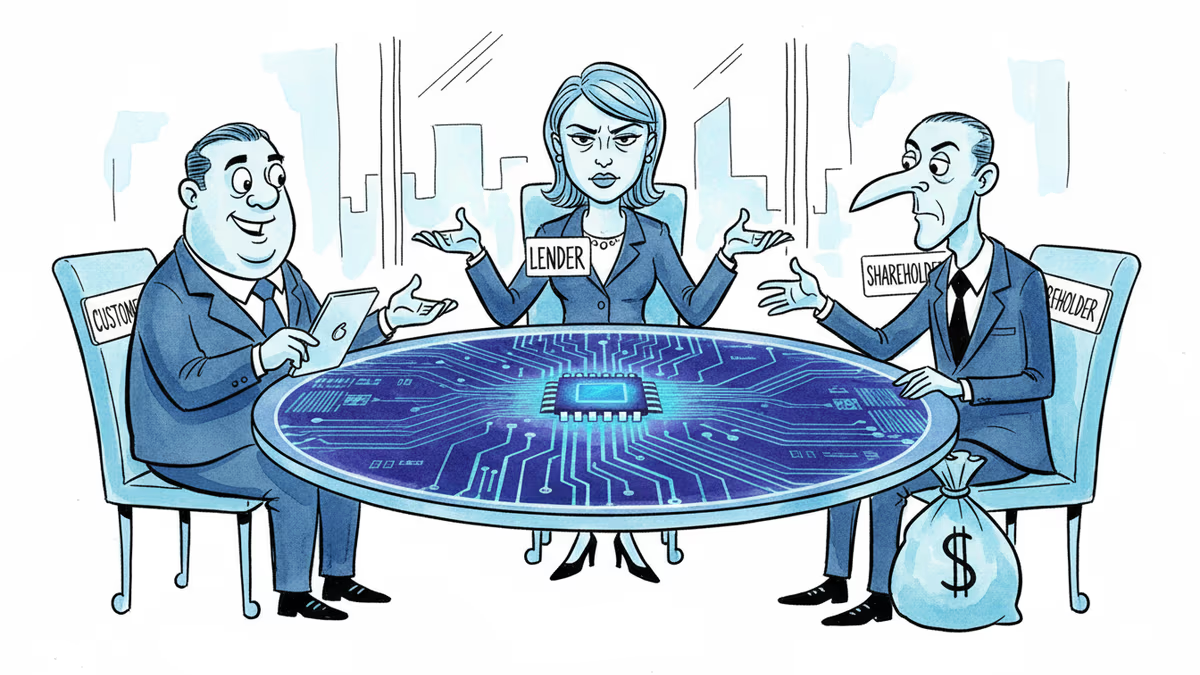
Cerebras Systems is targeting a $26.6B valuation in what could be 2026's largest tech IPO. But the real story is how deeply OpenAI is embedded in its capital structure—as customer, lender, and potential shareholder.

Despite fierce competition, the CEOs of Polymarket and Kalshi have co-invested in 5(c) Capital, a $35M VC fund targeting prediction market infrastructure. What this signals for the industry.
Quantonation raises €220M second fund despite quantum computing being years from industrial scale. Why investors are doubling down on unproven tech.

Neo's new accelerator program challenges Y Combinator's fixed 7% model with founder-friendly terms. But what's the real game being played here?
Cerebras Systems is targeting a $26.6B valuation in what could be 2026's largest tech IPO. But the real story is how deeply OpenAI is embedded in its capital structure—as customer, lender, and potential shareholder.
Despite fierce competition, the CEOs of Polymarket and Kalshi have co-invested in 5(c) Capital, a $35M VC fund targeting prediction market infrastructure. What this signals for the industry.
Quantonation raises €220M second fund despite quantum computing being years from industrial scale. Why investors are doubling down on unproven tech.
Neo's new accelerator program challenges Y Combinator's fixed 7% model with founder-friendly terms. But what's the real game being played here?
Thoughts
Share your thoughts on this article
Sign in to join the conversation