
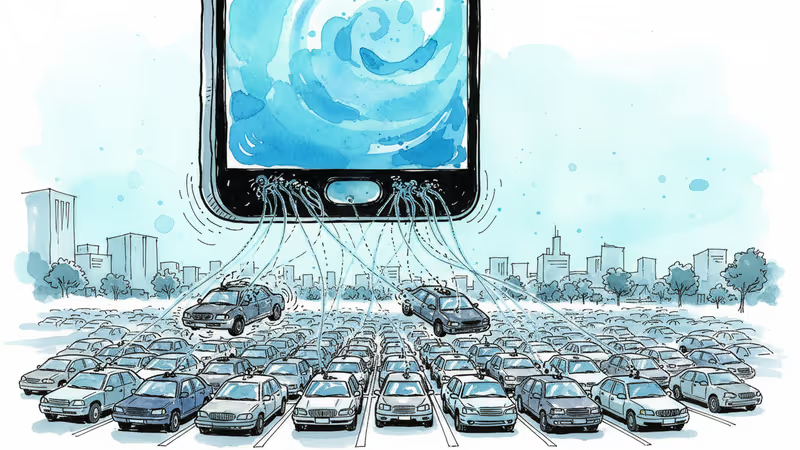
Your Phone Is Your Car Key Now - But Who's Watching?
Auto giants gather to standardize digital car keys, promising convenience while raising questions about security, privacy, and the future of vehicle ownership.
Last month in Palo Alto, over a dozen companies from Tesla to Apple to Samsung gathered for what might seem like a mundane tech conference. But the 16th annual "Plugfest" hosted by the Car Connectivity Consortium represents something bigger: the race to turn your smartphone into the universal key to every car on the road.
Digital keys aren't science fiction anymore. Tesla owners already unlock their cars with an app. BMW and Hyundai offer similar features. But here's the catch - none of these systems talk to each other. Switch from an iPhone to a Samsung Galaxy, or trade your BMW for a Ford, and you're back to fumbling with physical keys.
The Great Standardization Race
The Plugfest gathering brought together an unlikely alliance: automakers who typically compete fiercely, tech giants with conflicting ecosystems, and chipmakers betting billions on different standards. Their mission? Create a world where any phone can unlock any car.
This isn't just about convenience. It's about control over a $2.8 trillion automotive industry that's rapidly becoming a software business. The company that sets the standard doesn't just win - it gets to collect data from every car trip, every parking session, every moment you interact with your vehicle.
Apple wants your car to be another iPhone accessory. Google sees it as an extension of Android. Traditional automakers like Ford and GM are fighting to avoid becoming mere hardware vendors in someone else's ecosystem.
The Security Paradox
But convenience comes with a price tag measured in vulnerability. Physical keys are hard to duplicate; digital signals can be intercepted, replayed, or spoofed. Security researchers have already demonstrated attacks on existing digital key systems, sometimes unlocking cars from hundreds of feet away.
The stakes are higher than a stolen vehicle. Digital keys create a permanent record of where you go, when you travel, and how you use your car. This data goldmine is worth more than the car itself to companies building profiles for targeted advertising or insurance pricing.
Consider this: your phone already knows where you sleep, work, and shop. Add your car to that equation, and the picture becomes complete. Every parking lot becomes a data collection point. Every drive becomes a behavior pattern to be analyzed and monetized.

The New Mobility Economy
Digital keys are reshaping entire industries. Car-sharing services like Zipcar and Turo can now operate without physical key exchanges. Rental cars can be picked up directly from airport parking lots. Fleet managers can grant or revoke access to hundreds of vehicles with a few taps.
But the real disruption lies ahead. Imagine subscription-based car access where you pay monthly for different vehicle types. Need a truck for the weekend? Your digital key automatically works with the nearest available pickup. Heading to the airport? Your key switches to work with compact cars for better mileage.
This model threatens traditional car ownership. Why own a depreciating asset when you can access any vehicle type on demand? Auto manufacturers are already pivoting, viewing cars as platforms for ongoing service revenue rather than one-time sales.
The Privacy Reckoning
Here's what the industry doesn't advertise: digital keys create the most detailed surveillance network ever deployed. Your car knows not just where you go, but how fast you drive, how hard you brake, and how often you use different features.
Insurance companies are salivating. Imagine premiums that adjust in real-time based on your driving patterns. Employers could monitor company vehicle usage down to the minute. Governments could track citizens without warrants, simply by accessing "anonymized" mobility data.
The Car Connectivity Consortium promises privacy protections, but their standards are voluntary. Once your digital key is linked to your identity, that connection is permanent. There's no going back to anonymous travel.
The Resistance Movement
Not everyone's embracing this digital future. A growing number of consumers are choosing older vehicles specifically to avoid connected car features. Some states are considering "right to disconnect" legislation that would require automakers to offer non-connected versions of their vehicles.
Cybersecurity experts warn that digital keys represent a single point of failure. A software bug, server outage, or cyberattack could potentially disable millions of vehicles simultaneously. Physical keys might be old-fashioned, but they don't require internet connectivity or software updates.
The next time you unlock your car with your phone, remember: somewhere, an algorithm is taking notes.
Authors
Related Articles
Toyota unveils Fluorite, a custom game engine for automotive digital cockpits. Analyzing how gaming technology could reshape the driving experience and industry dynamics.
Samsung Electronics' union branch revealed that 84% of survey respondents oppose the government's roughly $290 billion (₩400 trillion) semiconductor megaproject in Gwangju. Government, management, the union and shareholders are all reading the same national project in sharply different ways.

Nvidia shipped roughly a billion RISC-V cores in 2024, then announced it would run CUDA on the open standard. We break down how royalty-free instruction sets and open software stacks are trying to route around CUDA's lock-in. Part 2 of the Semiconductor Sovereignty series.
US AI-chip export controls split into three layers in the first half of 2026 — January easing, a May crackdown on circumvention, and a pending bill. Nvidia erased China from its guidance and still posted a record $81.6 billion quarter. A look at the export policy that both shields and cages it.
Toyota unveils Fluorite, a custom game engine for automotive digital cockpits. Analyzing how gaming technology could reshape the driving experience and industry dynamics.
Samsung Electronics' union branch revealed that 84% of survey respondents oppose the government's roughly $290 billion (₩400 trillion) semiconductor megaproject in Gwangju. Government, management, the union and shareholders are all reading the same national project in sharply different ways.
Nvidia shipped roughly a billion RISC-V cores in 2024, then announced it would run CUDA on the open standard. We break down how royalty-free instruction sets and open software stacks are trying to route around CUDA's lock-in. Part 2 of the Semiconductor Sovereignty series.
US AI-chip export controls split into three layers in the first half of 2026 — January easing, a May crackdown on circumvention, and a pending bill. Nvidia erased China from its guidance and still posted a record $81.6 billion quarter. A look at the export policy that both shields and cages it.
Thoughts
Share your thoughts on this article
Sign in to join the conversation