
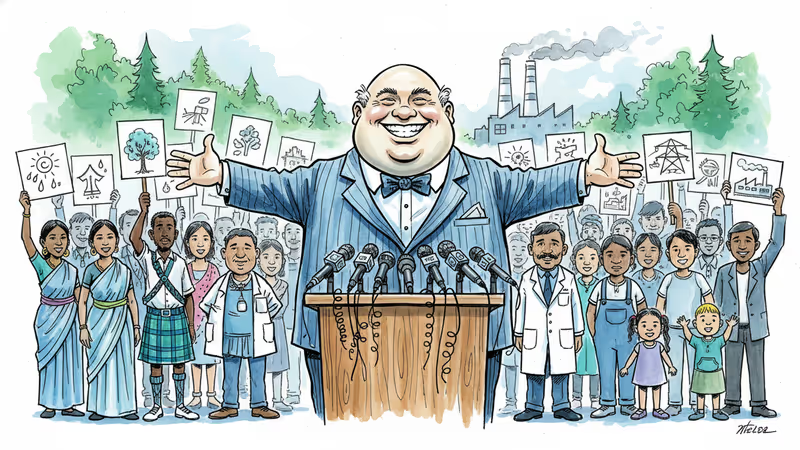
When Corporations Speak Up: The New Rules of Business Activism
From Apple to social media platforms, companies face growing pressure to take stands on social issues. But when does corporate activism help or hurt business?
What responsibility do you have to speak up when bad things happen in the world? And does that responsibility change when your voice could impact your bottom line?
The Verge's recent podcast episode cuts straight to the heart of a dilemma facing every modern company: whether to stay silent or speak out on social and political issues. From sports content creators to social media moderators to tech publications, every business now faces this choice.
The Price of Taking Sides
Corporate activism has become a high-stakes game. When Nike backed Colin Kaepernick in 2018, the company's stock initially dropped 3.2% in two days. Critics burned Nike shoes and called for boycotts. Yet within months, Nike's sales surged, and the campaign became a case study in successful brand positioning.
Apple has consistently spoken out on privacy rights and social issues, from opposing government backdoors to supporting LGBTQ+ rights. CEO Tim Cook has made it clear that staying silent isn't an option: "We only have one life, and it's the right thing to do." But this stance has created tensions in markets like China, where Apple's business interests sometimes conflict with its stated values.
The Silence Strategy
Not every company chooses to speak up. Many maintain what they call "political neutrality," focusing purely on business operations. During the 2020 racial justice protests, several major corporations initially stayed quiet, hoping to avoid alienating any customer segment.
But silence itself sends a message. Younger consumers, particularly Gen Z and millennials, increasingly expect brands to align with their values. A 2022 study by Edelman found that 67% of consumers choose brands based on their stance on social issues.
The Platform Dilemma
Social media platforms face unique challenges. They're not just businesses—they've become the public square where societal debates unfold. Twitter's transformation under Elon Musk into X exemplifies this tension. Musk's "free speech absolutist" approach has drawn both praise and criticism, while competitors like Meta maintain stricter content policies.

These platforms must balance free expression with advertiser concerns, regulatory pressure, and user safety. Their decisions affect not just their business but the broader information ecosystem.
The Authenticity Test
Consumers have become sophisticated at detecting performative activism—what critics call "woke-washing." Patagonia's decision to donate the company to fight climate change felt authentic because environmental activism has been core to the brand for decades. When Ben & Jerry's speaks out on social justice, it aligns with their long history of activism.
But when companies suddenly discover social causes during PR crises, consumers notice. The key isn't just what you say, but whether your actions match your words over time.
The Global Complexity
Multinational corporations face an additional challenge: different markets have different values. What plays well in California might alienate customers in Texas—or Beijing. Disney's experience with Florida's "Don't Say Gay" bill illustrates this complexity. The company's initial silence angered employees and customers, but speaking out triggered a political backlash that continues today.
Tech companies particularly struggle with this global balancing act. Platforms that promote free speech in Western markets must navigate authoritarian governments elsewhere, creating inherent contradictions in their policies.
The New Rules
Several principles are emerging for companies navigating this landscape:
Authenticity matters more than perfection. Consumers forgive companies that make mistakes while genuinely trying to do better, but they punish obvious pandering.
Actions speak louder than statements. Posting a black square on social media isn't enough—consumers want to see concrete changes in hiring, partnerships, and business practices.
Consistency builds trust. Companies that flip-flop on issues based on public pressure lose credibility with all sides.
Authors
Related Articles
As Trump's immigration crackdown intensifies, tech CEOs remain strategically silent while employees describe a culture of fear and uncertainty about their companies' commitment to protecting them.
Samsung Electronics' union branch revealed that 84% of survey respondents oppose the government's roughly $290 billion (₩400 trillion) semiconductor megaproject in Gwangju. Government, management, the union and shareholders are all reading the same national project in sharply different ways.
Nvidia shipped roughly a billion RISC-V cores in 2024, then announced it would run CUDA on the open standard. We break down how royalty-free instruction sets and open software stacks are trying to route around CUDA's lock-in. Part 2 of the Semiconductor Sovereignty series.
US AI-chip export controls split into three layers in the first half of 2026 — January easing, a May crackdown on circumvention, and a pending bill. Nvidia erased China from its guidance and still posted a record $81.6 billion quarter. A look at the export policy that both shields and cages it.
As Trump's immigration crackdown intensifies, tech CEOs remain strategically silent while employees describe a culture of fear and uncertainty about their companies' commitment to protecting them.
Samsung Electronics' union branch revealed that 84% of survey respondents oppose the government's roughly $290 billion (₩400 trillion) semiconductor megaproject in Gwangju. Government, management, the union and shareholders are all reading the same national project in sharply different ways.
Nvidia shipped roughly a billion RISC-V cores in 2024, then announced it would run CUDA on the open standard. We break down how royalty-free instruction sets and open software stacks are trying to route around CUDA's lock-in. Part 2 of the Semiconductor Sovereignty series.
US AI-chip export controls split into three layers in the first half of 2026 — January easing, a May crackdown on circumvention, and a pending bill. Nvidia erased China from its guidance and still posted a record $81.6 billion quarter. A look at the export policy that both shields and cages it.
Thoughts
Share your thoughts on this article
Sign in to join the conversation