
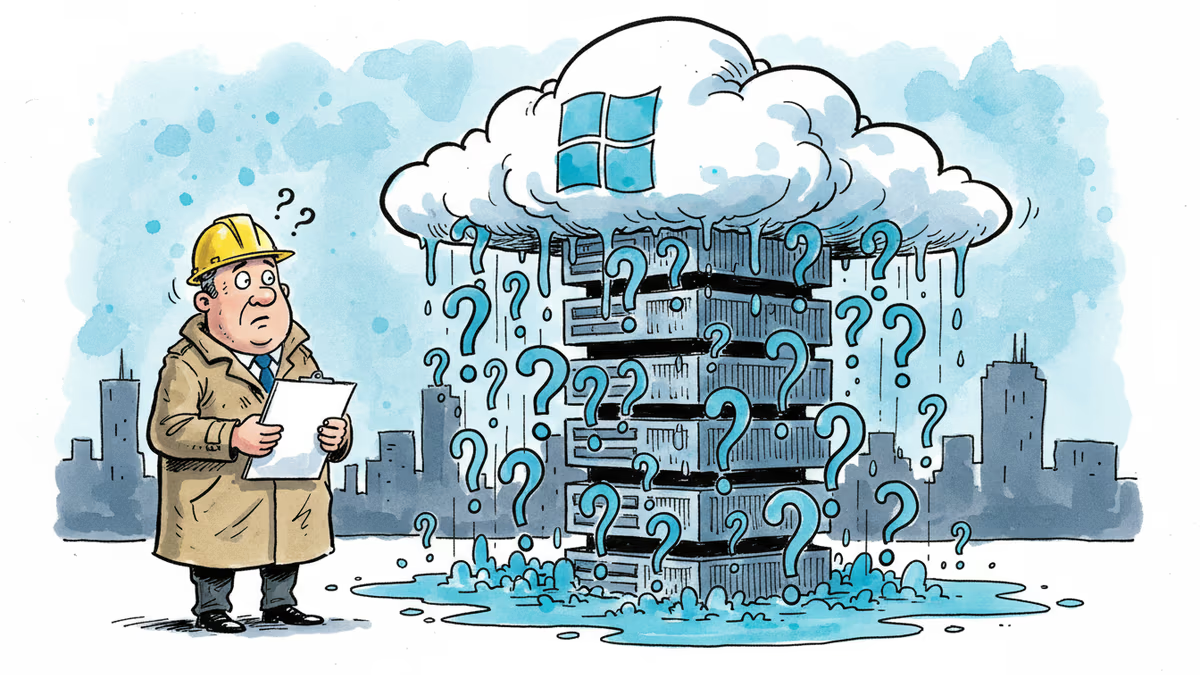
The Feds Called Microsoft's Cloud Security Docs 'A Pile of Sh*t
A U.S. government cybersecurity review found Microsoft's cloud documentation so inadequate that evaluators couldn't assess its security at all. Here's why that matters for everyone.
Somewhere in a federal government office in late 2024, a cybersecurity evaluator finished reading Microsoft's cloud security documentation and typed what everyone in the room was thinking: "The package is a pile of shit."
That line — buried in an internal government report obtained by ProPublica — is now very much public.
What Actually Happened
In late 2024, a U.S. federal cybersecurity evaluation team reviewed one of Microsoft's flagship cloud computing offerings. Their conclusion wasn't just critical — it was a statement of defeat. Microsoft's "lack of proper detailed security documentation" left the reviewers with a "lack of confidence in assessing the system's overall security posture."
Read that again: they couldn't assess it. Not "assessed it poorly." Couldn't do the job at all.
This wasn't a fringe auditor with a grudge. Federal cybersecurity evaluators are the gatekeepers for government cloud adoption. Their job is to certify that systems handling sensitive government data meet security standards. When they can't even evaluate a system, the entire framework of trust breaks down.
Why the Timing Stings
This evaluation didn't happen in a vacuum. It came in the wake of one of the most embarrassing stretches in Microsoft's security history. In 2023, Chinese state-backed hackers breached Microsoft's systems and accessed emails of senior U.S. government officials — including those in the State Department. A scathing report from the Cyber Safety Review Board later called Microsoft's security culture "inadequate."

In response, Microsoft CEO Satya Nadella launched the "Secure Future Initiative" and famously told employees that security would take priority over new features. The government's 2024 evaluation — which found documentation so poor that assessment was impossible — suggests the gap between the announcement and the reality remained wide.
Three Ways to Read This
For the federal government, this is a vendor accountability crisis in slow motion. Agencies from the Defense Department to Health and Human Services run on Microsoft's cloud infrastructure. If the documentation is so incomplete that evaluators can't assess risk, the government is essentially flying blind on the security posture of systems that handle classified and sensitive data. That's not a paperwork problem — it's a structural vulnerability.
For enterprise customers, the implications are uncomfortable. Corporations globally rely on Azure and Microsoft 365 for everything from HR systems to financial records. If the U.S. federal government — with its dedicated cybersecurity apparatus — couldn't get adequate documentation, what are private companies actually receiving when they sign enterprise agreements? Most businesses don't have the resources or leverage to demand the documentation the feds couldn't get.
For Microsoft, there's a counterargument worth acknowledging. Cloud security documentation is genuinely complex — spanning thousands of controls, configurations, and shared-responsibility boundaries. Some critics of the evaluation might argue that government requirements are inconsistent or that the "pile of shit" comment reflects frustration with bureaucratic process rather than actual insecurity. Microsoft has not publicly responded to the specific findings. But that silence is its own kind of statement.
The Bigger Pattern
This story sits inside a larger tension that's been building for years: governments and critical institutions have become deeply dependent on a handful of cloud providers — Microsoft, Amazon, Google — while their ability to independently verify the security of those platforms has lagged far behind.
The EU's DORA (Digital Operational Resilience Act), which came into force in January 2025, is partly a response to exactly this dynamic — forcing financial institutions to demand more rigorous documentation and audit rights from cloud vendors. The U.S. has no equivalent framework yet.
When a single vendor's cloud outage can ground airlines, shut down hospitals, and freeze government services — as CrowdStrike's July 2024 incident demonstrated — the question of who can actually audit these systems stops being academic.
Authors
Related Articles
A critical vulnerability in Starlette—downloaded 325 million times per week—puts millions of AI agent servers at risk, exposing stored credentials for email, databases, and third-party services.
Google is building AI agents that search the web proactively, without user prompting. That's not just a product update — it's a fundamental shift in who controls the information you receive.

GitHub confirmed hackers stole data from 3,800 internal repositories via a poisoned VS Code extension. Here's why developer tools are now the most dangerous attack surface in tech.
A Utah woman was sentenced to life in prison partly because of her Google searches and deleted texts. The Kouri Richins case reveals how digital footprints have become the courtroom's most reliable witness.
A critical vulnerability in Starlette—downloaded 325 million times per week—puts millions of AI agent servers at risk, exposing stored credentials for email, databases, and third-party services.
Google is building AI agents that search the web proactively, without user prompting. That's not just a product update — it's a fundamental shift in who controls the information you receive.
GitHub confirmed hackers stole data from 3,800 internal repositories via a poisoned VS Code extension. Here's why developer tools are now the most dangerous attack surface in tech.
A Utah woman was sentenced to life in prison partly because of her Google searches and deleted texts. The Kouri Richins case reveals how digital footprints have become the courtroom's most reliable witness.
Thoughts
Share your thoughts on this article
Sign in to join the conversation