
Mapping the China AI Algorithm Registry Ecosystem: Beyond DeepSeek's Global Rise
DeepSeek is just one of thousands. Explore the China AI algorithm registry ecosystem, where over 22% of models are state-linked, and vertical AI is revolutionizing carbon audits and robotics.
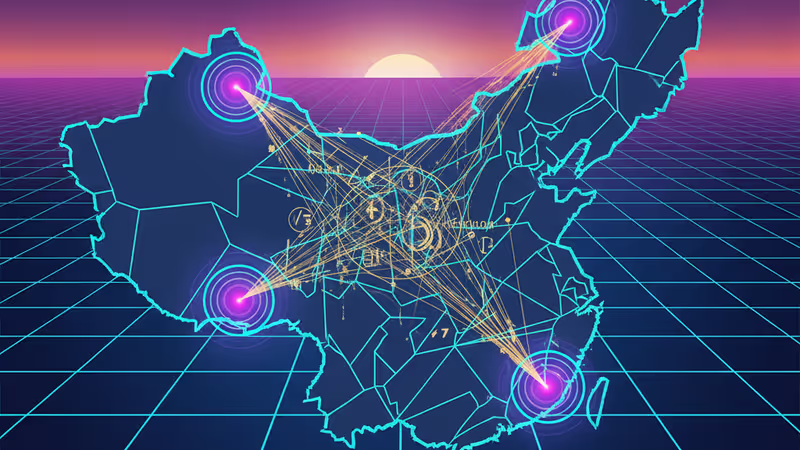
One database tracks thousands of AI models. While DeepSeek captured global headlines in early 2025, it was merely entry number 152 in a vast, state-mandated archive. Since 2023, China has quietly built the world's most detailed map of a nation's AI ecosystem through its mandatory algorithm registry.
The China AI Algorithm Registry Ecosystem: Regulation as a Roadmap
The Cyberspace Administration of China (CAC) requires every developer launching tools with "public opinion properties" to file their algorithms. This process, according to experts at Trivium China, has created an unprecedented view of technological progress. As of April 2025, state-linked filings—from state-owned enterprises to government-backed institutes—account for 22% of the total registry, showcasing a deep integration between the public and private sectors.

From Humanoids to Carbon Audits: AI's Vertical Expansion
Innovation is no longer confined to the coasts. While Beijing and Shenzhen remain dominant, Hefei has emerged as a speech-recognition powerhouse, and Guizhou powers heavy-duty models like Huawei's Pangu through its massive data centers. Startups are finding immense value in niche applications: Zhongtan Puhui reports its AI agents can complete carbon emission audits in 15 minutes, a task that previously took 30 days, at 10% of the original cost.
- Squirrel AI: Operates 3,000+ centers serving 1.2 million students.
- UBtech: First humanoid robot firm to list on the HKEX; sells to 40+ countries.
- XVerse: Its app 'Saylo' reached 20 million users worldwide.
Authors
Related Articles
DeepSeek's V4 won't replicate the R1 shock—but it redraws the open-source AI map on pricing, long-context efficiency, and China's push to ditch Nvidia. Here's what's worth watching.
Stanford-Princeton study reveals systematic censorship in Chinese AI models. DeepSeek refuses 36% of sensitive questions while US models refuse less than 3%.
Anthropic exposes how DeepSeek, Moonshot AI, and MiniMax used 24,000+ fake accounts to steal Claude's capabilities through 16 million conversations. The scale and implications revealed.
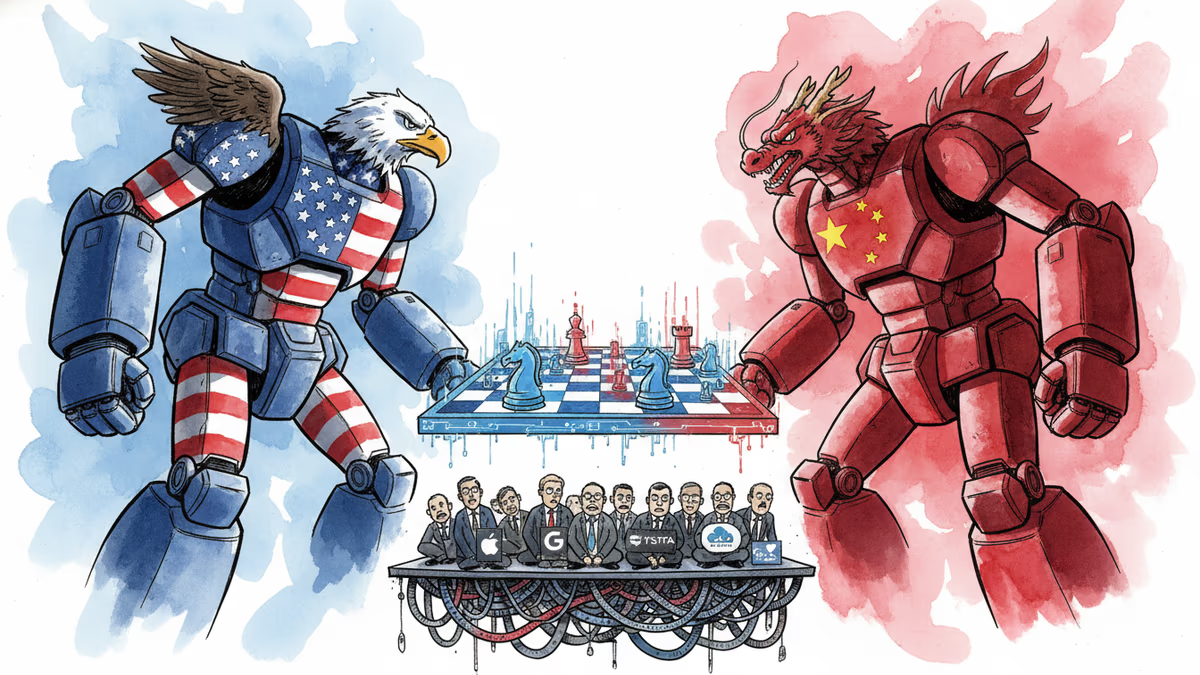
OpenAI accused DeepSeek of stealing AI capabilities before any new model launch. The real battle isn't about copying—it's about who controls AI's future.
DeepSeek's V4 won't replicate the R1 shock—but it redraws the open-source AI map on pricing, long-context efficiency, and China's push to ditch Nvidia. Here's what's worth watching.
Stanford-Princeton study reveals systematic censorship in Chinese AI models. DeepSeek refuses 36% of sensitive questions while US models refuse less than 3%.
Anthropic exposes how DeepSeek, Moonshot AI, and MiniMax used 24,000+ fake accounts to steal Claude's capabilities through 16 million conversations. The scale and implications revealed.
OpenAI accused DeepSeek of stealing AI capabilities before any new model launch. The real battle isn't about copying—it's about who controls AI's future.
Thoughts
Share your thoughts on this article
Sign in to join the conversation