
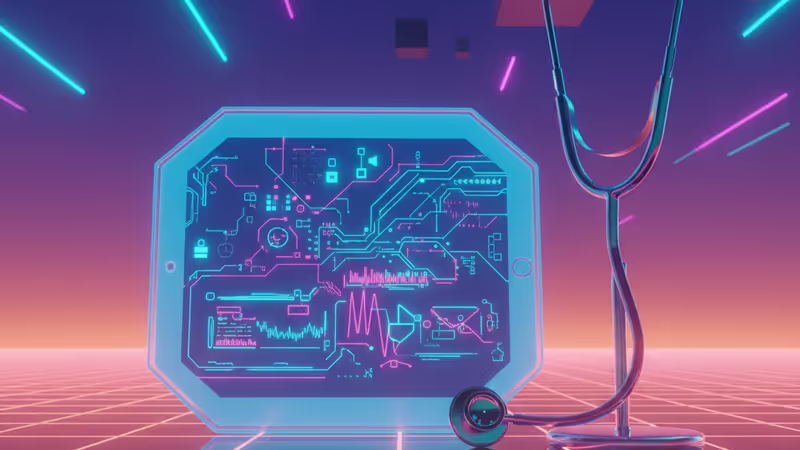
The Pitt Season 2 AI Accuracy GPT-5.2: Debunking the 98% Myth
Exploring the reality of medical AI accuracy as portrayed in 'The Pitt' Season 2. Analyzing OpenAI's GPT-5.2 hallucination rates and the role of AI in hospitals.
Can you trust a machine that's wrong 10% of the time with your life? The latest episode of HBO Max’s The Pitt Season 2 has sparked an intense debate over the integration of generative AI in emergency rooms. While Dr. Baran Al-Hashimi claims that AI will slash charting time by 80%, real-world data suggests a much messier reality.
The Pitt Season 2: Fact-Checking the 98% AI Accuracy Claim
In the show, Dr. Al-Hashimi states that generative AI is 98% accurate at present. However, fact-checking this claim reveals significant caveats. While a systematic review in the BMC Medical Informatics journal found accuracy rates of 98% in controlled, quiet environments, those numbers plummet in noisy, high-pressure ER settings. In environments with heavy crosstalk and medical jargon, accuracy can drop as low as 50%.

GPT-5.2 Hallucination Rates and the Reality of Medical AI
The gap between fiction and reality is further highlighted by current tech benchmarks. According to OpenAI, its recently released GPT-5.2 Thinking model has an average hallucination rate of 10.9%. Even with internet access, the error rate only drops to 5.8%. For a physician, being wrong nearly 6% to 11% of the time is a catastrophic margin of error in patient care.
Authors
Related Articles

OpenAI has reorganized for the second time in a month, merging ChatGPT and Codex into a single agentic platform under president Greg Brockman's unified product leadership.
After two weeks of witnesses calling him a liar, OpenAI CEO Sam Altman testified in his own defense, claiming Elon Musk tried to kill the company twice.
Sam Nelson, 19, died after following ChatGPT's advice to mix Kratom and Xanax. His parents are suing OpenAI for wrongful death, raising urgent questions about AI trust, liability, and design.
OpenAI's new Daybreak initiative uses the Codex AI agent to find and patch security vulnerabilities before attackers do—putting it in direct competition with Anthropic's secretive Claude Mythos.
OpenAI has reorganized for the second time in a month, merging ChatGPT and Codex into a single agentic platform under president Greg Brockman's unified product leadership.
After two weeks of witnesses calling him a liar, OpenAI CEO Sam Altman testified in his own defense, claiming Elon Musk tried to kill the company twice.
Sam Nelson, 19, died after following ChatGPT's advice to mix Kratom and Xanax. His parents are suing OpenAI for wrongful death, raising urgent questions about AI trust, liability, and design.
OpenAI's new Daybreak initiative uses the Codex AI agent to find and patch security vulnerabilities before attackers do—putting it in direct competition with Anthropic's secretive Claude Mythos.
Thoughts
Share your thoughts on this article
Sign in to join the conversation