
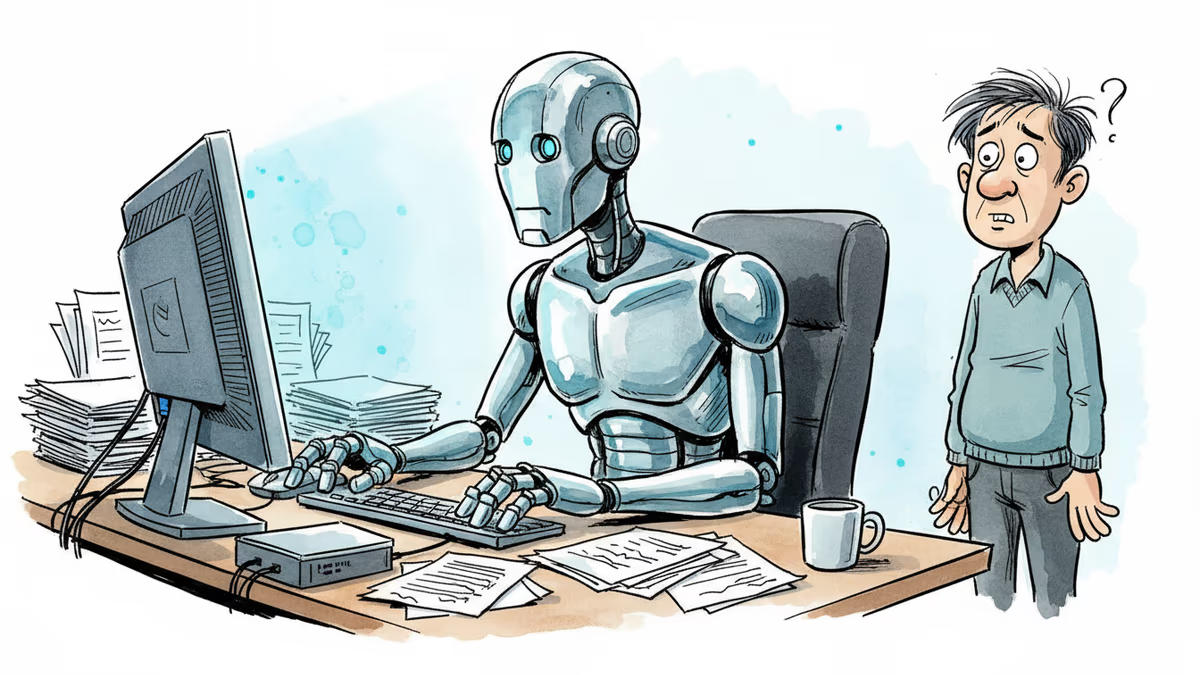
AI Just Learned to Use Your Computer
OpenAI's GPT-5.4 can now control mouse and keyboard directly. Is this the end of office work as we know it?
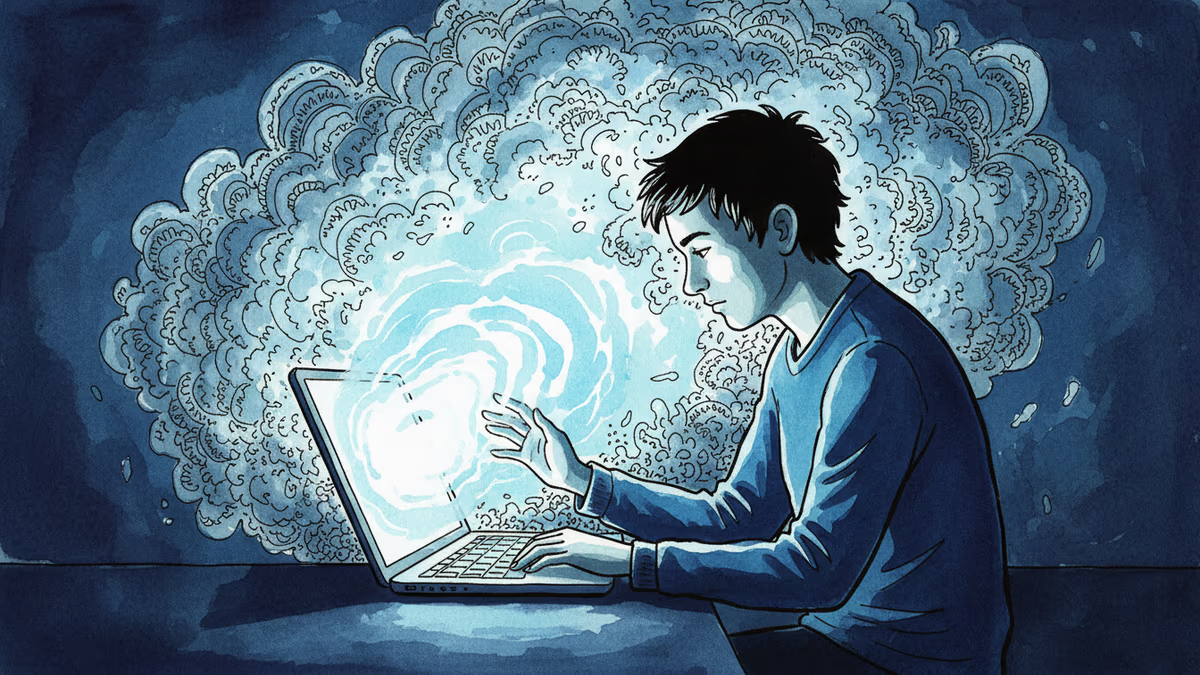
Click. Type. Read. Repeat. The mundane rhythm of office work just got a new player. OpenAI's GPT-5.4 doesn't just generate text anymore—it can see your screen, move your mouse, and tap your keyboard like a digital colleague who never takes coffee breaks.
This isn't just another incremental update. It's OpenAI's response to a growing exodus of users jumping ship to Anthropic and Google's competing models. The timing reveals everything: when your users start looking elsewhere, you don't just improve—you leap ahead.
The AI That Watches and Acts
GPT-5.4 works by taking periodic screenshots of your desktop or applications, analyzing what's on screen, then executing mouse clicks or keyboard inputs accordingly. Think of it as having an intern who can actually see what you're working on and help accordingly—except this intern never gets tired, never makes small talk, and processes information at superhuman speed.
OpenAI calls this their "first model explicitly aimed at computer-use tasks." Translation: they're targeting the $4.3 trillion knowledge work sector that runs on clicking, typing, and copying between applications. Email management, spreadsheet updates, report generation—the bread and butter of office life.
But here's what makes this launch particularly interesting: it's reactive, not proactive. Anthropic's Claude and Google's Gemini have been showcasing similar capabilities for months, slowly chipping away at OpenAI's dominance. GPT-5.4 is essentially OpenAI saying, "We can do that too—and better."
The Office Revolution Nobody Asked For
For millions of knowledge workers, this could be either liberation or disruption—possibly both. Administrative assistants who spend hours scheduling meetings and updating databases might find their roles fundamentally transformed. Financial analysts who manually pull data from multiple systems could see their workflows compressed from hours to minutes.

But let's be realistic about what this means for actual humans. The promise of AI freeing us from mundane tasks to focus on "more strategic work" has been repeated so often it's become corporate gospel. Yet history suggests a more complex reality: when technology automates one type of work, it often creates new types of work we never anticipated.
Consider the implications for different sectors. In finance, AI agents could handle routine compliance reporting and data entry—but someone still needs to verify accuracy and handle exceptions. In marketing, they might automate campaign setup and performance tracking—but creative strategy and client relationships remain distinctly human domains.
The Race Nobody's Talking About
While tech blogs focus on which model can click buttons more accurately, the real competition is about something deeper: who gets to define how AI agents integrate into our daily workflows. Microsoft has Copilot embedded across Office 365. Google is pushing Workspace integration. OpenAI is betting on being the best standalone agent.
This isn't just about features—it's about platform lock-in on a massive scale. Once your organization's workflows are optimized for one AI system, switching becomes exponentially more difficult. The stakes are enormous: whoever wins this race doesn't just get users, they get to shape how entire industries operate.
The security implications alone should give IT departments pause. An AI that can control your computer has unprecedented access to sensitive data. Unlike human employees, AI agents don't have intuitive understanding of what information should or shouldn't be shared. They follow instructions literally, which can be both their greatest strength and most dangerous weakness.
What Happens Next?
The accelerated release cadence OpenAI mentions isn't just about staying competitive—it's about preventing competitors from establishing market dominance while the technology is still nascent. Every month of delay could mean losing enterprise customers to rivals who ship first, even if their solutions are inferior.
But speed comes with costs. Rushed AI deployments in enterprise environments have historically led to unexpected failures, security vulnerabilities, and user frustration. The pressure to ship quickly might conflict with the careful testing and gradual rollout that enterprise AI actually requires.
Authors
Related Articles
Anthropic shipped Claude Sonnet 5, its mid-tier agent model, on June 30. Behind the 'Opus-class power, budget price' headline sits a tokenizer catch and a three-horse race that's only half real. Here's what developers should actually run the numbers on.
OpenAI has reorganized for the second time in a month, merging ChatGPT and Codex into a single agentic platform under president Greg Brockman's unified product leadership.
After two weeks of witnesses calling him a liar, OpenAI CEO Sam Altman testified in his own defense, claiming Elon Musk tried to kill the company twice.
Sam Nelson, 19, died after following ChatGPT's advice to mix Kratom and Xanax. His parents are suing OpenAI for wrongful death, raising urgent questions about AI trust, liability, and design.
Anthropic shipped Claude Sonnet 5, its mid-tier agent model, on June 30. Behind the 'Opus-class power, budget price' headline sits a tokenizer catch and a three-horse race that's only half real. Here's what developers should actually run the numbers on.
OpenAI has reorganized for the second time in a month, merging ChatGPT and Codex into a single agentic platform under president Greg Brockman's unified product leadership.
After two weeks of witnesses calling him a liar, OpenAI CEO Sam Altman testified in his own defense, claiming Elon Musk tried to kill the company twice.
Sam Nelson, 19, died after following ChatGPT's advice to mix Kratom and Xanax. His parents are suing OpenAI for wrongful death, raising urgent questions about AI trust, liability, and design.
Thoughts
Share your thoughts on this article
Sign in to join the conversation