
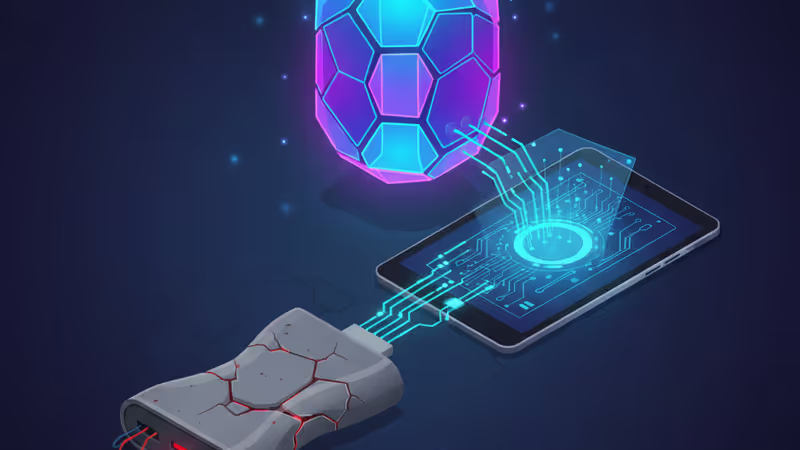
The Power Bank Is Obsolete. Hyper's Founder Is Betting on a Post-Lithium Future.
Hyper's founder is back with BMX and semi-solid state batteries. Is this the end of lithium-ion fire risk and the start of a new era for portable power?
The Lede: Beyond the Battery Brick
The humble power bank in your carry-on has become a source of anxiety. It’s not just about charge anymore; it’s about safety. A recent wave of lithium-ion battery recalls has put the entire category under scrutiny from the FAA and airlines, transforming a travel essential into a potential liability. Into this trust vacuum steps Daniel Chin, the celebrated founder of Hyper, with a new venture, BMX. He isn't just launching another battery; he's betting that a new chemistry—semi-solid state—can solve the safety and longevity crisis plaguing our portable power.
Why It Matters: The Great Battery Reset
This is more than a new product launch; it’s the start of a fundamental reset in the mobile accessory market. The 'power bank' category, long a race to the bottom on price, is being fractured by a new, premium tier defined by technology, not just capacity.
- The End of Commodity Trust: The era of grabbing the cheapest, biggest power bank is over. Safety, once an assumed feature, is now the primary selling point. This creates a market-opening for premium brands that can credibly offer a safer alternative.
- The Regulatory Moat: As aviation authorities tighten rules around traditional lithium-ion batteries, products built on inherently safer chemistries like semi-solid state could gain a significant competitive advantage, potentially even becoming the preferred standard for air travel.
- A New Axis of Innovation: For years, innovation in power banks meant slightly faster charging or a slimmer profile. BMX and its peers are shifting the battleground to core battery science, promising double the lifespan and a stable chemistry that mitigates the risk of thermal runaway.

The Analysis: Pedigree Meets Propulsion
To understand BMX's potential, you must understand its founder. Daniel Chin built Sanho's Hyper brand into an institution for Apple power users by obsessing over the details and anticipating the ecosystem's needs. He didn't just sell chargers; he sold integrated solutions. Targus acquired his company for that very expertise. Now, Chin is applying that same playbook to a much deeper problem.
This move pits agile newcomers like BMX against established giants like Anker and Mophie. The incumbents face a classic innovator's dilemma: do they risk cannibalizing their highly optimized, low-cost lithium-ion supply chains to invest in a nascent, more expensive technology? This hesitation gives BMX a crucial window to establish semi-solid state as the new gold standard for discerning users.
The term "semi-solid state" is itself a strategic masterstroke. It's a pragmatic bridge technology—safer and more durable than liquid lithium-ion, but more manufacturable and cost-effective today than a pure solid-state battery. It allows BMX to deliver next-generation benefits without waiting for the “holy grail” of battery tech to fully mature.
PRISM's Take: Your Next Power Bank Won't Be a Power Bank
BMX isn't just selling a better battery; it's selling peace of mind. In a world of exploding chargers and airline warnings, that's an invaluable commodity. Chin's proven track record in the high-stakes Apple accessory market provides the credibility needed to command a premium for this technological leap.
The immediate challenge will be educating consumers to look beyond milliamp-hours and understand the intrinsic value of superior chemistry. However, the market is primed for this change. The success of BMX’s SolidSafe won't just be measured in units sold, but in how quickly it forces the rest of the industry to abandon the volatile, aging technology of the past. This is the beginning of the end for the traditional power bank as we know it.
Authors
Related Articles

Finnish startup Donut Lab has cleared its biggest credibility hurdle: independent testing by state-owned VTT confirms its solid-state battery is the real thing. What does this mean for the race to commercialize next-gen batteries?
Behind Apple AirPods discounts and Lego roses lies a deeper strategy. How weekend deals shape consumer behavior and ecosystem lock-in tactics.

Bambu Lab's P1S 3D printer changes everything about home manufacturing - but what happens when making things becomes this easy?

Chinese researchers have solved the 30-year sulfur battery decay problem using chlorine. Discover how this sodium-sulfur breakthrough could lead to cheaper, high-density energy storage.
Finnish startup Donut Lab has cleared its biggest credibility hurdle: independent testing by state-owned VTT confirms its solid-state battery is the real thing. What does this mean for the race to commercialize next-gen batteries?
Behind Apple AirPods discounts and Lego roses lies a deeper strategy. How weekend deals shape consumer behavior and ecosystem lock-in tactics.
Bambu Lab's P1S 3D printer changes everything about home manufacturing - but what happens when making things becomes this easy?
Chinese researchers have solved the 30-year sulfur battery decay problem using chlorine. Discover how this sodium-sulfur breakthrough could lead to cheaper, high-density energy storage.
Thoughts
Share your thoughts on this article
Sign in to join the conversation