
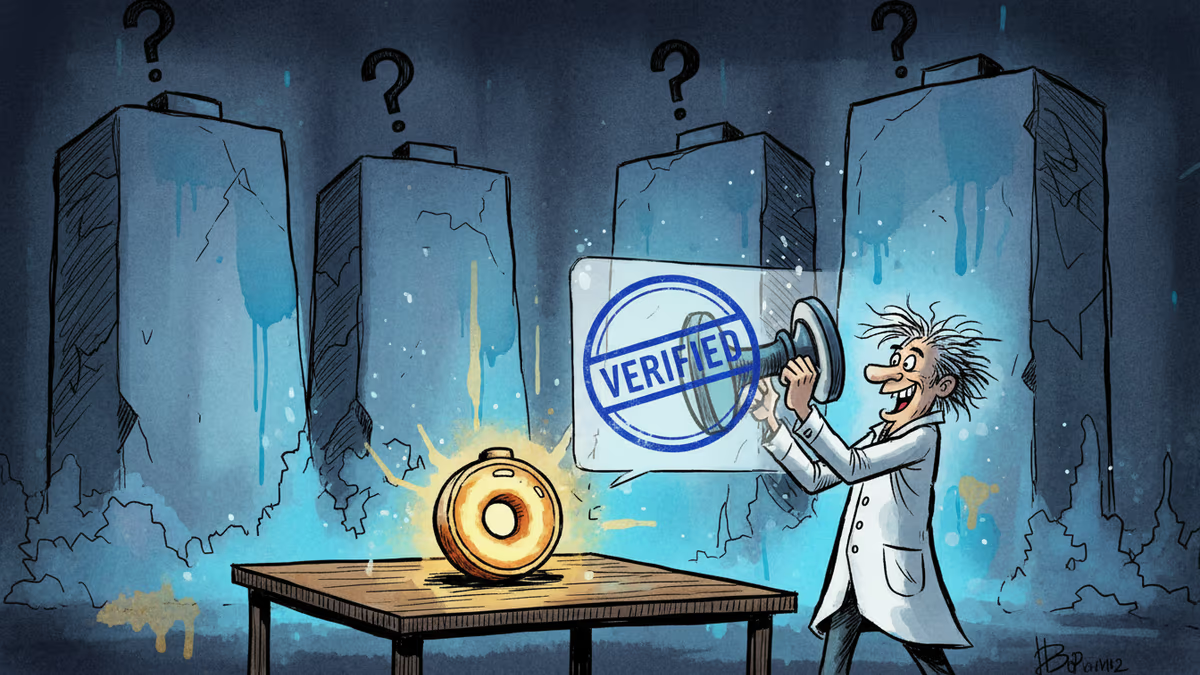
Not a Supercapacitor After All — Donut Lab Has Proof
Finnish startup Donut Lab has cleared its biggest credibility hurdle: independent testing by state-owned VTT confirms its solid-state battery is the real thing. What does this mean for the race to commercialize next-gen batteries?
In the battery world, being called a supercapacitor is not a compliment.
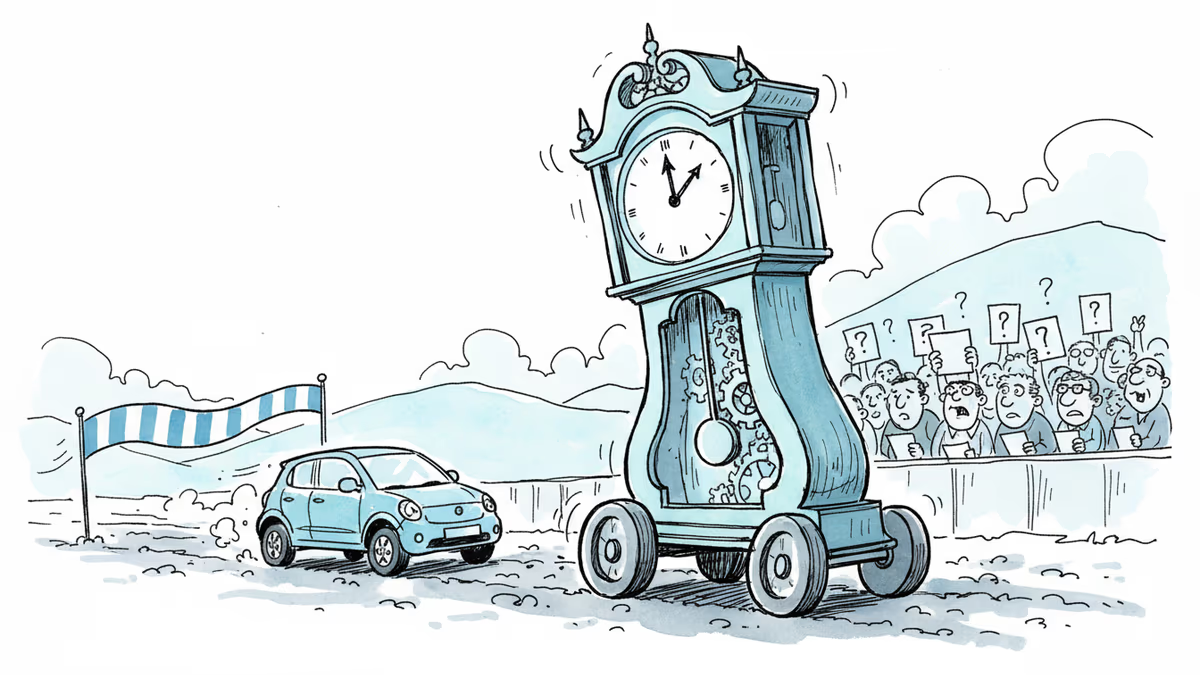
When Donut Lab, a Finnish startup, unveiled what it claimed was a working solid-state battery earlier this year, skeptics immediately raised a pointed question: was this actually a supercapacitor dressed up as something more impressive? It wasn't an idle accusation. The two technologies can look deceptively similar from the outside — both charge and discharge quickly — but they are fundamentally different animals.
The Supercapacitor Problem
A supercapacitor stores energy electrostatically, not chemically. It can absorb and release electricity at remarkable speed, which is why it shows up in regenerative braking systems and camera flashes. But it holds far less energy than a battery and isn't suited for sustained, long-duration power delivery. If Donut Lab's product were actually a supercapacitor, its claims about solid-state battery technology would be, at best, misleading.
The distinction matters enormously for the markets Donut Lab is targeting — electric vehicles, grid storage, and consumer electronics. In those applications, energy density and cycle life are everything. A supercapacitor simply doesn't cut it.
VTT Steps In
Donut Lab's answer to the skeptics: independent verification. The company commissioned VTT, Finland's state-owned technical research centre, to test its product. The results, now published, confirm that what Donut Lab built is a genuine battery — one that demonstrates both fast charge-discharge characteristics and sufficient energy storage capacity to qualify as the real thing.

Solid-state batteries replace the liquid electrolyte in conventional lithium-ion cells with a solid material. The theoretical benefits are significant: lower fire risk, higher energy density, and longer lifespan. The catch is that no one has managed to manufacture them at scale. Toyota, Samsung SDI, and QuantumScape have collectively spent billions chasing this goal and are still years away from mass production.
Why a Startup's Lab Result Actually Matters
Independent verification by a credible institution changes the conversation around Donut Lab in concrete ways. Before the VTT results, the company was a promising claim. After them, it's a verified data point in a field where verified data points are scarce.
For investors, that distinction is worth real money. For automakers scouting battery partnerships, it's an invitation to take a closer look. For competitors — the large incumbents with their multi-billion-dollar R&D budgets — it's a reminder that breakthrough results don't require a giga-factory to emerge from.
The timing is also notable. EV adoption has hit a rough patch in several major markets, with consumer hesitation driven partly by battery anxiety: charging time, range, longevity, safety. Solid-state batteries are the most credible technology candidate to address all four concerns simultaneously. Any credible progress in that direction carries outsized significance right now.
The Gap Between 'Working' and 'Scalable'
None of this means Donut Lab is about to disrupt CATL or Panasonic. There is a vast distance between a verified lab result and a battery cell rolling off a production line by the millions. Materials sourcing, manufacturing yield, cost per kilowatt-hour, thermal management at scale — these are the problems that have humbled far larger organizations.
The more immediate question is what happens next. Does Donut Lab pursue independent scale-up? Does it become an acquisition target for a major automaker or battery conglomerate? Does it license its technology? The history of battery innovation is littered with startups that proved the science but couldn't navigate the industrial economics.
Authors
Related Articles
Elon Musk confirmed on Tesla's Q1 2026 earnings call that Hardware 3 vehicles will never receive unsupervised Full Self-Driving — locking out millions who paid for the feature.
CATL's third-gen Shenxing LFP battery claims charging speeds nearly 5x faster than Hyundai or Porsche's best 800V systems. Here's what that really means.
The Netherlands became the first European country to officially approve Tesla's FSD Supervised. With EU's type-approval framework, this could ripple across 27 member states fast.
Rivian's R2 SUV launches in June with a target of 20,000–25,000 units by year-end. If it hits even the low end, it would outsell every EV under $60K except the Tesla Model Y. Here's what's really at stake.
Elon Musk confirmed on Tesla's Q1 2026 earnings call that Hardware 3 vehicles will never receive unsupervised Full Self-Driving — locking out millions who paid for the feature.
CATL's third-gen Shenxing LFP battery claims charging speeds nearly 5x faster than Hyundai or Porsche's best 800V systems. Here's what that really means.
The Netherlands became the first European country to officially approve Tesla's FSD Supervised. With EU's type-approval framework, this could ripple across 27 member states fast.
Rivian's R2 SUV launches in June with a target of 20,000–25,000 units by year-end. If it hits even the low end, it would outsell every EV under $60K except the Tesla Model Y. Here's what's really at stake.
Thoughts
Share your thoughts on this article
Sign in to join the conversation