

The End of Lithium? Sodium-Sulfur Chlorine Battery Research Breakthrough
Chinese researchers have solved the 30-year sulfur battery decay problem using chlorine. Discover how this sodium-sulfur breakthrough could lead to cheaper, high-density energy storage.
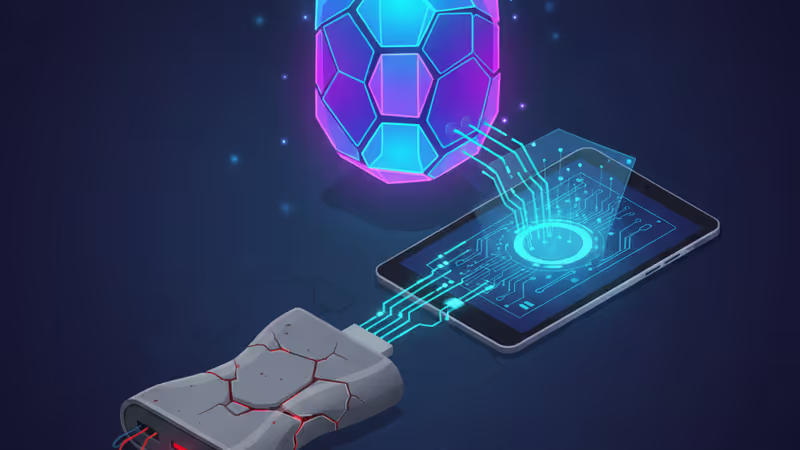
The battery world's cost structure is about to get a major shakeup. After decades of struggling with sulfur's volatile chemistry, a Chinese research team has unlocked a way to make it the star of the show using an unlikely partner: chlorine.
Sodium-Sulfur Chlorine Battery: Solving the Decay Puzzle
For years, sulfur has been the 'holy grail' of battery research due to its massive power density. However, it's notorious for forming unwanted materials that kill a battery's lifespan. This rapid decay kept lithium-sulfur batteries off the market despite their promise.

The researchers didn't just fight sulfur's complexity—they embraced it. By introducing chlorine into the mix, they've created a sodium-sulfur battery where sulfur acts as the primary electron donor. This pivot allows for impressive energy storage using materials that are significantly cheaper than today's rare metals.
Affordable Power for the Masses
This isn't just a win for the lab; it's a potential win for the consumer. Sodium and sulfur are abundant and dirt-cheap compared to lithium and cobalt. If this laboratory success scales, it could drastically lower the cost of electric vehicles and large-scale energy storage systems (ESS).
Authors
Related Articles

Finnish startup Donut Lab has cleared its biggest credibility hurdle: independent testing by state-owned VTT confirms its solid-state battery is the real thing. What does this mean for the race to commercialize next-gen batteries?

Scientists crack the molecular code for storing summer heat until winter arrives. Could this breakthrough finally make fossil fuel heating obsolete?

Lunar Energy raises $232M as stationary battery storage becomes the hottest investment in energy tech. Virtual power plants could replace costly peaking plants within years.
Hyper's founder is back with BMX and semi-solid state batteries. Is this the end of lithium-ion fire risk and the start of a new era for portable power?
Finnish startup Donut Lab has cleared its biggest credibility hurdle: independent testing by state-owned VTT confirms its solid-state battery is the real thing. What does this mean for the race to commercialize next-gen batteries?
Scientists crack the molecular code for storing summer heat until winter arrives. Could this breakthrough finally make fossil fuel heating obsolete?
Lunar Energy raises $232M as stationary battery storage becomes the hottest investment in energy tech. Virtual power plants could replace costly peaking plants within years.
Hyper's founder is back with BMX and semi-solid state batteries. Is this the end of lithium-ion fire risk and the start of a new era for portable power?
Thoughts
Share your thoughts on this article
Sign in to join the conversation