
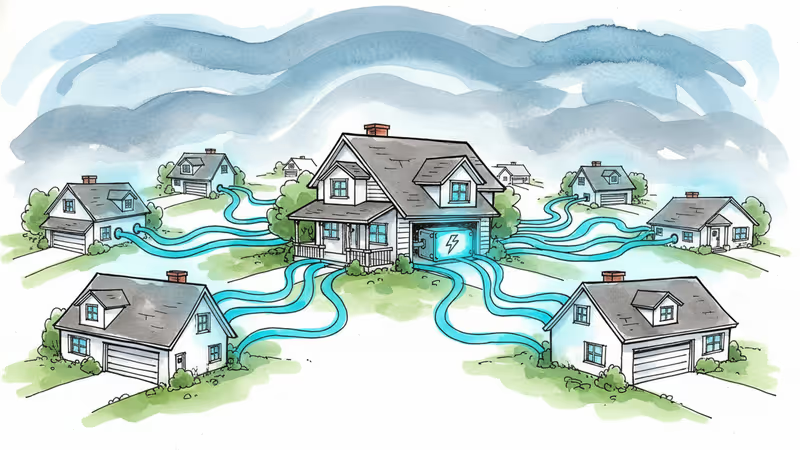
Why Investors Are Ditching EVs for Home Batteries
Lunar Energy raises $232M as stationary battery storage becomes the hottest investment in energy tech. Virtual power plants could replace costly peaking plants within years.
Forget electric vehicles—the smart money is flowing into batteries that never leave the house. Lunar Energy's latest funding announcement proves investors are betting big on stationary storage over automotive applications.
The $232 Million Vote of Confidence
The six-year-old startup just closed two massive funding rounds back-to-back: a $130 million Series C led by Activate Capital and a $102 million Series D from B Capital and Prelude Ventures. That brings Lunar Energy's total funding to over $500 million—a war chest that signals serious ambitions in the home battery space.
Lunar Energy installs battery packs in homes across California, Georgia, and Washington. But these aren't just backup power systems for blackouts. The company's 15kWh and 30kWh modules are nodes in something much bigger: a virtual power plant that can supply electricity to the grid when demand peaks.
The startup plans aggressive scaling—from 20,000 units by year-end to 100,000 units by 2028. That's the kind of manufacturing ramp typically reserved for consumer electronics, not energy infrastructure.
Why Home Batteries Beat Car Batteries
The timing isn't coincidental. Trump's gutting of key Inflation Reduction Act provisions has created policy whiplash for automotive battery manufacturers who'd planned massive U.S. production facilities. Meanwhile, stationary storage has emerged as the bright spot in an otherwise turbulent sector.
The math is compelling. America's electrical grid is straining under dual pressures: an increasingly electrified economy and exploding data center demand from AI. Traditional solutions—building more power plants and transmission lines—take decades and cost billions. Batteries can be deployed in months.

Lunar Energy's virtual power plant (VPP) software doesn't just store and release electricity. It orchestrates an entire ecosystem, controlling EV chargers and appliances to balance supply and demand in real-time. Industry experts believe such systems could replace costly, polluting peaking power plants within just a few years.
The Competition Heats Up
The space is getting crowded fast. Base Power raised a staggering $1 billion in October, just six months after a $200 million round. Tesla operates its own Powerwall-based VPP, while former Tesla executive J.B. Straubel's Redwood Materials has launched its own energy storage division. Even Ford wants in on the action.
This isn't just about startups anymore. The transformation from "batteries as backup" to "batteries as infrastructure" represents a fundamental shift in how we think about energy systems. Five years ago, these were bit players. Today, they're becoming the backbone of grid resilience.
The Modular Advantage
What makes batteries so attractive isn't just their technical capabilities—it's their modularity. Unlike traditional power plants that require massive upfront investments and years of construction, battery systems can be built incrementally. Start small, scale fast, adjust as needed.
Prices have been dropping rapidly too. While still expensive compared to some fossil fuel sources, the cost trajectory is clear. And unlike gas peakers that sit idle most of the time, batteries provide multiple revenue streams: grid services, peak shaving, renewable integration.
The Bigger Picture
This funding frenzy reflects a broader energy transition that's happening faster than most predicted. Distributed energy resources—solar panels, home batteries, smart inverters—are reshaping how electricity flows. The old model of centralized generation and one-way distribution is giving way to a dynamic, two-way energy marketplace.
For homeowners, it's about more than backup power. It's about participating in energy markets, potentially earning money from their batteries while contributing to grid stability. For utilities, it's about managing peak demand without building expensive infrastructure.
Authors
Related Articles
Scientists crack the molecular code for storing summer heat until winter arrives. Could this breakthrough finally make fossil fuel heating obsolete?
Massive fossil fuel outages during East Coast snowstorm show grid vulnerabilities, while Texas batteries prove their worth. What does this mean for energy security in an era of extreme weather?
170 million Americans face a historic deep freeze. The 2026 US record winter storm brings -50°F wind chills and threatens critical infrastructure.

Chinese researchers have solved the 30-year sulfur battery decay problem using chlorine. Discover how this sodium-sulfur breakthrough could lead to cheaper, high-density energy storage.
Scientists crack the molecular code for storing summer heat until winter arrives. Could this breakthrough finally make fossil fuel heating obsolete?
Massive fossil fuel outages during East Coast snowstorm show grid vulnerabilities, while Texas batteries prove their worth. What does this mean for energy security in an era of extreme weather?
170 million Americans face a historic deep freeze. The 2026 US record winter storm brings -50°F wind chills and threatens critical infrastructure.
Chinese researchers have solved the 30-year sulfur battery decay problem using chlorine. Discover how this sodium-sulfur breakthrough could lead to cheaper, high-density energy storage.
Thoughts
Share your thoughts on this article
Sign in to join the conversation