
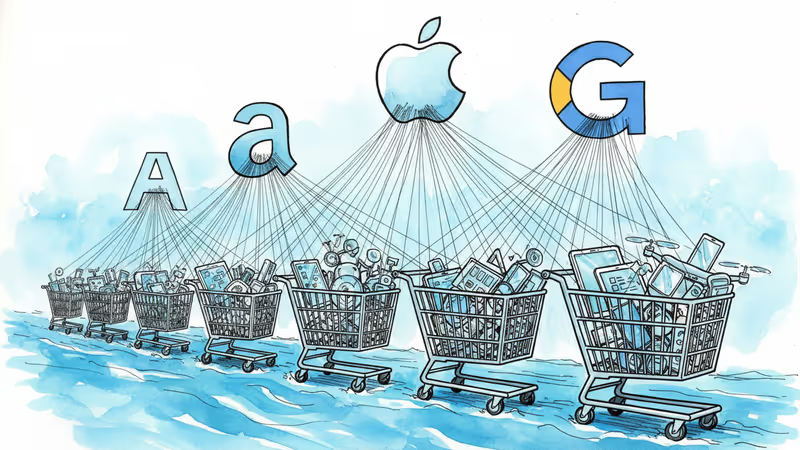
Weekend Deals Reveal More Than Just Savings
Behind Apple AirPods discounts and Lego roses lies a deeper strategy. How weekend deals shape consumer behavior and ecosystem lock-in tactics.
Apple AirPods 4 with ANC for $119. Lego roses for $9.91. Google TV Streamer for $79.99. On the surface, it's just another weekend of tech deals. But look closer, and these discounts reveal something more calculated than simple price cuts.
The Strategic Timing Behind the Savings
Why are these deals happening now? With Valentine's Day just three weeks away, companies aren't just clearing inventory—they're positioning themselves for maximum ecosystem capture. Apple's$50 discount on AirPods 4 isn't about being generous; it's about getting more users locked into their audio ecosystem before the gift-giving season hits peak momentum.
The Lego roses deal is particularly telling. At $9.91 for a 120-piece set, it's cheaper than most real bouquets, but it's also training consumers to think of plastic bricks as romantic gifts. It's a subtle shift in how we define meaningful presents—and Lego is betting that shift will stick beyond Valentine's Day.
Google's TV Streamer discount follows the same playbook. Drop the price by $20 to $79.99, and suddenly more living rooms have Google's gateway device. Once installed, users naturally gravitate toward Google's services, creating long-term value that far exceeds the initial discount.
The Real Cost of 'Free' Trials
Apple TV Plus offering a 30-day free trial might seem like pure consumer benefit, but it's actually one of the most sophisticated retention strategies in streaming. Get viewers hooked on shows like "Ted Lasso" or their acclaimed sci-fi content, and many will forget to cancel before the $12.99 monthly fee kicks in.
This isn't accidental. Streaming services have perfected the psychology of free trials—they know exactly how long it takes for a service to become habit-forming. The free month isn't a gift; it's an investment in future subscription revenue.

The pattern extends beyond entertainment. Whether it's Apple's ecosystem integration, Google's smart home connectivity, or subscription services' auto-renewal tactics, these deals are designed to create long-term customer relationships, not one-time transactions.
When Deals Become Traps
The AirPods 4 discount illustrates this perfectly. At $119, they're positioned as a budget-friendly alternative to the $199 AirPods Pro 3. But here's the catch: once you're using AirPods, switching to non-Apple earbuds means losing seamless device switching, spatial audio, and Find My integration. The initial savings become a gateway to ecosystem dependency.
Google's TV Streamer works similarly. Sure, it offers better performance than most smart TV interfaces, but it also means your viewing habits, voice commands, and smart home controls flow through Google's servers. The $20 discount is a small price for Google to pay for that level of data access.
Even the Lego roses represent a subtle form of market conditioning. By normalizing plastic flowers as romantic gifts, Lego is expanding beyond traditional toy categories into lifestyle and relationship markets. Today's $5 discount could reshape how an entire generation thinks about gift-giving.
The Consumer Paradox
Here's the uncomfortable truth: these deals often do provide genuine value while simultaneously serving corporate interests. The AirPods 4 really do offer excellent sound quality for $119. The Google TV Streamer genuinely improves most TV experiences. Apple TV Plus actually produces some of the best sci-fi content available.
But that doesn't make the underlying strategy any less calculated. Companies have learned to create win-win scenarios where consumers get immediate benefits while corporations secure long-term advantages. It's sophisticated enough that both sides can feel like they're winning—at least initially.
The real question isn't whether these deals offer value, but whether consumers understand the full cost of that value. When you buy discounted AirPods, you're not just buying earbuds—you're buying into Apple's vision of how audio should work. When you try Apple TV Plus for free, you're not just watching shows—you're training the algorithm that will influence your future viewing choices.
Authors
Related Articles

Bambu Lab's P1S 3D printer changes everything about home manufacturing - but what happens when making things becomes this easy?

Apple retains deep oversight on its 2026 Siri upgrade powered by Google Gemini. Discover how Apple is erasing Google branding and using local servers to protect user privacy.
A simple space heater review reveals a major tech trend: the battle for the intelligent home. Learn why this 'dumb' appliance matters for the future of tech.

Holiday tech gift guides reveal crucial shifts in consumer preferences, market maturity, and strategic opportunities for tech companies and investors. PRISM analyzes the deeper trends.
Bambu Lab's P1S 3D printer changes everything about home manufacturing - but what happens when making things becomes this easy?
Apple retains deep oversight on its 2026 Siri upgrade powered by Google Gemini. Discover how Apple is erasing Google branding and using local servers to protect user privacy.
A simple space heater review reveals a major tech trend: the battle for the intelligent home. Learn why this 'dumb' appliance matters for the future of tech.
Holiday tech gift guides reveal crucial shifts in consumer preferences, market maturity, and strategic opportunities for tech companies and investors. PRISM analyzes the deeper trends.
Thoughts
Share your thoughts on this article
Sign in to join the conversation