
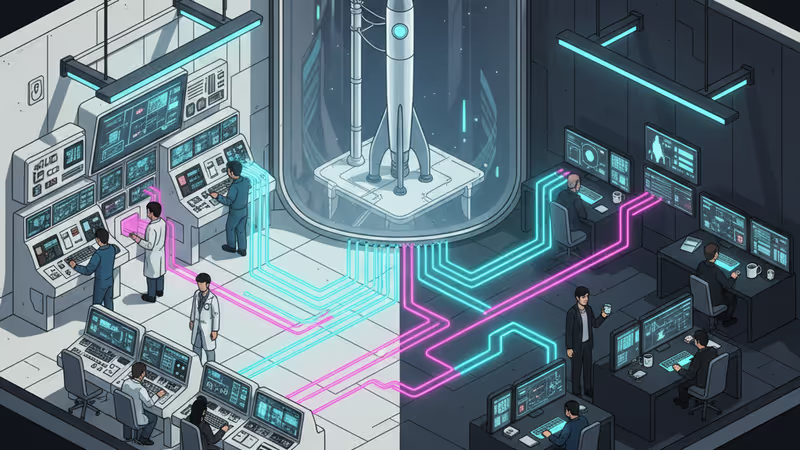
The Isaacman Era: Is NASA Now a Silicon Valley Spinoff?
Jared Isaacman's confirmation as NASA chief isn't just a leadership change. It's the ultimate fusion of private space and public ambition. Here's why it matters.
The Lede: The Rules of the Cosmos Just Changed
Jared Isaacman's Senate confirmation to lead NASA isn't just a new face in the administrator's office; it's a seismic shift signaling the final fusion of private ambition and public space exploration. For executives, investors, and strategists, this appointment is a flashing signal: the line between commercial space and national strategy has been erased. The world's most powerful space agency is now being run with the mindset of a tech founder who has personally flown on a competitor's rocket. The implications will be felt from Wall Street to low Earth orbit.
Why It Matters: A New Operating System for NASA
Isaacman’s ascent from SpaceX customer to NASA chief fundamentally alters the agency's trajectory and the competitive landscape. This isn't about policy tweaks; it's about a potential rewrite of NASA’s core operating system.
- Accelerated Commercialization: Forget pilot programs. Expect a firehose of public-private partnerships. Isaacman's entire career is a testament to the speed and efficiency of the commercial model. This means NASA is likely to double down on buying services—lunar landers, space stations, planetary probes—rather than owning and operating the hardware. This moves the agency from prime contractor to anchor tenant.
- Redefined Contractor Dynamics: The elephant in the room is Isaacman’s close relationship with Elon Musk. While he will face intense scrutiny to ensure fairness, his very presence changes the calculus for competitors like Blue Origin, Boeing, and Lockheed Martin. The culture of SpaceX—fast iteration, vertical integration, aggressive timelines—is now at the top of the food chain, forcing the entire legacy aerospace industry to adapt or risk obsolescence.
- A Shift in Risk Tolerance: Government agencies are famously risk-averse. Tech founders are risk-takers by definition. Isaacman's leadership could inject a new urgency and a higher tolerance for calculated failure into NASA's culture, particularly for programs like Artemis. This could dramatically shorten timelines to the Moon and Mars, but will undoubtedly clash with entrenched institutional safety protocols.
The Analysis: From Public Servant to Private Pioneer

For decades, NASA administrators have been a mix of former astronauts, scientists, and career politicians—stewards of a government institution. Appointing a tech CEO and private astronaut represents the culmination of a trend that began with the Commercial Crew program a decade ago. It’s an admission that the innovation engine for space now resides outside of government labs.
President Trump's initial hesitation, citing the conflict of interest, wasn't unfounded—it’s the central tension of this new era. How can the head of NASA, who is meant to foster a competitive industrial base, be so closely tied to its most dominant player? The answer is that the administration is making a strategic bet: that the benefits of a commercial-first, Silicon Valley mindset outweigh the risks of perceived favoritism. This is a geopolitical calculation. In the race against China's state-funded, methodical space program, the White House is betting that agile capitalism, not bureaucracy, is America’s ace in the hole.
- In-space infrastructure: Private space stations (Axiom, Vast), lunar logistics, and orbital servicing.
- Downstream data applications: Companies that can process and analyze the flood of data from new satellite constellations.
- Component and subsystem suppliers: The thousands of smaller companies building the avionics, life support, and propulsion systems for the new fleet of commercial spacecraft.
Isaacman’s appointment is the ultimate validation of the "Government as a Customer" model, a trend that will define deep tech investment for the next decade.
PRISM's Take: An Audacious but Necessary Gamble
Handing the keys to NASA to a tech entrepreneur who is a close associate of its biggest contractor is an audacious, politically fraught gamble. The potential for conflicts of interest and cultural clashes with NASA's 60-year-old DNA is immense. However, it may be the only move that can keep the agency ahead in the 21st-century space race.
The old model of decade-long development cycles and cost-plus contracts is no longer fit for purpose in an era of exponential technological change and intense geopolitical competition. Isaacman's confirmation is a clear signal that the U.S. is betting its future in space not on government bureaucracy, but on the relentless, disruptive power of the private sector. His biggest challenge won't be engineering or physics; it will be hacking the bureaucracy of Washington D.C.
Authors
Related Articles
American Airlines just signed Starlink for 500+ aircraft. It's not just about faster inflight internet — it's a calculated move in the run-up to what could be the largest IPO in history.
SpaceX's upgraded Starship V3 completed its first test flight, deploying 20 Starlink simulators but losing the Super Heavy booster. With an IPO weeks away, the stakes just got higher.
SpaceX's IPO filing puts AI at the center, claiming a $26.5 trillion market opportunity. But can Grok compete with OpenAI and Anthropic for enterprise customers?
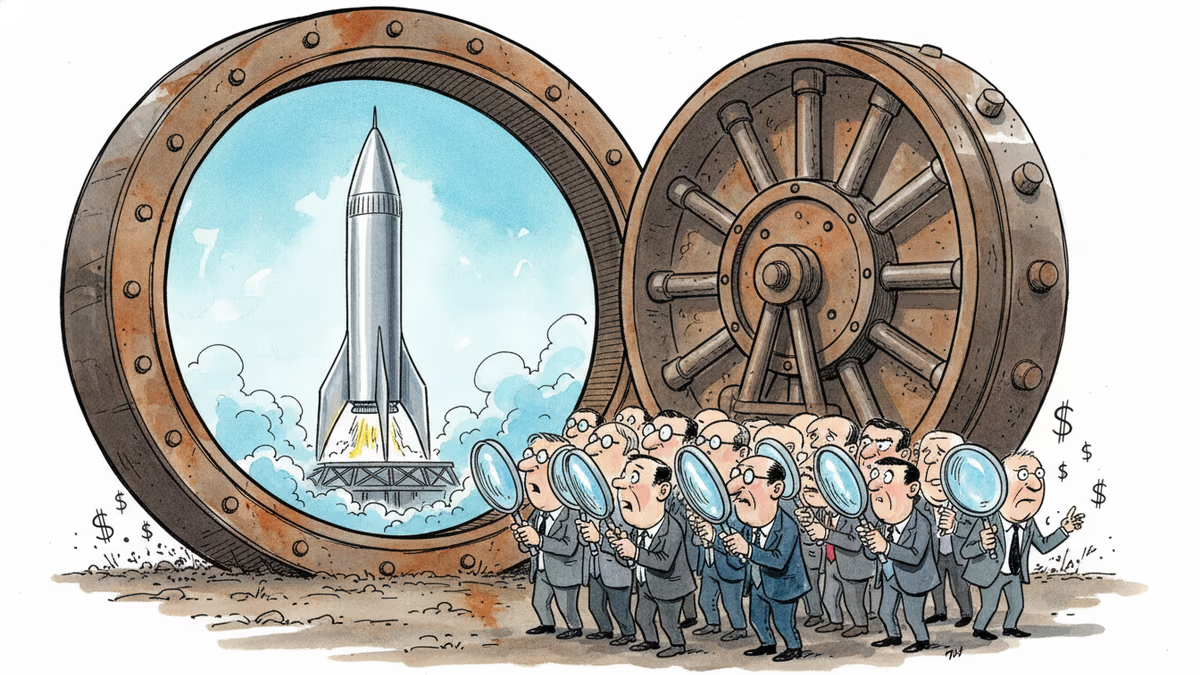
SpaceX filed a nearly 400-page S-1 with the SEC, targeting an IPO as early as June 12. Here's what the filing reveals—and what it doesn't.
American Airlines just signed Starlink for 500+ aircraft. It's not just about faster inflight internet — it's a calculated move in the run-up to what could be the largest IPO in history.
SpaceX's upgraded Starship V3 completed its first test flight, deploying 20 Starlink simulators but losing the Super Heavy booster. With an IPO weeks away, the stakes just got higher.
SpaceX's IPO filing puts AI at the center, claiming a $26.5 trillion market opportunity. But can Grok compete with OpenAI and Anthropic for enterprise customers?
SpaceX filed a nearly 400-page S-1 with the SEC, targeting an IPO as early as June 12. Here's what the filing reveals—and what it doesn't.
Thoughts
Share your thoughts on this article
Sign in to join the conversation