

Why NASA Just Killed Its Own Rocket Program
NASA abandons its Exploration Upper Stage project, outsourcing to ULA instead. A sign of changing space exploration paradigms or budget reality?
One Procurement Notice, Decades of Change
A single line buried in a government procurement website just rewrote the future of space exploration. NASA's Marshall Space Flight Center posted what seemed like routine paperwork: they'd sole-source next-generation upper stages for Artemis IV and V missions from United Launch Alliance.
But that bureaucratic sentence marked the death of NASA's 10-yearExploration Upper Stage program. As Steinbeck wrote about loss making darkness deeper, this cancellation somehow makes spaceflight's future brighter.
The $41 Billion Question
The Space Launch System was supposed to be America's return ticket to the Moon. Instead, it became a $41 billion per launch monster that devoured budgets faster than it could reach orbit. Adding a custom upper stage would have pushed costs into the stratosphere—literally and figuratively.
ULA already has the Centaur V upper stage, tested and ready. Meanwhile, SpaceX's Falcon Heavy can handle similar payloads for $150 million—roughly 1/27th the cost. NASA faced a choice: pride or pragmatism. They chose pragmatism.
Industry Shakeup: Winners and Losers

This decision creates clear winners and losers across the aerospace ecosystem. ULA just secured a major contract extension, while traditional NASA contractors who were banking on the Exploration Upper Stage face an uncertain future.
For SpaceX, this validates their disruptive approach. If NASA—the gold standard of space agencies—is abandoning in-house development, it signals that the old model is broken. Other space agencies worldwide are watching closely.
Startup space companies see opportunity. If NASA is willing to outsource major components, smaller players might get their shot at government contracts previously reserved for aerospace giants.
The New Space Economics
This shift reflects a fundamental change in how space exploration works. The Apollo-era model—government develops everything internally—is giving way to a "government sets goals, private sector provides means" approach.
The numbers tell the story. NASA's Commercial Crew Program delivered astronaut transportation for $55 million per seat versus the Space Shuttle's $450 million. When private companies can deliver the same service for 1/8th the cost, the math becomes unavoidable.
What This Means for Moon Missions
The immediate impact on Artemis missions remains unclear. Using ULA's existing technology might actually accelerate the timeline—no need to wait for NASA's custom solution to finish development.
But there are strategic implications. America's space program is becoming increasingly dependent on private contractors. What happens if those companies face financial difficulties, change priorities, or get acquired by foreign entities?
Authors
Related Articles

NASA's Artemis III has been redesigned as an Earth-orbit mission. SpaceX and Blue Origin say their landers won't be ready until late 2027. What does this mean for the future of lunar exploration?

Artemis II splashed down successfully in the Pacific, marking humanity's first crewed deep space mission in over 50 years. But the harder question isn't whether we can go back — it's why we should.
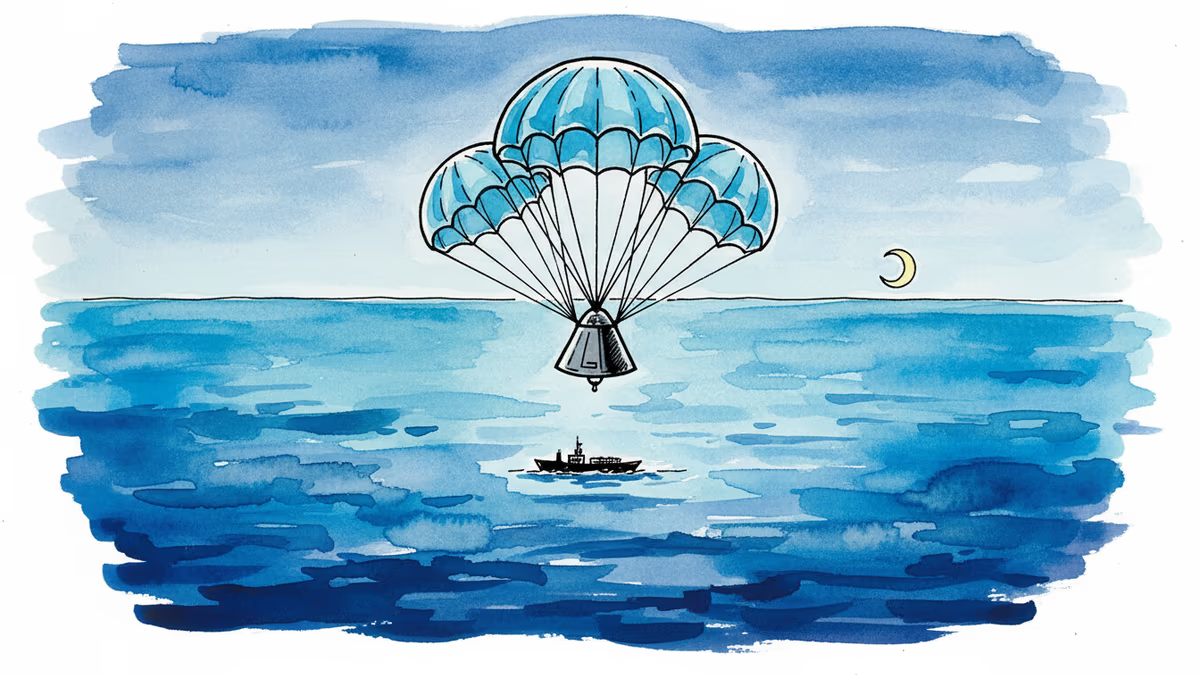
NASA's Orion capsule splashed down safely after humanity's first crewed lunar voyage in 54 years. The mission succeeded. Now the harder questions begin.
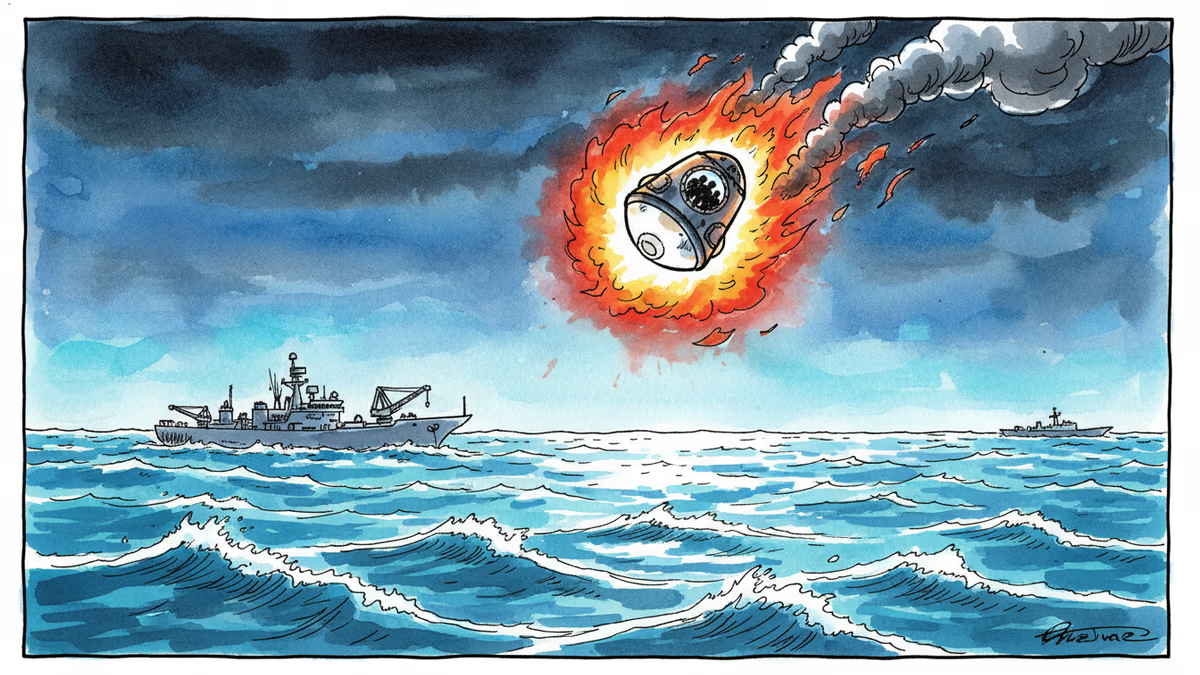
Artemis II's four astronauts are returning to Earth Friday night. The splashdown off Southern California isn't the anticlimax it sounds—it's the most technically perilous moment of the entire lunar journey.
NASA's Artemis III has been redesigned as an Earth-orbit mission. SpaceX and Blue Origin say their landers won't be ready until late 2027. What does this mean for the future of lunar exploration?
Artemis II splashed down successfully in the Pacific, marking humanity's first crewed deep space mission in over 50 years. But the harder question isn't whether we can go back — it's why we should.
NASA's Orion capsule splashed down safely after humanity's first crewed lunar voyage in 54 years. The mission succeeded. Now the harder questions begin.
Artemis II's four astronauts are returning to Earth Friday night. The splashdown off Southern California isn't the anticlimax it sounds—it's the most technically perilous moment of the entire lunar journey.
Thoughts
Share your thoughts on this article
Sign in to join the conversation