
NASA's New Moon Strategy: Earth Tests Before Lunar Landing
NASA Administrator Jared Isaacman revamps Artemis III to test SpaceX and Blue Origin landers near Earth before attempting human lunar landing missions later this decade.
The $93 Billion Question: Are We Ready for the Moon?
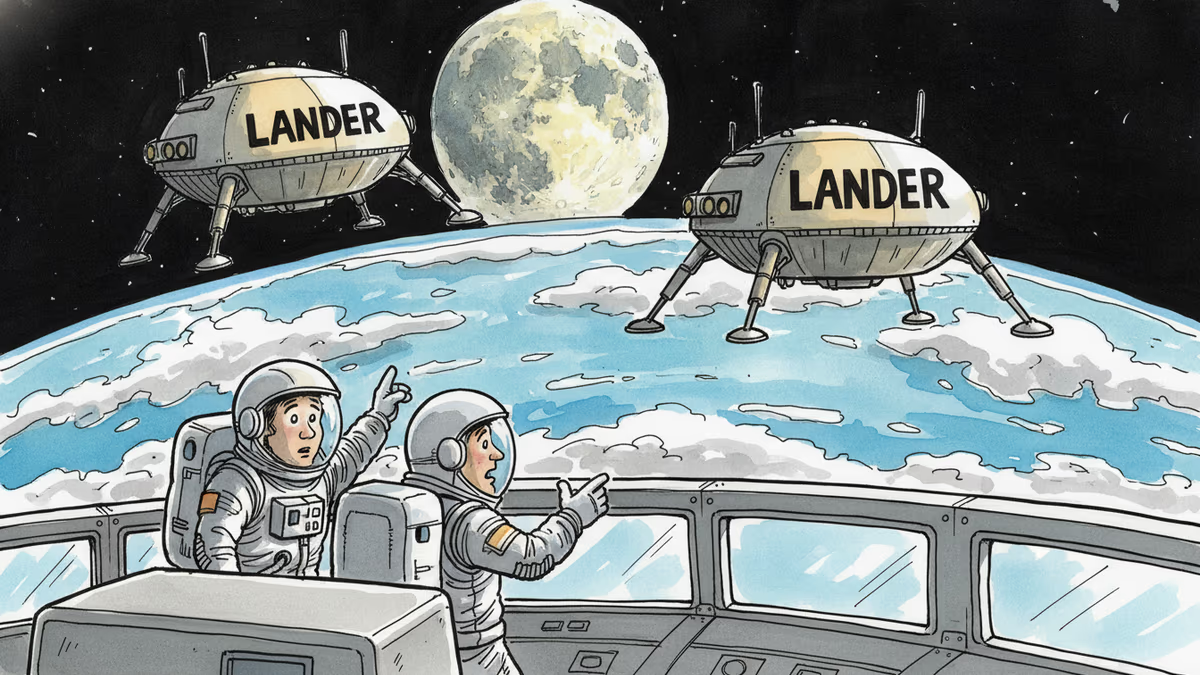
NASA just hit the reset button on America's return to the Moon. Administrator Jared Isaacman's announcement last week fundamentally changed Artemis III from a lunar landing mission into something more cautious: an Earth-vicinity test of the very landers meant to carry astronauts to the lunar surface.
The math is stark. Two companies—SpaceX with its Starship and Blue Origin with Blue Moon MK2—hold contracts worth billions to deliver working lunar landers. Both are scheduled for unmanned lunar tests in 2025. But putting human lives aboard? That's where NASA is pumping the brakes.
Two Landers, Two Philosophies
The contrast between these landers reflects broader tensions in space strategy. SpaceX's Starship is Elon Musk's Mars-bound behemoth—50 meters tall, capable of carrying 100+ tons to the lunar surface. It's designed for building permanent bases, not just planting flags.
Blue Origin's approach is more measured. Their Blue Moon MK2 focuses specifically on lunar operations, emphasizing precision over payload capacity. Jeff Bezos has long advocated for the Moon as humanity's industrial base, requiring sustained, reliable access rather than spectacular one-offs.
Both companies face the same challenge: proving their systems can safely transport humans across the 240,000-mile void to the Moon and back. No pressure.

The China Factor
Behind NASA's cautious recalibration lies an uncomfortable reality: China's 2030 timeline for human lunar landing. While NASA wrestles with contractor delays and budget overruns, China's Chang'e missions have systematically demonstrated lunar capabilities—sample return, rover operations, far-side communications.
The Senate's support for Isaacman's revised plan suggests bipartisan recognition that a failed lunar landing attempt could damage American space leadership more than a delayed one. But this calculation assumes China won't accelerate its own timeline.
Industry insiders point to another factor: the SLS rocket's limited flight rate. With only one or two launches per year possible, every mission becomes precious. Using Artemis III for lander validation, rather than risking it on an untested lunar landing, spreads the technical risk across multiple flights.
The Contractor Perspective
For SpaceX and Blue Origin, Earth-vicinity testing offers mixed benefits. It provides valuable flight data and NASA confidence-building, but also extends the timeline before revenue-generating operational missions begin.
SpaceX, already conducting ambitious Starship test flights, may view the requirement as bureaucratic caution. Blue Origin, still working toward its first orbital flight, might welcome the additional development time.
The real winner could be NASA's risk management. Testing complex rendezvous operations between Orion and the landers near Earth—where rescue is possible—makes engineering sense, even if it lacks the inspirational punch of lunar exploration.
Authors
Related Articles
American Airlines just signed Starlink for 500+ aircraft. It's not just about faster inflight internet — it's a calculated move in the run-up to what could be the largest IPO in history.
SpaceX's upgraded Starship V3 completed its first test flight, deploying 20 Starlink simulators but losing the Super Heavy booster. With an IPO weeks away, the stakes just got higher.
SpaceX's IPO filing puts AI at the center, claiming a $26.5 trillion market opportunity. But can Grok compete with OpenAI and Anthropic for enterprise customers?
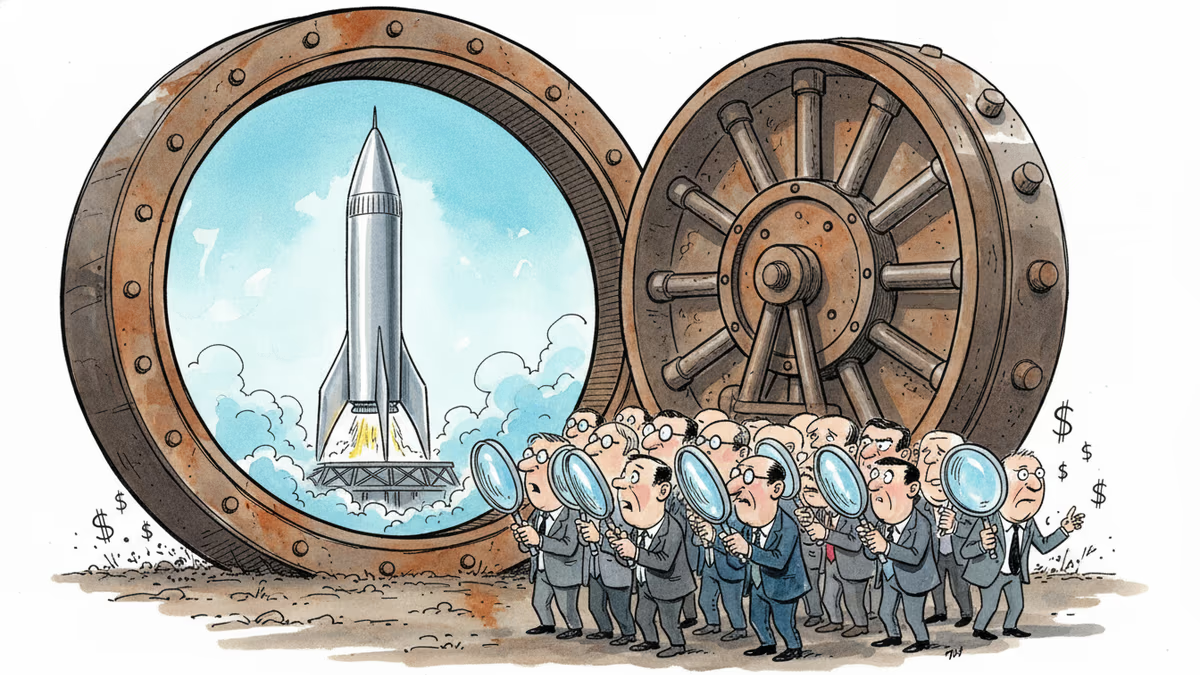
SpaceX filed a nearly 400-page S-1 with the SEC, targeting an IPO as early as June 12. Here's what the filing reveals—and what it doesn't.
American Airlines just signed Starlink for 500+ aircraft. It's not just about faster inflight internet — it's a calculated move in the run-up to what could be the largest IPO in history.
SpaceX's upgraded Starship V3 completed its first test flight, deploying 20 Starlink simulators but losing the Super Heavy booster. With an IPO weeks away, the stakes just got higher.
SpaceX's IPO filing puts AI at the center, claiming a $26.5 trillion market opportunity. But can Grok compete with OpenAI and Anthropic for enterprise customers?
SpaceX filed a nearly 400-page S-1 with the SEC, targeting an IPO as early as June 12. Here's what the filing reveals—and what it doesn't.
Thoughts
Share your thoughts on this article
Sign in to join the conversation