

The $0.02 War: Why Voice AI Architecture Is Now a Strategic Governance Decision
The voice AI landscape is fragmenting into Native S2S and Unified Modular architectures. Discover why the $0.02 price point is only half the story for enterprises.
The rigid trade-off between speed and control in voice AI is collapsing. As enterprise agents move from experimental pilots to regulated workflows, the choice of architecture has evolved from a performance metric into a critical strategic decision. Google and OpenAI are battling for dominance with 'Native' models, while players like Together AI are countering with 'Unified' modular systems that promise the best of both worlds.
Decoding the Three Paths to Real-Time Voice
Enterprise decision-makers currently face three distinct architectural paths. Native S2S models, including Gemini 3.0 Flash, offer human-like latency of 200 to 300ms. However, these 'black boxes' offer limited visibility into reasoning steps, making them a risky bet for highly regulated industries like finance or healthcare.

The Modular Counter-Attack: Speed Meets Governance
Unified modular architectures represent a significant shift. By co-locating components like Whisper Turbo and Mist v2 on the same GPU clusters, Together AI has slashed latency to near-native levels. This allows for critical interventions—like PII redaction and deterministic pronunciation—that are nearly impossible in end-to-end S2S models. For a healthcare provider, the ability to redact patient names mid-stream is more important than a slightly more 'expressive' voice.
Authors
Related Articles
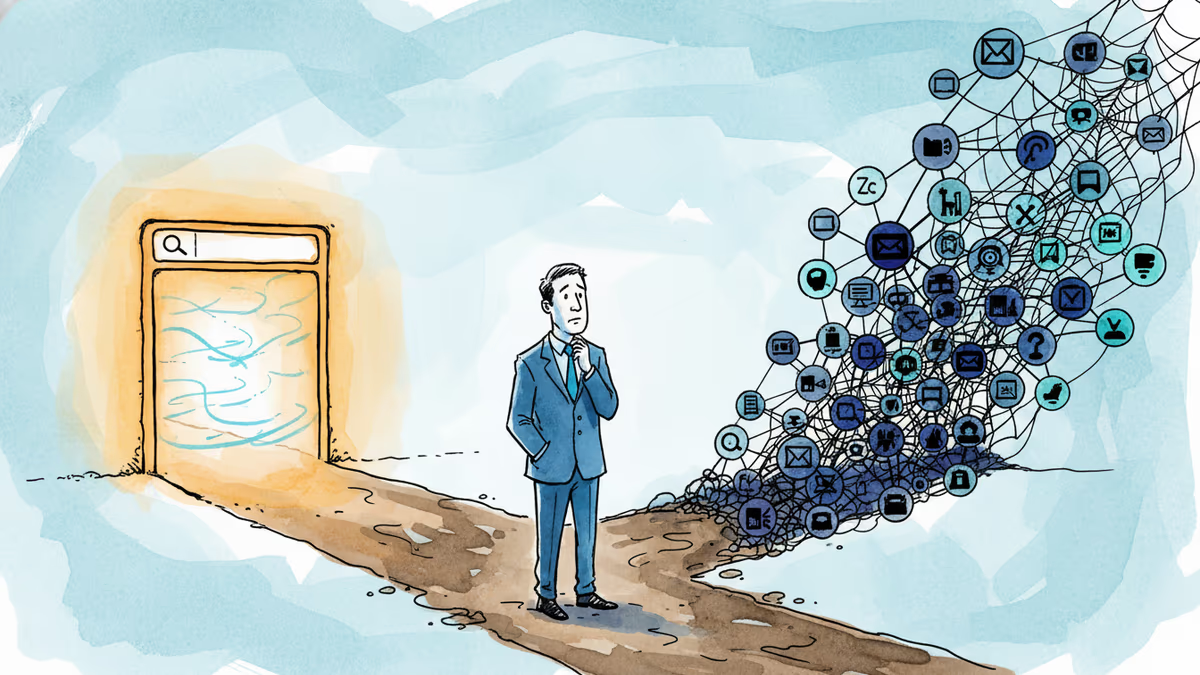
In a post-Google I/O interview, Sundar Pichai acknowledged flawed search results, real AI anxiety, and an AGI timeline that makes the label irrelevant. Here's what he said — and what it means.

OpenAI has reorganized for the second time in a month, merging ChatGPT and Codex into a single agentic platform under president Greg Brockman's unified product leadership.
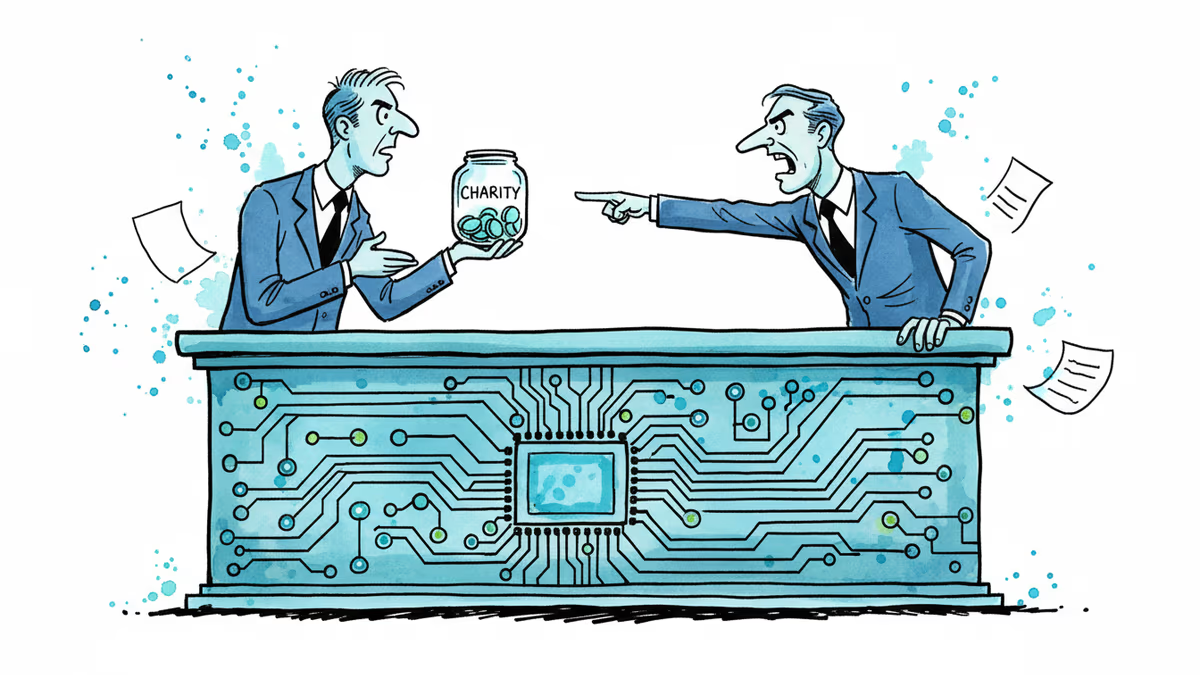
After two weeks of witnesses calling him a liar, OpenAI CEO Sam Altman testified in his own defense, claiming Elon Musk tried to kill the company twice.

Sam Nelson, 19, died after following ChatGPT's advice to mix Kratom and Xanax. His parents are suing OpenAI for wrongful death, raising urgent questions about AI trust, liability, and design.
In a post-Google I/O interview, Sundar Pichai acknowledged flawed search results, real AI anxiety, and an AGI timeline that makes the label irrelevant. Here's what he said — and what it means.
OpenAI has reorganized for the second time in a month, merging ChatGPT and Codex into a single agentic platform under president Greg Brockman's unified product leadership.
After two weeks of witnesses calling him a liar, OpenAI CEO Sam Altman testified in his own defense, claiming Elon Musk tried to kill the company twice.
Sam Nelson, 19, died after following ChatGPT's advice to mix Kratom and Xanax. His parents are suing OpenAI for wrongful death, raising urgent questions about AI trust, liability, and design.
Thoughts
Share your thoughts on this article
Sign in to join the conversation