
The Endgame for TV Tech: Why LG and Samsung’s 2026 Color War Matters
LG and Samsung are set for a 2026 TV showdown with new MicroLED and RGB LED tech. This isn't just an upgrade; it's a race for perfect color that will redefine the market.
The Lede: The Era of ‘Perfect Color’ Arrives
In 2026, the long-running war for your living room enters its final, decisive chapter. Announcements from LG and Samsung signal a fundamental shift beyond incremental upgrades in brightness or contrast. We are entering the era of color perfection, where consumer displays will finally be capable of reproducing the full spectrum of color that high-end cinema cameras can capture. For executives, this isn't just about a better movie night; it's a signal that the last technical barrier between professional creator intent and mass-market consumer experience is about to fall, with profound implications for the entire media and entertainment ecosystem.
Why It Matters: A Market Realignment
The move by LG and Samsung to launch displays achieving 100% of the BT.2020 color gamut is a watershed moment. For years, this standard has been the theoretical 'holy grail' for display technology—a color space so wide that most content isn't even produced for it yet. Hitting this benchmark creates several second-order effects:
- The New Hyper-Premium Tier: These televisions, especially in new, more accessible 75-inch and even 55-inch sizes, will establish a new price ceiling above today's flagship OLEDs. This creates a halo effect, pulling the entire market's average selling price (ASP) upward.
- Content Becomes the Bottleneck: When the display is no longer the limiting factor, the pressure shifts squarely onto Hollywood studios, game developers, and streaming platforms. Expect an accelerated push for content to be captured, mastered, and streamed in the full BT.2020 color space, demanding more sophisticated production pipelines and higher bandwidth.
- The End of Technical Compromise: The primary consumer choice for a decade has been a trade-off: OLED's perfect blacks and pixel-level control versus QLED's superior brightness and color volume. True MicroLED technology, which Samsung is pursuing, promises the best of both worlds—the self-emissive nature of OLED with even greater brightness and longevity than QLED, effectively ending the debate.

The Analysis: Decoding the Display Duel
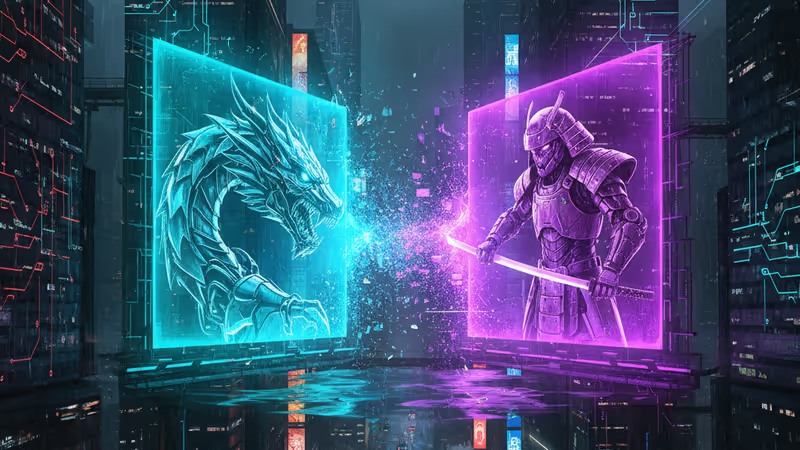
This isn't just another round in the perennial LG vs. Samsung rivalry; it's a battle of competing philosophies on the path to visual perfection. It's critical to understand the technological nuances beneath the marketing.
Samsung's "Micro RGB" is their consumer-facing brand for true MicroLED. This is the endgame technology where each individual red, green, and blue sub-pixel is its own microscopic, inorganic LED. It is incredibly difficult and expensive to manufacture at scale, especially in smaller screen sizes. Samsung’s ability to bring this down to 55 inches by 2026 would represent a monumental manufacturing breakthrough.
LG's "RGB LED," as described, appears to be a different beast. Rather than being a self-emissive display like MicroLED or OLED, it sounds like the ultimate evolution of LCD technology. It likely uses clusters of RGB Mini-LEDs as a backlight instead of standard white ones. This allows for far more precise control over the color and brightness illuminating the LCD panel's pixels, enabling the massive color gamut but without the manufacturing complexity of true MicroLED. It’s a brilliant, if potentially interim, step to challenge MicroLED on performance without the same cost hurdles.
This sets the stage for a classic market conflict: a revolutionary (and likely very expensive) technology from Samsung versus a supreme evolution of existing tech from LG that could deliver 95% of the performance for a significantly lower price.
PRISM's Take: The Plateau is Over
After a decade where TV improvements felt incremental to the average consumer, 2026 marks a genuine paradigm shift. We are leaving the 'good enough' plateau and beginning the climb towards a new peak in visual fidelity. The introduction of near-perfect color reproduction into the living room will have a cascading effect, forcing the entire content creation and distribution chain to level up. While the initial price tags will be astronomical, this is the technology that will define the premium viewing experience for the next decade. The South Korean giants are not just selling new TVs; they are selling the promise of seeing an image exactly as its creator intended—a promise the industry has been chasing for 50 years.
Authors
Related Articles

Samsung and SK unveiled a chip and AI investment package worth thousands of trillions of won on June 29. The headline number swings wildly by outlet, but the real contest isn't capital — it's water and power.
40,000 Samsung union workers rallied at its Pyeongtaek chip plant, threatening an 18-day strike over wages. With AI-driven RAM shortages already lifting consumer prices, the timing couldn't be worse.

Memory makers can't build fabs fast enough. By end of 2027, supply will cover just 60% of demand. Here's why the shortage could last until 2030—and what it means for AI, your devices, and the chip industry.

Samsung's Galaxy S26 now supports AirDrop through Quick Share, making cross-platform file sharing seamless. What does it mean when Android starts dismantling one of Apple's most beloved moats?
Samsung and SK unveiled a chip and AI investment package worth thousands of trillions of won on June 29. The headline number swings wildly by outlet, but the real contest isn't capital — it's water and power.
40,000 Samsung union workers rallied at its Pyeongtaek chip plant, threatening an 18-day strike over wages. With AI-driven RAM shortages already lifting consumer prices, the timing couldn't be worse.
Memory makers can't build fabs fast enough. By end of 2027, supply will cover just 60% of demand. Here's why the shortage could last until 2030—and what it means for AI, your devices, and the chip industry.
Samsung's Galaxy S26 now supports AirDrop through Quick Share, making cross-platform file sharing seamless. What does it mean when Android starts dismantling one of Apple's most beloved moats?
Thoughts
Share your thoughts on this article
Sign in to join the conversation