

The $30 Microsoft Office Anomaly: Why the 'Buy It Once' Model Refuses to Die
A deep dive into why a $30 perpetual license for Microsoft Office matters. It's not just a deal; it's a signal of peak subscription fatigue and a crack in the SaaS model.
The Lede: Beyond the Bargain Bin
A perpetual license for Microsoft Office Professional Plus is currently being offered for under $30. While the price point is remarkable, the strategic implication is what demands executive attention. This isn't merely a software discount; it's a potent market signal indicating significant, persistent resistance to the dominant 'Software as a Service' (SaaS) model. It reveals a durable market segment that values ownership and cost predictability over the continuous feature rollouts of subscription services like Microsoft 365.
Why It Matters: Cracks in the Subscription Monolith
The success of these deep-discount offers points to two critical second-order effects in the software industry:
- Peak Subscription Fatigue: Consumers and small businesses are increasingly scrutinizing their recurring monthly expenses. The psychological burden of countless small debits is creating a powerful demand for alternatives. This deal is a pressure-release valve for a market saturated with rental models for everything from entertainment to productivity.
- The "Good Enough" Threshold: For a large swath of the market, the feature set of Office 2019 is more than sufficient. The incremental, AI-driven enhancements in Microsoft 365 are not compelling enough to justify a perpetual subscription cost for users whose needs are stable. This challenges the SaaS assumption that customers always need the latest version.

The Analysis: The Ghost of the Perpetual License
Microsoft's pivot to the Microsoft 365 subscription model has been a masterclass in building a recurring revenue empire. It transformed the company's financial stability and locked customers into its ecosystem with cloud storage and continuous updates. However, this strategy intentionally left a vacuum that the grey market is now expertly filling.
These sub-$30 licenses are not typically offered by Microsoft directly. They are almost always sourced from the volume licensing channel—keys originally sold in bulk to large enterprises that are then resold by third parties. While the legitimacy can be murky, their popularity demonstrates a fundamental market disconnect. Microsoft is focused on the high-value recurring revenue customer, but it has deprioritized the budget-conscious user who wants to own their tools.
This creates a competitive opening, not just for grey market resellers, but for alternatives like Google Workspace and open-source options like LibreOffice. Yet, for many, the file compatibility and familiarity of the native Microsoft Office suite remain the gold standard, making a one-time purchase, even for an older version, an irresistible proposition.
PRISM's Take: A Pragmatic Protest Vote
This $30 Office deal is far more than a simple bargain. It's a protest vote against subscription hell and a pragmatic bet on "good enough" technology. Users who purchase this are making a calculated trade-off: they sacrifice access to cutting-edge features and future updates (Office 2019's extended support ends in late 2025) for financial certainty and digital ownership. For Microsoft, it’s a phantom menace—a reminder that even in the age of the cloud, the desire to simply buy a product and be done with it is a powerful economic force that cannot be ignored.
Authors
Related Articles
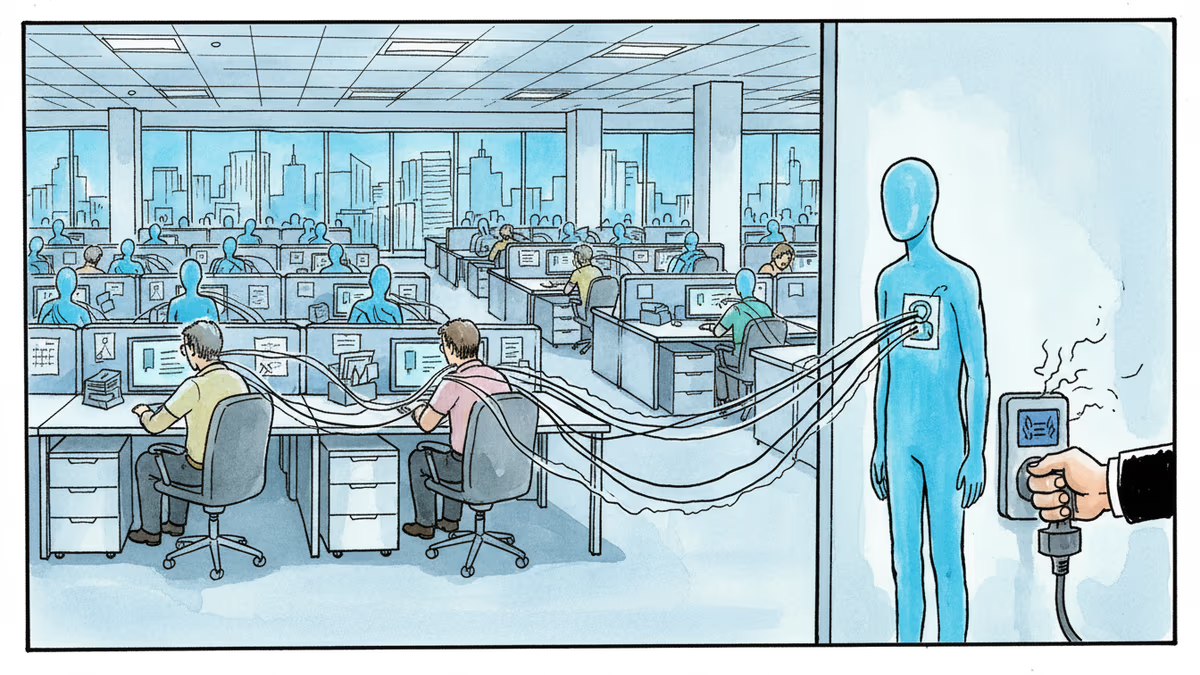
Okta CEO Todd McKinnon on why AI agents need identity management, the SaaSpocalypse threat, and why the kill switch might be the most important button in enterprise tech.

Why billions in AI funding isn't reaching certain SaaS startups. VCs reveal what they're avoiding and what they're seeking in the new AI landscape.

AI coding agents are threatening the $1 trillion SaaS industry. As companies choose to build rather than buy, the per-seat pricing model crumbles. Is this the end of software as we know it?

Salesforce deployed every weapon in its arsenal to convince investors that AI agents won't kill SaaS. But are they fighting the right battle?
Okta CEO Todd McKinnon on why AI agents need identity management, the SaaSpocalypse threat, and why the kill switch might be the most important button in enterprise tech.
Why billions in AI funding isn't reaching certain SaaS startups. VCs reveal what they're avoiding and what they're seeking in the new AI landscape.
AI coding agents are threatening the $1 trillion SaaS industry. As companies choose to build rather than buy, the per-seat pricing model crumbles. Is this the end of software as we know it?
Salesforce deployed every weapon in its arsenal to convince investors that AI agents won't kill SaaS. But are they fighting the right battle?
Thoughts
Share your thoughts on this article
Sign in to join the conversation