
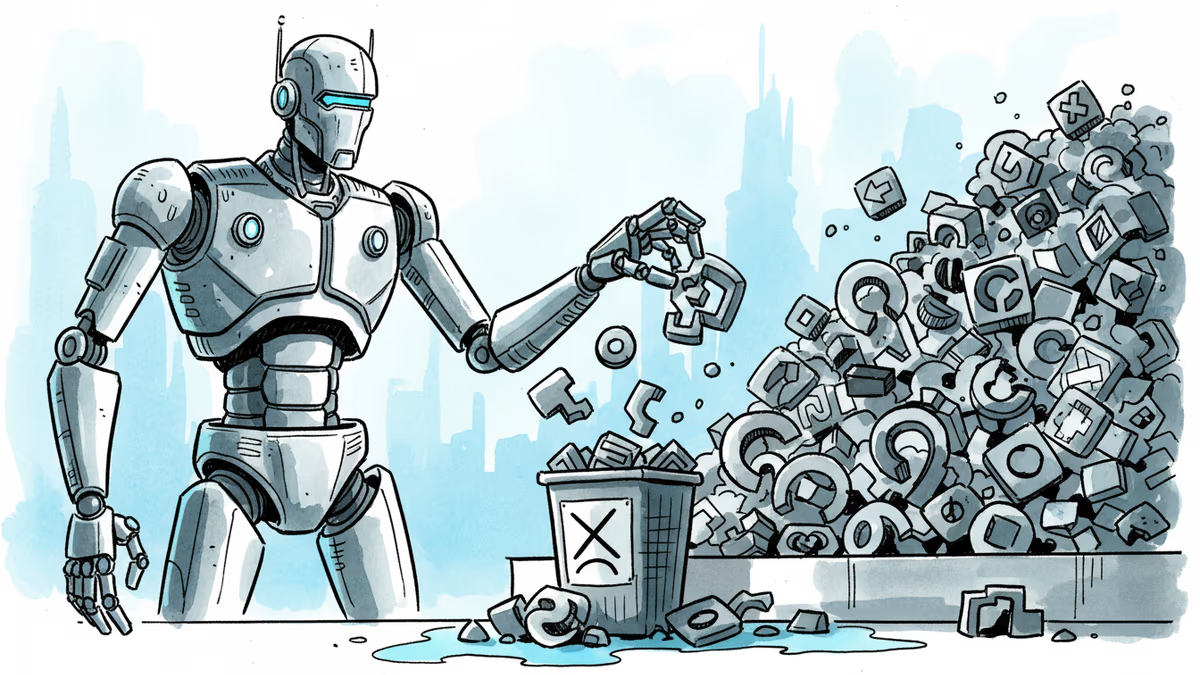
The AI Startups VCs Won't Touch Anymore
Why billions in AI funding isn't reaching certain SaaS startups. VCs reveal what they're avoiding and what they're seeking in the new AI landscape.
$50 billion poured into AI, but some startups can't get a dime
Investors have thrown billions at AI companies over the past few years. Yet as every company scrambles to rebrand with "AI" in its name, a clear pattern emerges: certain types of AI startups are becoming investment pariahs.
TechCrunch's conversations with VCs reveal a stark shift in what gets funded. The days of throwing money at anything with artificial intelligence are over. Investors now want companies that solve "real problems" – but what does that actually mean?
The Boring List: What VCs Are Avoiding
Aaron Holiday from 645 Ventures didn't mince words about what's "quite boring to investors these days":
- Startups building thin workflow layers
- Generic horizontal tools
- Light product management solutions
- Surface-level analytics
Basically, "anything an AI agent can now do."
Abdul Abdirahman at F Prime added that generic vertical software "without proprietary data moats" has lost its luster. Igor Ryabenky from AltaIR Capital went deeper: "If your differentiation lives mostly in UI and automation, that's no longer enough. The barrier to entry has dropped, which makes building a real moat much harder."
The Workflow Wars: Who Really Owns the Process?
Jake Saper from Emergence Capital sees the differences between Cursor and Claude Code as the "canary in the coal mine." One owns the developer's workflow, the other just executes tasks. "Developers are increasingly choosing execution over process."
This shift threatens any product banking on "workflow stickiness" – the strategy of getting humans hooked on using your software continuously. "Pre-Claude, getting humans to do their jobs inside your software was a powerful moat, but if agents are doing the work, who cares about human workflow?"

The implications are staggering. Entire categories of SaaS companies built on human habit formation are watching their moats evaporate.
The Integration Apocalypse
Saper also highlighted how Anthropic's Model Context Protocol (MCP) is turning integration businesses into mere utilities. "Being the connector used to be a moat. Soon, it'll be a utility."
MCP makes connecting AI models to external data and systems easier than ever. No more downloading multiple integrations or building custom ones – just use the protocol. For startups whose entire value proposition was "we connect X to Y," this is existential.
What's Still Hot: The New Investment Thesis
Despite the carnage, certain AI SaaS categories remain investor darlings:
- AI-native infrastructure startups
- Vertical SaaS with proprietary data
- Systems of action (helping users complete tasks)
- Platforms deeply embedded in mission-critical workflows
Ryabenky emphasized that companies need "real workflow ownership and clear understanding of the problem from day one." The new rules are brutal: "Massive codebases are no longer an advantage. What matters more is speed, focus, and the ability to adapt quickly."
Even pricing models need overhauls. "Rigid per-seat models will be harder to defend, while consumption-based models make more sense in this environment."
The Replication Test
Ryabenky offered a harsh litmus test for struggling SaaS companies: "If the product is mostly an interface layer without deep integration, proprietary data, or embedded process knowledge, strong AI-native teams can rebuild it quickly. That is what makes investors cautious."
The examples are everywhere: "Generic productivity tools, project management software, basic CRM clones, and thin AI wrappers built on top of existing APIs" all fail this test.
The Survival Guide
For companies caught in this transition, Ryabenky suggests immediate action: integrate AI deeply into products and update marketing to reflect that reality. "Investors are reallocating capital toward businesses that own workflows, data, and domain expertise, and away from products that can be copied without much effort."
The message is clear: depth beats breadth, ownership trumps access, and proprietary data matters more than pretty interfaces.
Authors
Related Articles

Lucra Sports CEO Dylan Robbins landed Cathie Wood's ARK Invest as a Series B lead without building AI. The story behind his unconventional fundraising playbook.

SolarSquare is raising $55-60M at a $450-500M valuation, more than doubling its worth in 18 months. Here's what's driving investor conviction in India's residential solar market.

Indian venture capital has quietly displaced Silicon Valley in its own backyard. Only one American VC made India's top 10 investor list last year. Here's why that matters beyond India.

Cerebras Systems IPO yields a $5.3 billion return for Benchmark. Explore the 8.5-year journey from a reluctant first meeting to challenging Nvidia's AI dominance.
Lucra Sports CEO Dylan Robbins landed Cathie Wood's ARK Invest as a Series B lead without building AI. The story behind his unconventional fundraising playbook.
SolarSquare is raising $55-60M at a $450-500M valuation, more than doubling its worth in 18 months. Here's what's driving investor conviction in India's residential solar market.
Indian venture capital has quietly displaced Silicon Valley in its own backyard. Only one American VC made India's top 10 investor list last year. Here's why that matters beyond India.
Cerebras Systems IPO yields a $5.3 billion return for Benchmark. Explore the 8.5-year journey from a reluctant first meeting to challenging Nvidia's AI dominance.
Thoughts
Share your thoughts on this article
Sign in to join the conversation